
Cookies From Home
Seattle author Kat Lieu introduces a first-of-its-kind cookbook centered on Asian cookies.
By Daniel Anderson December 31, 2025

Kat Lieu has built a career out of baking, storytelling, and standing up for what she believes in. A former doctor of physical therapy turned bestselling cookbook author, she’s based in Seattle, is the founder of the online community Subtle Asian Baking and is the author of Modern Asian Baking at Home, a book that redefined how home bakers approach flavors from across the Asian diaspora.
Her latest book, 108 Asian Cookies, published in October, is a personal tribute. The number 108 is deeply intentional: a nod to her late father, who loved the number eight for its meaning of luck and fortune, and who Lieu once comforted at the end of his life by telling him he had finally “won the lottery.” After his passing, she says he “kept sending me eights,” a sign she took as a blessing. From there, she knew her next book needed to end with an eight, and 108 became a way to honor both her family and her Chinese culture, which prizes the number as a symbol of abundance.
True to Lieu’s ethos, 108 Asian Cookies is a book that gathers flavors, traditions, and communities together. It is also the first cookbook solely dedicated to Asian cookies. It’s filled with inventive recipes, many co-created with members of her Subtle Asian Baking community, featuring ingredients like gochujang, ube, miso, tahini, matcha, and even MSG.
Here, Lieu discusses the inspiration behind the book, its mission and impact, and why she uses her platform to champion humanitarian causes.
This interview has been edited for clarity and length.
How would you say this book challenged you compared to some of your past works—either creatively or logistically?
Every time I write a cookbook, it feels like a blur because it comes so naturally to me. I love to eat, I love to be in my kitchen, and the recipes just come to me. Sometimes I’ll literally wake up with an idea and think, “I’m going to make that.” That’s how my viral mochi cookies started—I had strawberries about to expire in my fridge and thought, “Why not make a strawberries-and-cream mochi cookie?”
The part that always challenges me is when I put “Asian” in the title. I ask myself: am I inclusive enough to represent all of Asia? And honestly, I can’t be. There’s just so much I can’t touch. To truly capture the whole of Asia, you’d need years to travel, learn techniques, and immerse yourself. So I preface my work as “third-culture Asian diaspora.” Some recipes are traditional, some are inspired by things I learned from my neighbors, like making laddoo and burfi, but I don’t claim complete authenticity. Is it a purely Indonesian cookie if it wasn’t made by someone born and raised in Indonesia, making it from scratch with their grandmother? Probably not. Much of what I do is based on my own research and conversations with Asian baking communities.
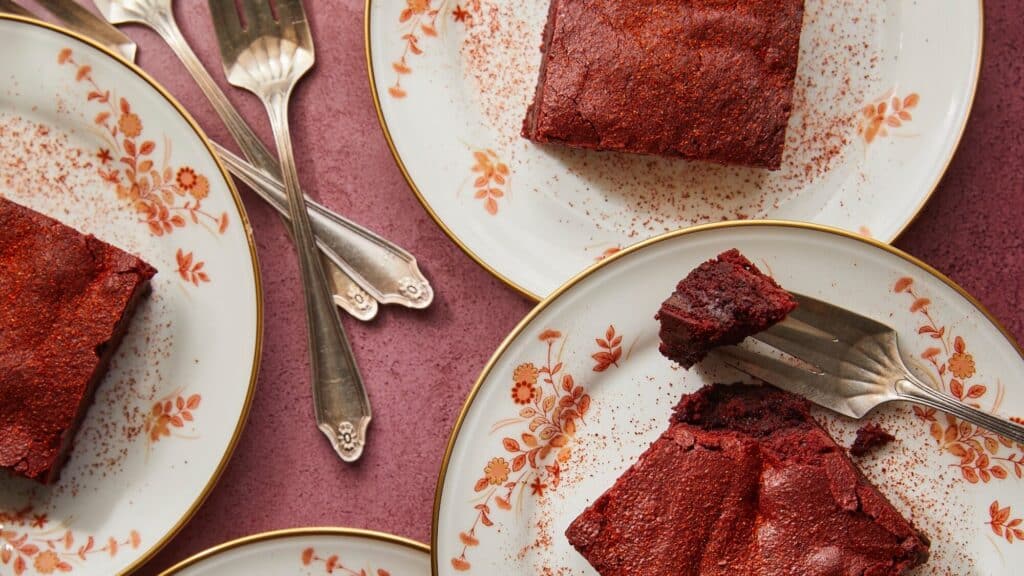
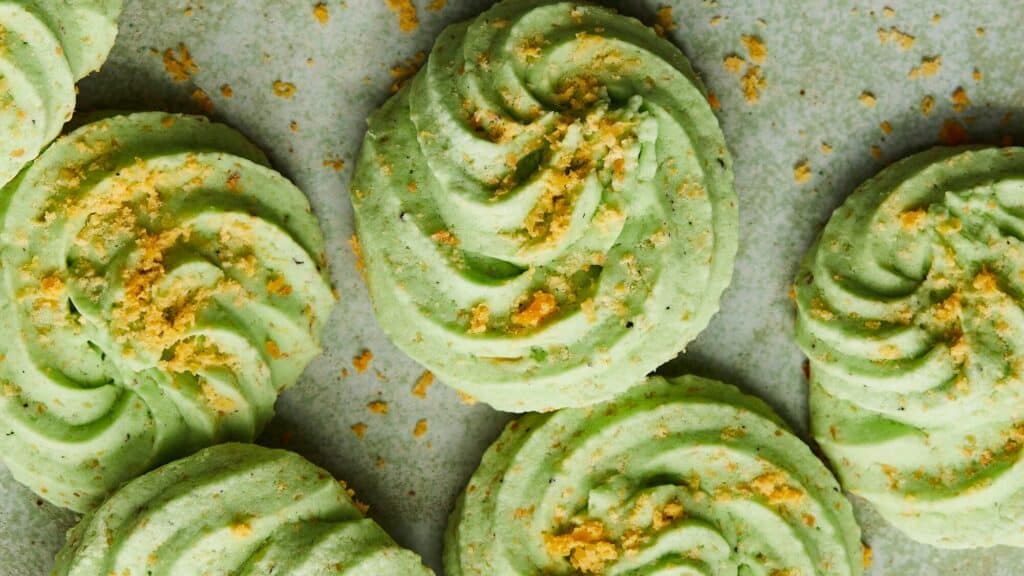
This book feels so playful, with unexpected flavor combinations readers might not have seen before. When you’re developing recipes like that, what’s your process for figuring out if a recipe works or needs to be pulled back?
With every cookie, you start with a base and foundation of flour, butter, sugar. Those don’t change much. If you want a crispier cookie, you add baking soda; a fluffier one, baking powder. Once you have the base, it’s about building flavor. Take the fish sauce cookie, for example. I made it, tasted it, and thought it was good. I gave it to two Asian friends, and they didn’t taste the fish sauce at all. Then a white friend tried it and said it was too strong. So you have to calibrate to taste. And you have to account for how flavors develop. Fish sauce, in particular, gets stronger as it sits. The next day I opened the container and thought, Whoa, this smells like a fish cookie.
I rely on my immediate family as my first guinea pigs. My husband loves sweets, my mom prefers things not too sweet, and my son has that honest, Goldilocks palate. Together, they give me a good range of feedback. I taste everything myself too, of course. After that, I have a team of volunteer recipe testers, some who have worked with me on all three of my books, who I trust completely. I send them the recipes, they test, take photos, and give me detailed notes. I retest based on their feedback and sometimes send recipes back for a second or third round. Each cookie in this book was tested at least three or four times before it made the final cut.
Was there one recipe that gave you the biggest headache?
Oh, absolutely. A few cookies gave me nightmares. I literally lost sleep over them. The biggest one was the pho cookie. At first, I went way too heavy on the pho flavor and fish sauce, and it had so many components, a lime drizzle, a meaty broth-like flavor. People kept saying, This just isn’t it. I had to change it many, many times to finally get it right.
In the foreword, you talk about being a third-culture person and blending Asian ingredients with an American lens. There hasn’t really been an “Asian cookie cookbook” before, and when most people think of cookies, they think of chocolate chip or snickerdoodles, which are very Western. What do you hope readers take away from this book? And how did you approach balancing the celebration of Asian flavors, often “not too sweet,” with the goal of redefining what cookies can be?
The message of this book is really about reclaiming space. I want people to see that yes, Asians bake, and we’ve been baking for centuries. We’ve steamed buns, made pastries, and developed our own techniques long before Western baking was introduced through colonization. A lot of this book is about reclaiming that narrative and showing that our flavors aren’t “other.” They’re not gross or unhealthy, they deserve to shine.
It’s also about pushing back against bias. Every time I post something with sticky rice or sweet potato, it goes viral, but I get comments saying it’s too sugary or unhealthy. People don’t write those things on posts about frosted cookies or chocolate cake. And when we do show up in mainstream spaces, we’re often tokenized. It’s frustrating because I see white creators getting book deals, prime-time TV shows, bestseller status, while Asian and BIPOC creators have to work twice as hard just to be heard. I’ve been on local TV, I’m articulate, I’m giving a TEDx talk this October, and yet I still get told I don’t show enough of myself.
But if this book inspires even one little girl who looks like me to think, “If Kat Lieu can do this, so can I,” then it’s worth it. Because you can’t be what you can’t see. My parents pushed me to be a physical therapist for 13 years because they didn’t see creative people succeeding. I want to change that for the next generation, and with every book, open another shelf for books like this one.
I caught very briefly on your Instagram that some of the book’s proceeds are going to World Central Kitchen. Can you tell me more about that decision? And as a followup, you often use your platform to speak out and fundraise for causes, even when it risks backlash. Many content creators stay quiet out of fear of losing brand deals or followers. What gives you the courage and strength to keep speaking up, especially when it can feel exhausting with so much bad news every day?
If someone orders through my website and fills out a form, I multiply that number by 108 and donate it personally. One of the organizations is World Central Kitchen, to help feed Gaza. I’ve always done activism and given back. When I started my group Subtle Asian Baking, I would rally members to fundraise, we’ve raised over $101,000 through bake sales, donation drives, and Instagram fundraisers. It’s surprisingly effective. Recently, I sold cookie boxes with recipes from my cookbooks and raised $5,000 in one weekend. All of that went to help feed Gaza and to the ACLU—kind of a big “eff you” to ICE.
I just have a lot of empathy for people. I actually burned out as a physical therapist because I would carry my patients’ lives and emotions home with me. Content creation isn’t my full-time job, it’s not my bread and butter. I have books, freelance work, and retirement savings, so I don’t fear losing my platform. I’d rather use it to do good while I can. The only scary part is when people DM me threats, which is why I never share my child, husband, or where I live online. People have called me antisemitic, but my stance is simple: children shouldn’t starve. Food is a universal right.
As for others who stay silent, that’s their choice. I won’t judge. If someone wants to protect their brand deals and not speak out, that’s on them. I just care about what I can do while I’m here. Life is short. I want to make a difference.
Follow Us

Rearview Mirror: An Oyster Party, Money for Art, and Mac & Cheese at 30,000 Feet
Things I did, saw, ate, learned, or read in the past week (or so).
We Partied for Art I love a party, and I love art, so when the Henry Art Gallery invited me to its annual fundraising gala, it was paddle’s up from the get-go. Held on the floor of Pioneer Square’s Railspur building in a space managed by Rally, Angela Dunleavy’s latest venture (read all about it…

Urban Grit Meets Wild Beauty: Inside Seattle Art Museum’s Beyond Mysticism
Seattle’s history is rooted in its fascinating juxtaposition of industry and nature, inspired by the region’s dramatic landscapes and rapidly changing cityscape. Seattle Art Museum’s current exhibition, Beyond Mysticism: The Modern Northwest, invites you to meet the artists who captured that tension and transformed it into a bold new vision of Modernism. Modernism, Made in…

Our March/April Issue Has Arrived!
Inside you’ll find Best Places to Live, a packed spring arts guide, and more stories from across the region.
The future’s bright, and so is the cover of Seattle magazine’s March/April issue! Featuring a mural by local artist (and 2023 Most Influential pick) Stevie Shao, the colorful cover is a snap from Woodinville, one of the six “Best Places to Live” featured inside. While we usually focus on Seattle neighborhoods, this year we expanded…

Supporting Roles
Three women in the Northwest are helping local artists through newly launched residencies outside of Seattle. Here, we take a look inside these thoughtfully designed spaces, and learn what drove their founders to become cornerstones in the creative community.
Iolair Artist Residency Eastsound, WA Years ago, after studying photography and earning a Bachelor of Fine Arts at the University of Washington, Pacific Northwest native Linda Lewis realized that she didn’t want to spend the rest of her life behind a camera. “The minute I graduated from school, I was far more inspired by the…