
Driftwood Dreams
Cascadia Art Museum uncovers the lost Surrealist who spent 40 years painting in Seattle.
 By Sarah Stackhouse December 11, 2025

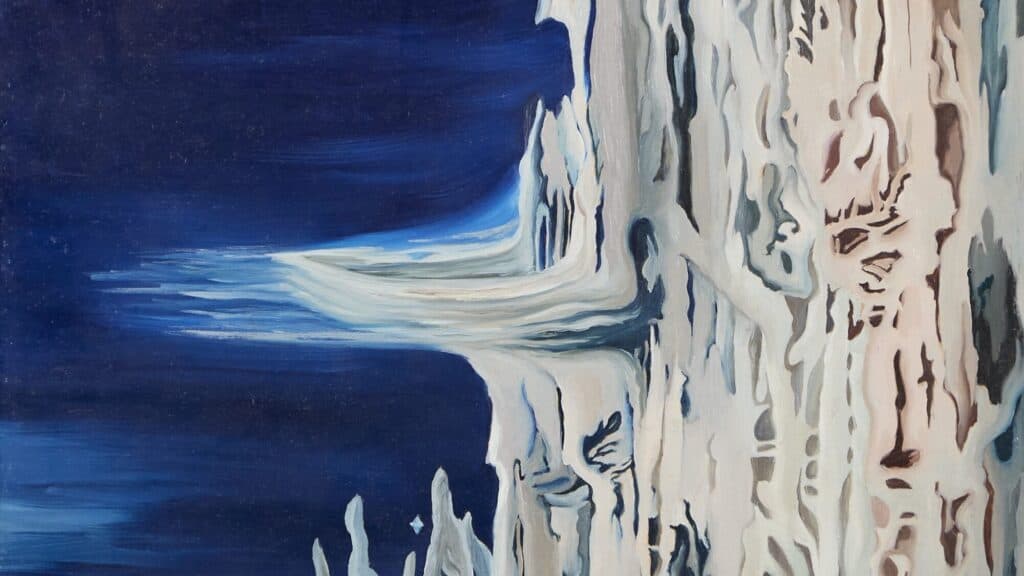
One of the most compelling parts of Objects of the Elements: The Art of Elsa Thoresen at Cascadia Art Museum in Edmonds is a display case filled with the actual pieces of driftwood artist Elsa Thoresen used as source material, mostly in the 1930s and ’40s. They’re ordinary enough at first glance—knotted and gnarled by weather and water—until you turn toward the paintings they inspired. In Thoresen’s hands, those same fragments become vast, shapeshifting terrains: ridges twisting into otherworldly silhouettes, organic forms hovering in airy muted colors like dreamscapes. As the museum’s marketing manager Sydney Kaemmerlen puts it, “To me, they almost look like sci-fi landscapes.” The work is startlingly contemporary for art made nearly a hundred years ago.
The rediscovery of Thoresen, and this first American exhibition of her work, has been decades in the making. Although she lived in Seattle for 40 years, Thoresen slipped out of local memory. Curator David Martin first encountered her paintings in 1990, when he owned a gallery on Capitol Hill. He had fallen in love with her work but couldn’t find any substantial biographical information beyond notes about her early years in Scandinavia. There were no archives or clear trail of her life after she returned to the U.S. Even the existence of her daughter was unknown to him.
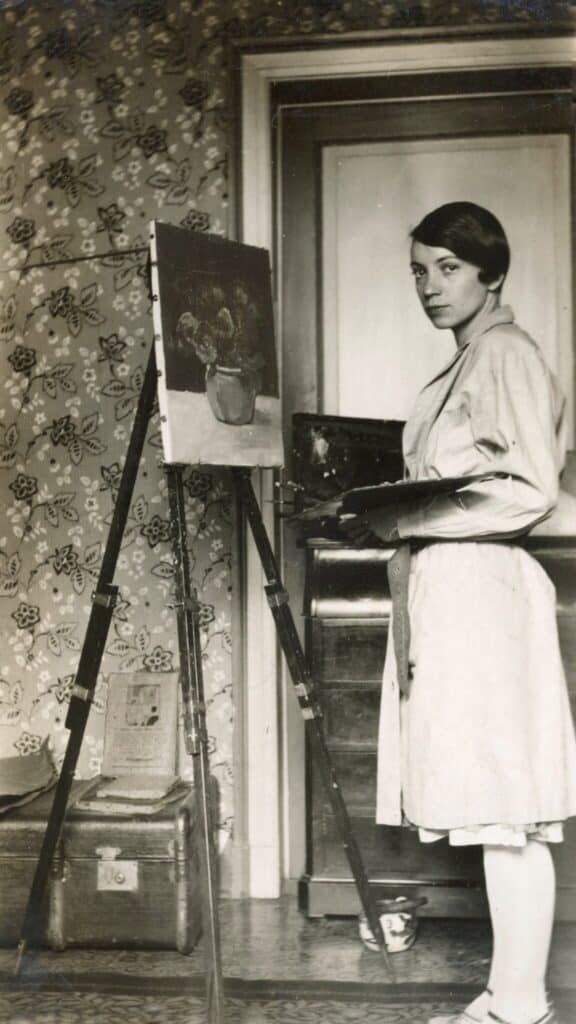
More than thirty years later, during unrelated research in Paris, Martin happened upon someone who knew Thoresen’s daughter, Alice Tompkins, who lived on Camano Island. That introduction finally filled in the story he’d been missing: Thoresen grew up in Minnesota, where her father had returned after running a medical practice in Seattle in the 1890s. The middle of three siblings, the family moved to Oslo, Norway in 1920, when she was 14. She studied art there and in Brussels, married Danish artist Vilhelm Bjerke-Petersen in 1935, and raised two children while establishing herself as a well-known Surrealist painter in Europe. War pushed the family through Denmark, Paris, and Sweden, where she continued to exhibit and experiment before returning to Seattle in 1954, where she shifted into a new mode of painting.
The exhibition walks through this arc. Early works show her standing in the Surrealist movement. Thoresen and Bjerke-Petersen were included in major European exhibitions throughout the 1930s. She was one of only a handful of women featured in the 1938 International Surrealist Exhibition in Paris. She moved in circles that included Marcel Duchamp, Max Ernst, and Sophie Taeuber-Arp, who published her work in the magazine Plastique, where Thoresen also served as an editor.
The move to Sweden in 1944 (prompted by Bjerke-Petersen’s political activism and anti-Fascist cartoons) expanded their circle again. There she worked alongside the all-male Halmstad Group of modernist painters, who helped introduce Surrealism to Sweden with a distinctly Scandinavian sensibility shaped by the region’s light and coastline. She also experimented with new materials, including the embroidered fabric piece on view in the exhibition, created from chalk sketches and signatures by artists such as Kurt Schwitters and Wilhelm Freddie.
After World War II, the family spent time in New York, where Bjerke-Petersen exhibited at the Museum of Non-Objective Painting (the precursor to the Guggenheim). In 1947, Thoresen was included in the International Exhibition of Surrealism in Paris, organized by Duchamp, André Breton, and Aimé Maeght.
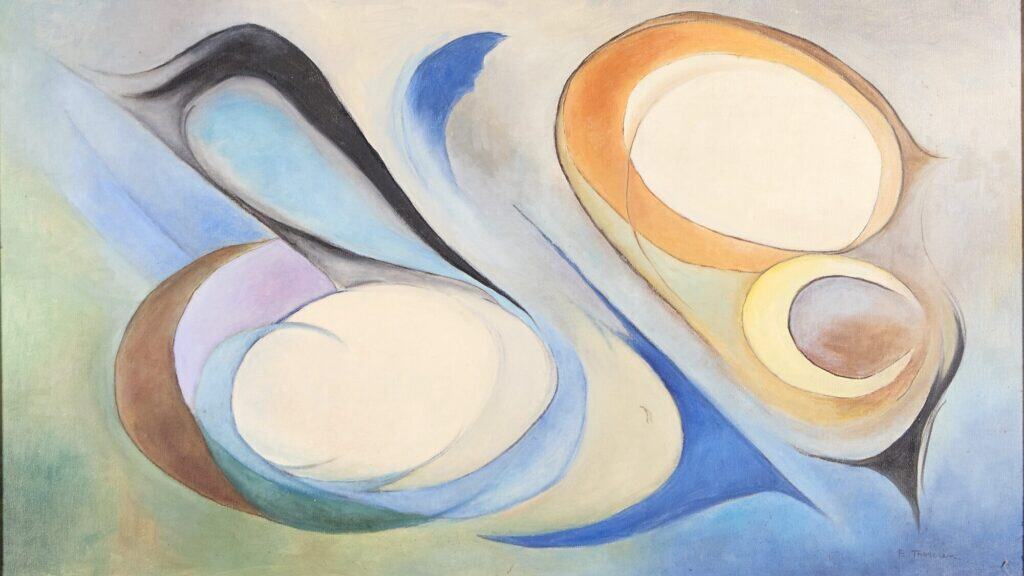
In 1953, Thoresen and Bjerke-Petersen divorced, and she married a family friend. The following year the newlyweds moved with her children to Seattle, settling on Capitol Hill. In this era of the show, the work shifts. Gone are the tightly rendered Surrealist compositions of her European years. In Seattle, she embraced a more lyrical, expansive abstraction still rooted in natural forms but softer and more fluid.
Thoresen’s last completed painting—finished in 1993 and included in the exhibition—brings the two halves of her career together. “We see that same driftwood motif coming through the center, but we still have that biomorphic abstraction shaping in there too. You can really see the journey of her artistic expression,” Kaemmerlen says.
A companion exhibition in the West Gallery adds a striking selection of works by Bjerke-Petersen. His pieces carry the structured energy of Surrealism, with bright colors and crisp lines, but with an added geometry shaped by his studies with Paul Klee and Wassily Kandinsky. Several of his beautiful ceramics are also included.
Every work in the Thoresen exhibition comes from her family’s collection. These paintings lived privately for decades, and this is exactly the kind of rediscovery Cascadia Art Museum was built for, bringing Northwest artists into view with thoughtful context. Now, these paintings are on the museum’s walls, filling in a piece of Seattle’s art history that had been hiding. And maybe it’s my own bias toward the region, but the Pacific Northwest does seem to run through much of her work. The colors, mood, and organic shapes all point back to something elemental—like driftwood from the Sound—where an entire world can be seen in one small piece of nature.
A new publication accompanies the exhibition, the first book devoted entirely to Thoresen’s work. Objects of the Elements: The Art of Elsa Thoresen can purchased online or at the museum.
The show runs through March 8, 2026. Cascadia Art Museum is open Wednesday through Sunday, 11 a.m. to 5 p.m.
Follow Us

The Secret Lives of Spiders
A new Pacific Science Center exhibit asks visitors to trade fear for fascination.
Every year, spiders kill about 20 people worldwide. That’s fewer than scorpions, lightning strikes, or hippos—and a tiny fraction of the 17.9 million deaths caused by cardiovascular disease. Yet spiders might still be the creatures we fear most. Pacific Science Center’s new exhibition, Spiders: From Fear to Fascination, aims to change that. Created by the…

Sound To Summit: AANHPI Voices Rising in Seattle
Celebrate AANHPI Month in Seattle with art and cultural events
From the ornate pagodas in the International District to Japanese style-gardens, the influence of Asian and Islander cultures is visible across Seattle. Since its earliest days, Asian, Pacific Islander, and Native Hawaiian immigrants have been an inseparable part of Seattle’s fabric, influencing its cuisine, architecture, local businesses, and art scene. Just a decade after the…

Empowering Students through Photography | Sponsored
The arts are an important part of youth and education. Art teaches us to look at the world beyond ourselves and at the beauty of everyday occurrences around us and within each other. Started by high school photography instructors, the Washington State High School, Photography Competition (WSHSPC), believes all children should have the opportunity to speak…

Michael Nicoll Yahgulanaas’ ‘Carpe Fin’ Tells Its Story at Seattle Art Museum
Commissioned by SAM, the new piece is a 6-by-19-foot watercolor mural condensing a Haida folktale into one immense color-drenched panel
This article appears in print in the November 2019 issue. Click here to subscribe. Sensing an affinity between the iconography of his First Nation art tradition and the boldness and sweep of the Japanese film/graphic-novel visual style known as manga, Haida visual artist and British Columbia resident Michael Nicoll Yahgulanaas combines the two—“committed to,” as he puts it,…