
Artist Dylan Neuwirth Explores His Past in a New Short Novel
Known best for his neon and sculpture work, the Tacoma-based creative has released his rawest work to date—in written-word form.
 By Rachel Gallaher March 19, 2026

Dylan Neuwirth approaches life with the intensity of someone who seems to think they are always on the verge of losing it all. Whether making music, cycling hundreds of miles without stopping, or bending large-format neon pieces—all of which he’s done—there’s an all-in attitude that borders on obsession. Luckily for Neuwirth, he possesses the talent, grit, and decades of perspective that allow him to channel his addictive tendencies into positive creative avenues.
Earlier this year, right as he hit his 15-year sobriety mark (he’s been sober since February 3, 2011), Neuwirth self-published a novel, NOT A HOLOGRAM. Recently, in a blurb about the book, I wrote that its “autobiographical, stream-of-consciousness form is very Joycean, but also very of-the-moment—there are parts that feel like you’re scrolling through a social media feed—blending the way we think, feel, and experience the world with approaches to form that artists have been exploring for centuries.” The book combines email, prose, playlists, stream-of-consciousness narration, and AI-generated text, mirroring the ways in which we engage with language across platforms and one another.
“For me, the question isn’t whether the technology exists—it clearly does—but how we choose to engage with it,” Neuwirth says of using AI, which he acknowledges comes with a host of controversies. “I’m interested in using it the way artists have always used tools: as a collaborator, a mirror, or sometimes even an adversary. It can accelerate certain processes, surface ideas you wouldn’t have considered, or help refine language. But the responsibility for meaning still sits with the human being using it.”
NOT A HOLOGRAM is about Neuwirth—about his past, his family, his addictions, his career—but it’s also about all of us, and the things we’re stumbling around trying to discover about ourselves, or stumbling around trying to avoid. “The book started as a confrontation with myself,” he explains. “For years, I had built work around identity, technology, and spectacle, but I realized I was also performing a version of myself inside that system, my own narrative. At some point, I wanted to strip all of that away and see what was actually left.”
That self-exploration was accelerated after a routine health check-up led to a CT scan, which revealed potentially cancerous lesions on what Neuwirth calls his “bad ball.” He’s candid about the experience in the novel, and how that seemingly physical manifestation of so many psychic demons pushed him into a space where he started questioning everything he had long held onto as important. “In the book, it becomes a symbol of many other things: family history, addiction, ego, the shadow self I sometimes called ‘The Dylan,’” he says. “Writing the novel was a way of asking whether removing the mythology around those things would reveal anything real.”
As Neuwirth strips back his identity, searching for what’s foundational, what’s acquired or constructed, and what’s the result of trauma, he holds up a mirror to the reader, asking them to acknowledge everything they’re avoiding. Between social media, television, and other forms of entertainment—all available with a mere click, swipe, or like—it’s easy to distance ourselves from confronting who we really are, what we want, or what we stand for. Screens anesthetize us into a form of inaction and leave us emulating the things we see rather than tapping into our authentic selves. This allows us to avoid vulnerability, a trait that is not only scary to employ but incredibly powerful in its potential for creating authentic human connection.
It’s this human connection, the book suggests, that is the ultimate catalyst for healing and personal growth.
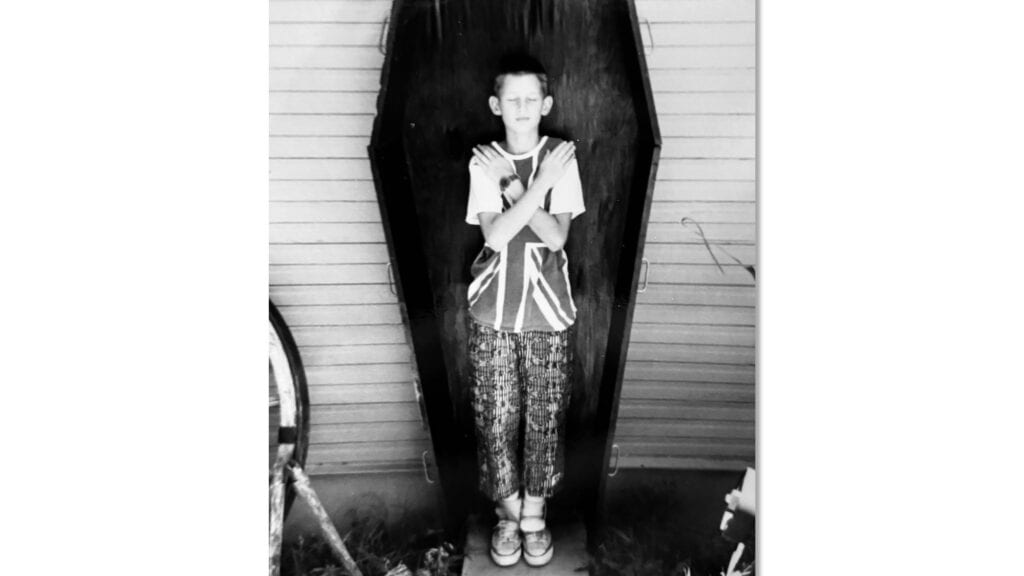
For Neuwirth, who spent decades building himself up as an artist, letting those protective walls crumble, or rather, tearing them down himself, was both terrifying and freeing. “Narrative and narrative control are powerful illusions,” he says. “We all tell ourselves stories about who we are and why things happened the way they did. Writing the book forced me to sit with the parts of my life that didn’t fit neatly into those stories.”
Deeply aware of the sparkly attraction of pop culture, Neuwirth deftly shape-shifted amongst its many forms, basking in the accolades—and power structures—that came along with “being good” at art. He worked at Chihuly Studio and Western Neon, producing pieces for high-end clients including Amazon, Microsoft, Alexandria Real Estate, the Bill & Melinda Gates Foundation, and MIT. His personal work showed in galleries across the city, each show digging a little deeper into personal wounds, including the experience of growing up with a mother whose addictions shattered more than one childhood—and the painful pathway of navigating the questions surrounding forgiveness.
Eventually, Neuwirth realized that success in its traditionally accepted definition wasn’t actually fulfilling. “For a long time, being an artist felt like the identity I had created, performed, and had to always defend,” he says. “You build a body of work, you cultivate a reputation, and you participate in the scenes of the movie that validate the role. At some point, I realized this identity had become another kind of trap. It’s nothing new. But then again, the growing and endless need for content to fund the movie demands new compromises. And no matter what, the studio, like the house, always wins. One day, I looked around and realized I had made all my money back from a series of cascading bets, and did what you do when this happens: left immediately and didn’t look back.”
While Neuwirth no longer produces visual art to show in galleries, he is still deeply interested in creative output as a personal, almost therapeutic, practice. NOT A HOLOGRAM is part memoir, part experimental text, and part healing journey.
“It was absolutely the hardest thing I have ever done,” Neuwirth says of writing the book. “Years of notes in my iPhone, abandoned books, essays, texts, artist statements, emails, letters of intent, court records; all of it scraped, scourged, extracted, sampled, reduced, and sourced to transmit this account. It’s not good, or bad—it just is.”
I will admit that I am close with Neuwirth. I’ve known him for more than a decade and have followed and written about his artistic and personal paths, so I don’t have the most objective approach to this work. However, the vulnerability shown in this book in undeniable. In the attempt to uncover his true self, Neuwirth burns a lot down and is left standing raw, still reaching out to others despite a past rife with unfulfilled relationships. He may say he doesn’t make art anymore, but there is no more beautiful project than his ability to be accountable for the past, look ahead, and move forward with an open heart and honest mind.
NOT A HOLOGRAM is available for purchase here.
Follow Us

Rearview Mirror: Spring Tea, an Arty Anniversary, and a New Look for Woodinville Whiskey
Things I did, saw, ate, learned, or read in the past week (or so).
Last Weekend to See Red Angels Every once in a while, a piece of art comes along and metaphorically knocks your whole world akilter. It becomes a kind of touchstone for other work, and something you come back to again and again in your head. For me, one of those pieces is Ulysses Dove’s Red…

Taste of Iceland Returns to Seattle
The three-day festival brings Icelandic food, music, art, and culture to venues across the city.
I have always been mesmerized by Iceland. It probably started in high school, when I was listening to Icelandic musician Björk. In the video for “Jóga,” she sings about her home country with such intensity while sweeping cliffs, mossy rocks, and jagged coastlines move across the screen. I remember thinking: what an incredible place. And then…

Studio Sessions: Tininha Silva
Brazilian-born fiber artist Tininha Silva talks about building a life in the Pacific Northwest and the coastal landscape that influences her work.
Along the shores of the Salish Sea, textures are everywhere—seaweed tangled in the tide, stones worn smooth by water, the strange geometry of coral and barnacles. Those details are finding their way into the work of artist Tininha Silva. Silva grew up in Brazil’s rugged Pernambuco region before moving to Seattle in 1999 after earning…

Spring Arts Preview: Film
Festivals keep the region’s movie scene busy this season.
Spring is festival season for Seattle movie lovers. For a few weeks each year, film festivals take over the city’s theaters, turning them into gathering spots for audiences eager to see what’s new on screen. Here are some worth catching. Seattle Jewish Film Festival The 31st annual Seattle Jewish Film Festival is a celebration of…