
The Story Behind the Bing Cherry
A new picture book follows Ah Bing from orchard history into folklore.
 By Sarah Stackhouse April 8, 2026

Seattle illustrator Julia Kuo first came across Ah Bing in a history book. She was reading The Making of Asian America: A History when a detail caught her attention: the Bing cherry, the most popular sweet cherry in the United States and a signature fruit of the Pacific Northwest, was tied to a Chinese immigrant. Kuo had grown up reading Chinese mythology at home while absorbing white American folk heroes at school, and Ah Bing struck her as someone who might belong alongside those American figures. Bing’s Cherries, the picture book Kuo created with writer Livia Blackburne (the two first worked together on I Dream of Popo), begins there.
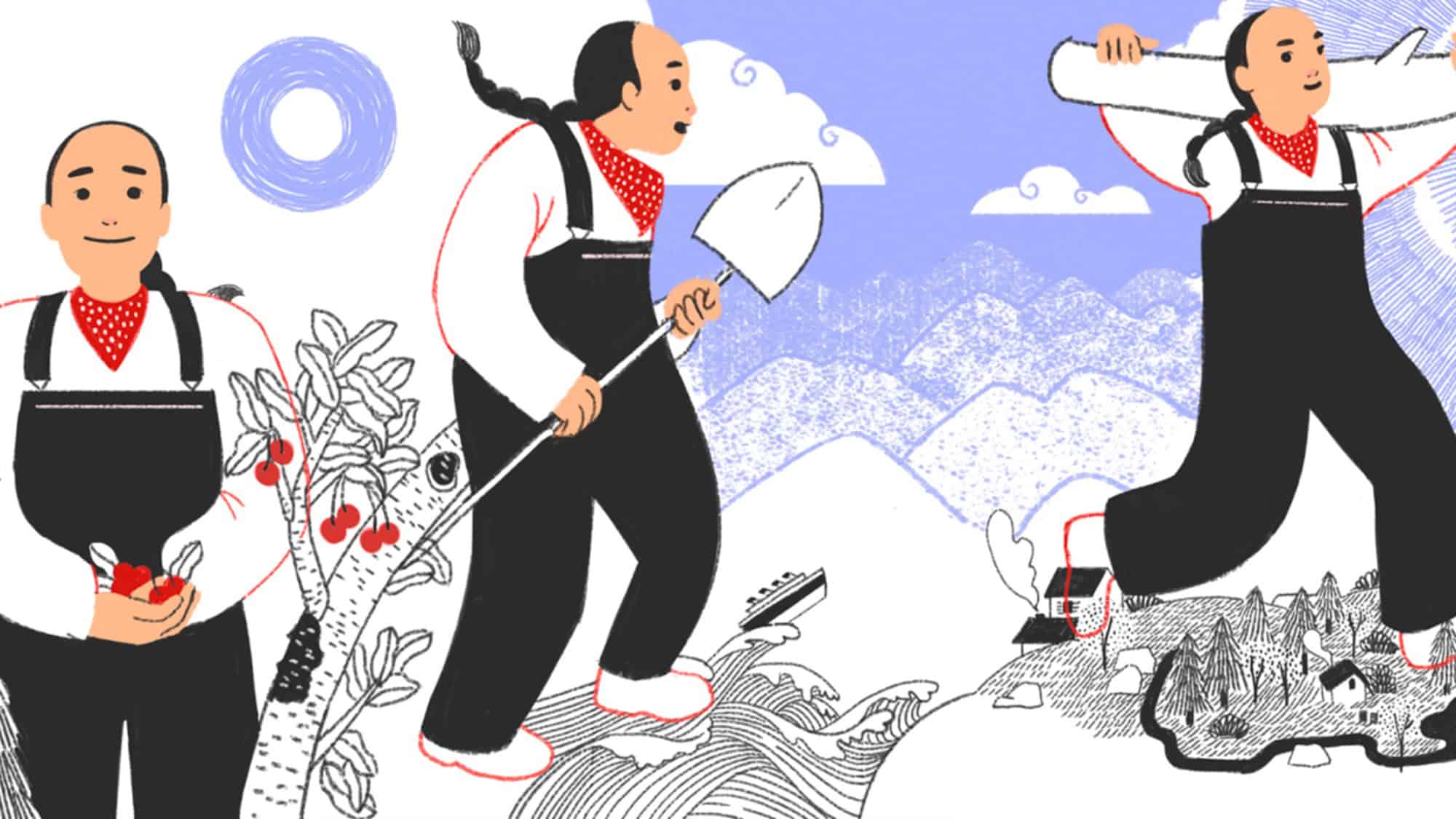
The book starts with the known details of Ah Bing’s life. He came to the United States around 1855 looking for work and later became a foreman in Seth Lewelling’s orchard in Milwaukie, Oregon. He was from northern China, which was less common among Chinese laborers in the United States at the time. He was very tall, close to six feet, and known to sing. According to one historical account, he had a wife in China and six or seven adopted sons. Another says Lewelling divided cherry seedlings between Bing and another Chinese worker to cultivate, and one of the trees in Bing’s row yielded the dark, sweet fruit that would take his name.

“I had never thought of the Bing name as a Chinese name,” Kuo says. “But when I heard Ah Bing, it really made sense.” She says that recognition connected back to how she grew up, moving between different kinds of storytelling traditions. “There could be another one,” she says. “There’s Johnny Appleseed, Paul Bunyan, and Ah Bing.”
Blackburne and Kuo did not turn that material into a straight historical account. Instead, they made it into a tall tale. Ah Bing’s height grows larger. His singing becomes part of the orchard’s magic. The story is carried by a girl and her father, who imagine the parts history left out.
For Kuo, that approach to the story connected to her own experience. Part of what interested her is the way families and communities build stories over time, sometimes from fact and sometimes from assumption, until the line between the two gets blurrier than we realize. She had long believed she understood why her parents moved back to Taiwan in the 1980s. In her mind, it had become a story about how hard it was to acclimate to life in the United States and find work. Only later did she learn that was not really the reason. They moved back because her grandparents wanted them to take over the family business.
We tell ourselves versions of the past all the time, especially about immigration, family sacrifice, and where we come from. Sometimes those stories begin in truth and then harden into something smoother or more dramatic. Sometimes they become a kind of tall tale inside a family. Blackburne, whose books also include YA fantasies, says she loved the idea of using mythology to get at that process, not just because so little is known about Ah Bing, but because exaggeration and admiration are often part of how stories are passed down in the first place.
Bing’s Cherries asks what happens when a life survives only in fragments, and who gets remembered in the first place. It also makes the case that stories like Ah Bing’s belong in the American folklore tradition too.
Blackburne says she never wanted Ah Bing to feel like a blank canvas. “I still want to make it clear that he was an actual person who was around,” she says. That is part of why the father-and-daughter structure mattered to her. The father shares what is known while the daughter imagines the rest. The girl’s version of Ah Bing is outsized and playful, but the book keeps returning to distance, longing, and home. He is an immigrant far from his family, carrying memories of one place while helping build something lasting in another. Part of the beauty of the book is that it reaches toward wonder, but does not lose sight of loneliness.
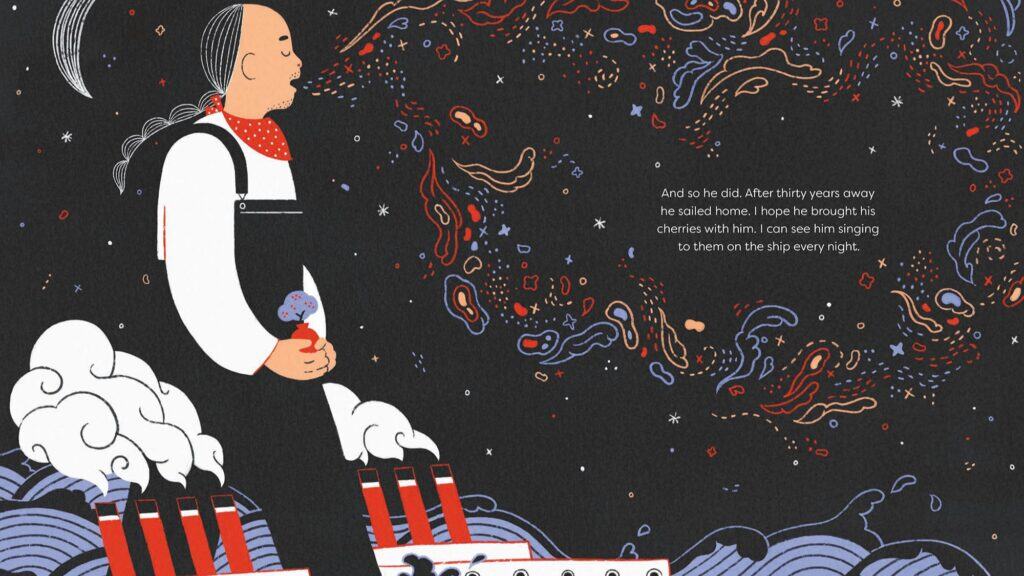
Ah Bing returned to China after decades in the United States and never came back. The exact reason is not fully known, but his story sits in the shadow of the Chinese Exclusion Act and the long history of anti-Asian racism in the West. Blackburne says it was impossible to write about him without thinking about that larger history, and the story’s parallels to the present are unmistakable.
For Kuo and Blackburne, Bing’s story also widened their sense of how long Chinese Americans have been shaping life in this country. Blackburne says she had tended to think of that influence in more recent terms, through families like her own who arrived in the late 20th century. Ah Bing pushed that timeline back.
Kuo says she wants children who look like Ah Bing to feel that they belong inside this kind of tale. “I would want kids to read this and feel American reading this,” she says, “feel like they belong here, that there’s a precedent for people who look like them and their parents.”
In a moment when anti-immigrant rhetoric is everywhere, Blackburne says stories like this can remind readers what has always been true of American life. The Bing cherry itself came out of collaboration between Ah Bing, the Chinese orchard man, and the orchard owner. It is just one example of people from different backgrounds creating something together.
In the Pacific Northwest, Bing cherries are common enough that the name rarely gets a second thought. Blackburne and Kuo have given it one. Their book does not recover everything about Ah Bing. Too much has been lost for that. But it does something just as important—it makes room for him in the American story he helped shape.
Follow Us

Staying in the Pocket with True Loves
The Seattle funk powerhouse heads to Jazz Alley for five soulful nights.
If you were to pull aside any casual music fan and ask them to cite quintessential Seattle music, you’d get a lot of grunge, the indie-rock explosion and folk revival of the ‘00s and ‘10s, and maybe some of the hip-hop that came bursting from the underground in the last 15 years. Your average person…

Rearview Mirror: Cool Jewels, a Record Store Relocation, and the Book the Internet Can’t Stop Talk About
Things I did, saw, ate, learned, or read in the past week (or so).
Book Buzz If you’re in certain circles of the internet—or frankly, a follower of the New York Times—you’ve probably stumbled upon the recent discourse surrounding Lindy West’s new book, Adult Braces: Driving Myself Sane. I read and enjoyed her 2016 memoir, Shrill: Notes from a Loud Woman, which essentially cemented her place in the pantheon…

Woven Wonders
Coast Salish weaving, past and present, on view at the Burke Museum.
On display now at the University of Washington’s Burke Museum of Natural History and Culture, Woven in Wool: Resilience in Coast Salish Weaving examines the traditional art form and its importance to Coast Salish communities. “This exhibition broadens the definition of American art by incorporating Indigenous voices and artistic practices historically marginalized due to biases…

Lifting the Fog
Beyond Mysticism at Seattle Art Museum broadens the old story of Northwest art.
For a long time, Northwest Modernism got boxed into one idea: mysticism—a way of describing the region’s art as inward-looking, spiritual, and closely tied to nature. That goes back to a 1953 Life magazine story about Mark Tobey, Kenneth Callahan, Guy Anderson, and Morris Graves, the four artists most associated with the Northwest School. Beyond…