
Going Widescreen with Clouds of the West
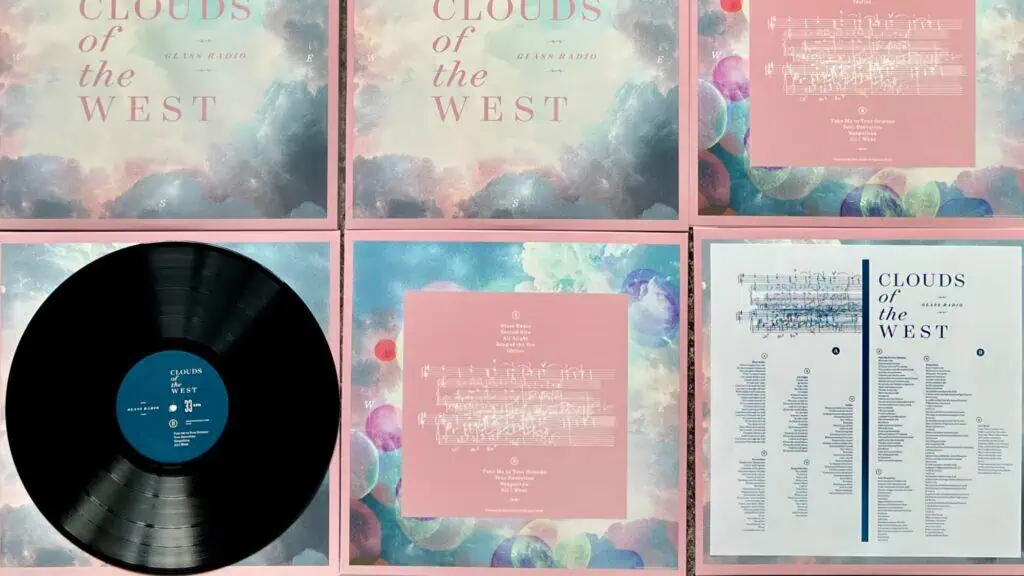
The chamber-pop band celebrates the vinyl release of 2025’s earthy and compelling Glass Radio.
By Rev. Adam McKinney February 23, 2026

When bands get described as having a “cinematic” sound, there’s typically a type of film that’s being evoked: a sweeping epic, a magnum opus, fraught with love and peril, careening across time and space and indulging in the highest of drama. This music may be beautiful and engrossing, but something it rarely feels is natural, as a logical expression of the central message that the songs are trying to convey.
Clouds of the West, the Seattle group anchored by the duo of Quentin Ertel and Rose Bellini, are, by their own admission, purveyors of a cinematic sound. They’re right to use that descriptor, and their latest album, 2025’s Glass Radio, certainly does have a widescreen quality that feels transportive—and, packed as it is with uncommon indie rock instrumentation like French horn, pipe and Hammond organ, marimba, viola, and the all-important cello, it is the kind of music that threatens to run off and score a film at any moment.
But what Clouds of the West possess is an earthiness, a grounding sense of purpose that negates any sense of ostentation that might cling to bands with similar aims. Glass Radio’s songs, for the most part, play less like epics and more like humanist dramas, with a sound that’s lush and full, but rarely flashy. This is an intersection of indie rock and chamber pop that never feels like it’s using its orchestral elements as a means to grandiosity.
As guitarist and lyricist Ertel says, Clouds of the West was a project that, by design, was meant to be transient, ever-shifting in makeup and output. This current iteration of the band, he says, coalesced organically.
“The name of the band came from this idea that musicians would come and musicians would go,” Ertel says. “I started the project with a friend of mine that I’d played with in a band about 20 years ago, and started loosely trading songwriting ideas, and put out a couple of projects. On both of those [projects], Rose played cello. That was how we came to be collaborators, and once we started collaborating, it felt really good for both of us.
“She started writing her own songs, and showed up with this batch of incredible pieces of music,” Ertel continues. “I nearly fell out of my chair when I heard it, and she was just like, ‘I gave it a shot! Here you go.’ I added some guitar parts, bass and vocals, and we did some down-and-dirty demos. We were having a lot of fun, so we went and made a record.”
Though Ertel and Bellini had both been playing music their whole lives, they came from different sides of the tracks in their musical upbringings.
“I’m primarily, almost exclusively, a classical player,” cellist and composer Bellini says. “I did all my music training as a classical cellist. Songwriting was never on my radar as something to do, never mind thinking of it as something I was capable of doing. The impetus and perspective comes from the classical, since that’s really all I know. I was listening to a lot of songs and trying to think of how those were built and how I could meld what I know with that.”
Ertel, meanwhile, had cut his teeth in rock bands, never learning to read music. It didn’t take long for them to find that middle ground where their mutual talents could thrive, though, and it all came down to the treatment of the cello.
“The cello is a really beautiful instrument, and often it’s kind of the icing on the cake, and that’s how it’s used by a lot of people,” says Ertel. “But when we recorded it, there was a moment when I put a mic on [Rose’s] cello. When we listened back to it, I was like, ‘Wow, it’s really gritty and growly.’ And she said, ‘That’s how a cello sounds to someone who’s actually playing a cello.’ It’s like, we’re recording a 200-plus-year-old instrument, played by someone who’s an amazing player, through a very DIY lens.”
Despite the name Clouds of the West coming long before this formation of the band, it turns out to be a striking descriptor for much of the music on Glass Radio: if cinema comes to mind, it’s the windswept Americana of Badlands or Bonnie and Clyde, of doomed young love under endless skies. When Clouds of the West decide to show off, as on the penultimate, seven-minute stunner “Neapolitan,” the sprightly instrumentation and depth of lyrical detail make it feel like tearing through a short story and wishing for more.
The core group is rounded out by Zeke Keeble on percussion and Rebecca Young on bass, and a who’s who of Seattle ringers (including violist Erin Wight, marimbist Erin Jorgensen, French horn player Daniel Kuhlmann, among others) joining them for the recording of Glass Radio. Wednesday, Feb. 25, finds Clouds of the West celebrating Glass Radio’s vinyl release, with the Raven Quartet and Erin Jorgensen opening, making for a deeply compelling night of music.
Clouds of the West’s Glass Radio vinyl release is on Wednesday, Feb. 25, doors at 7 p.m. at the Sunset Tavern, Ballard. Find tickets here.
Follow Us

Slow Burn R&B
South Seattle singer-songwriter Jaymin leans into vulnerability on debut EP Sweet Nothings, a self-recorded project rooted in intention and the city that raised him.
Seattle has long been a city that shapes artists before the rest of the world catches on. For Jaymin, that shaping happened in church choirs, suburban bedrooms turned makeshift studios, and late nights spent writing songs that favored feeling over flash. With the release of his debut EP, Sweet Nothings, the South Seattle–born singer-songwriter, backed…

Under the Big Top With ECHO
Cirque du Soleil’s latest show brings live music, astonishing feats of the human body, and circus magic to Marymoor Park.
The moment the lights dropped inside the Big Top, I squeezed my 11-year-old daughter’s arm. The collective thrill of being packed into the circus tent felt palpable, and you could tell everyone was thinking the same thing. Center stage sat a massive cube. What was it going to do? Crack open? Spit people out? We…

Seattle Center Festál at 30
How community backlash to a Disney plan helped shape one of Seattle’s most expansive cultural traditions.
In the late 1980s, Seattle Center was staring down an identity crisis. The city had hired the Disney Corporation to produce a redevelopment plan for the 74-acre campus—the most significant reimagining since the 1962 World’s Fair. When the final proposal was released, the reaction was immediate. Community groups pushed back, arguing the vision felt imported…

From the Emergency Room to ‘The Pitt’
Bellevue-raised nurse Ned Brower brings real-life experience to one of TV’s most medically accurate dramas.
HBO’s The Pitt, now in its second season, has distinguished itself as one of television’s most realistic medical dramas, earning awards like an Emmy and Golden Globe for Best Drama Series. The show has received widespread praise for its clinical accuracy and emotional intensity. Created by ER alums Noah Wyle, John Wells, and R. Scott…