
Outside the Frame
In their first solo museum exhibition in Seattle, artist Camille Trautman uses photography to reclaim history, narrative, and self-expression.
By Amanda Manitach December 8, 2025

This article originally appeared in the November/December 2025 issue of Seattle magazine.
You have probably seen Camille Trautman’s work without even realizing it. A huge photograph—20 feet wide—is currently hanging across the exterior of the Frye Art Museum, visible to passersby driving along Boren Avenue. The image is of a wooded landscape in black and white. Its edges are vacuous, with trees swallowed by darkness, but the foreground contains a shock of searing bright light emitting from a rectangle. The scattered glow illuminates a tangle of ferns and half-hidden branches, as well as the blurred face of a crouching figure, whose semi-translucent arms reach to wrap around an LCD screen.
The North American LCD no. 15 is one in a series of photographs by Trautman, the 28-year-old Seattle-born artist and photographer whose work will be on view both inside and outside the Frye through April 2026. It’s the latest in the Boren Banner Series, and the first solo museum exhibition of Trautman’s work in Seattle, which includes five additional photographs and the debut of their video, In the Land of the Liquid Crystals.
It is Trautman who is cradling the screen in the image, though you couldn’t tell at first glance. In each of the images from The North American LCD series, the figure is diffuse, spectral, lost in a soft blur.
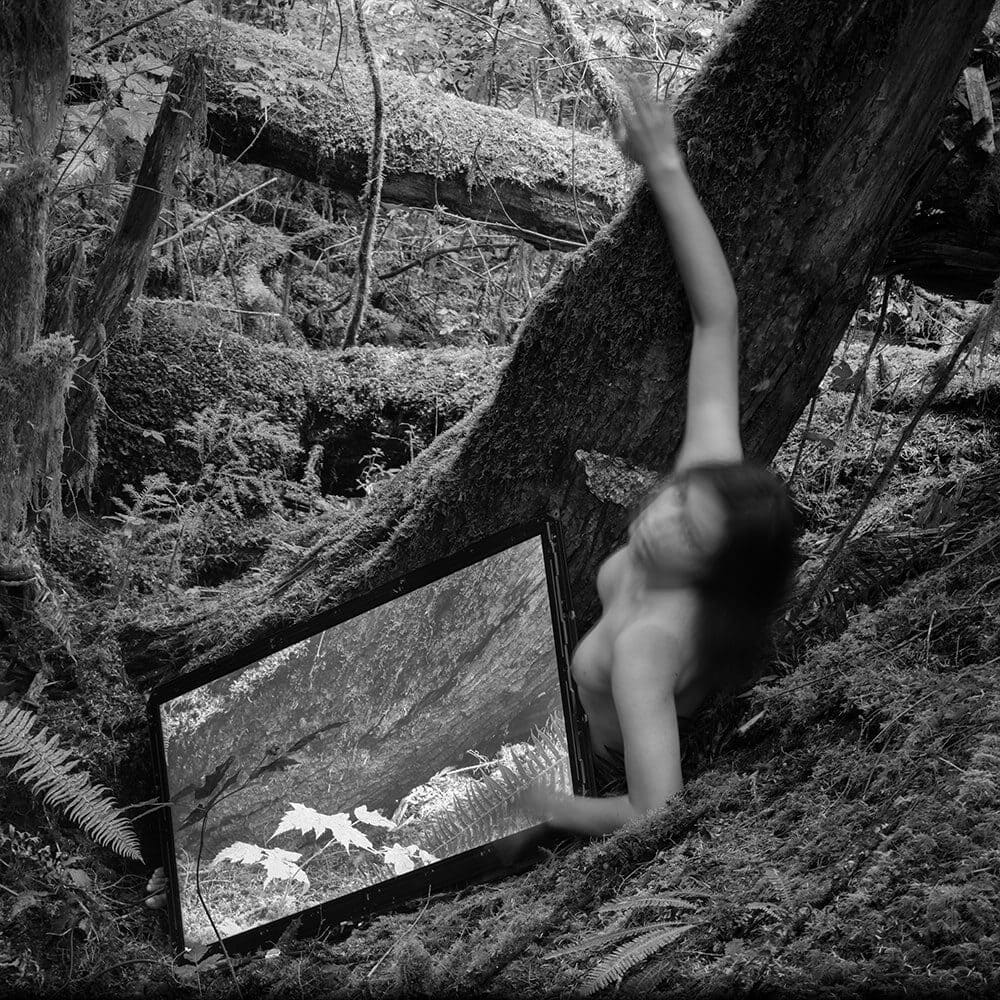
“I want to bring the viewer to a place where they question what they’re seeing,” Trautman says. “The convention, with an image, is that it’s just a singular moment, that we’re recording a moment in time. I’m trying to stretch that a bit and question what is remembered or what is forgotten. What’s being excluded and not seen outside of the image? That there is only one perspective, only one moment in time: I’m pushing back on that.”
Trautman, who graduated with an MFA from the University of Arizona earlier this year, is a member of the Duwamish Tribe, and currently resides in Shoreline. While they dabbled in darkroom photography in college, Trautman’s focus was biology. It wasn’t until the COVID-19 pandemic that Trautman began taking up photography as more than just a pastime.
“That was one thing I could control,” Trautman says.
Since then, the artist has produced numerous series of photographs that exist at the crossroads of portrait and landscape, interweaving place and person with masterful manipulation of analogue techniques. All photographs are shot on film. Overlay imagery is woven into the frame by using portable projectors to paint with light in real time. The smudged bodies and ethereal glow are the result of long exposure, where film has been exposed for multiple minutes at a time. The results are something teetering on unreal. Figures cling to the image as if they were ghosts—an allusion to the continued erasure of Indigenous bodies from colonial depictions of landscape.
This spectral style of documentation is as much about unraveling monolithic narratives of time and reality as it is about recording a moment. A place can hold multitudes, and a figure can, too. In the LCD series, the illusory body is an expression of Trautman’s process of coming out as transgender, with a nakedness that vacillates between erotic and awkward, and features that are never fully opaque.
“How am I describing my own body? How do I fit in this landscape?” Trautman asks.
“Do I really fit here? I’m sort of feeling a little uncomfortable.”
It’s a mythology for modern times: the obsessive search for the self reflected in the ever-present liquid-crystal pools at our fingertips, Narcissus lost in the labyrinthine digital landscape. In this telling, the LCD is more than a reflecting pool; it’s a mise en abyme where everything is real, but everything is also a construct, from gender and selfhood to history and the landscape itself. As Trautman’s statement for the work points out, “every photograph is a reminder that the act of framing is never neutral.”
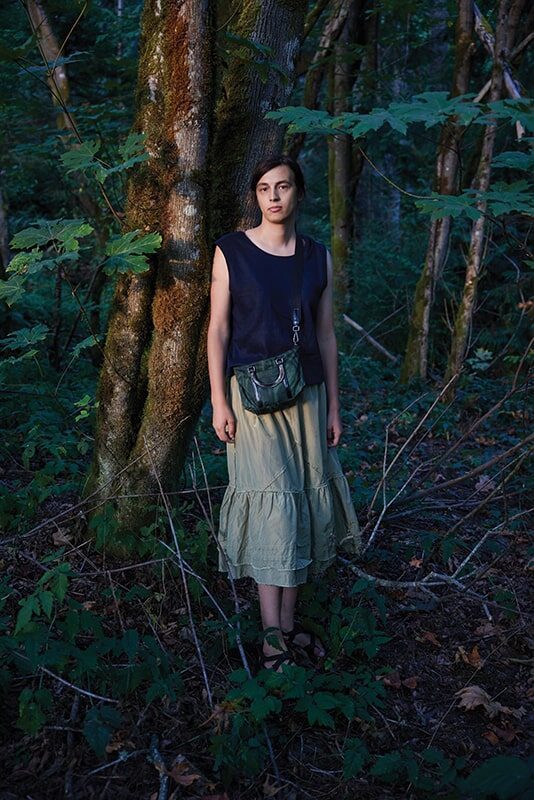
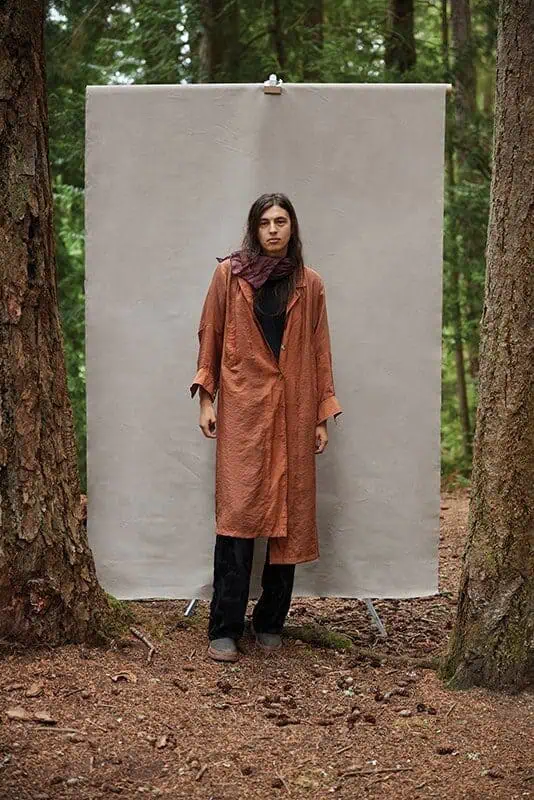
“It’s important for people to recognize Indigenous artists who are working beyond traditional forms, and to see the diverse ways they are archiving and sharing their stories,” says Alexis L. Silva, curatorial assistant at the Frye and curator of the Boren Banner Series. “Camille is doing this in a particularly beautiful and compelling way.”
The Boren Banner Series is something else that developed during the pandemic—a space the museum could use to showcase work on the outside.
“There is something about Camille’s images that catches your eye,” Silva says. “I don’t want people to go off the road! But I do want them to do a double-take when they drive by. I want them to circle back for another look, and maybe even be five minutes late for work because they stop to see the work inside.”
Follow Us

Taste of Iceland Returns to Seattle
The three-day festival brings Icelandic food, music, art, and culture to venues across the city.
I have always been mesmerized by Iceland. It probably started in high school, when I was listening to Icelandic musician Björk. In the video for “Jóga,” she sings about her home country with such intensity while sweeping cliffs, mossy rocks, and jagged coastlines move across the screen. I remember thinking: what an incredible place. And then…

Artist’s Corner: Tininha Silva
Brazilian-born fiber artist Tininha Silva talks about building a life in the Pacific Northwest and the coastal landscape that influences her work.
Along the shores of the Salish Sea, textures are everywhere—seaweed tangled in the tide, stones worn smooth by water, the strange geometry of coral and barnacles. Those details are finding their way into the work of artist Tininha Silva. Silva grew up in Brazil’s rugged Pernambuco region before moving to Seattle in 1999 after earning…

Spring Arts Preview: Film
Festivals keep the region’s movie scene busy this season.
Spring is festival season for Seattle movie lovers. For a few weeks each year, film festivals take over the city’s theaters, turning them into gathering spots for audiences eager to see what’s new on screen. Here are some worth catching. Seattle Jewish Film Festival The 31st annual Seattle Jewish Film Festival is a celebration of…

Spring Arts Preview: Visual Art
New exhibitions across Seattle offer plenty of reasons to spend an afternoon gallery hopping.
Pioneer Square’s First Thursday crowds may be getting the headlines, but the city’s visual arts scene stretches far beyond one neighborhood. From Belltown to Ballard to Capitol Hill—and even down to Tacoma—galleries and museums are presenting new exhibitions that reward a slow look. Here are the shows we recommend seeing this spring. Indira Allegra: The…