From the Emergency Room to ‘The Pitt’
Bellevue-raised nurse Ned Brower brings real-life experience to one of TV’s most medically accurate dramas.
By Daniel Anderson February 9, 2026

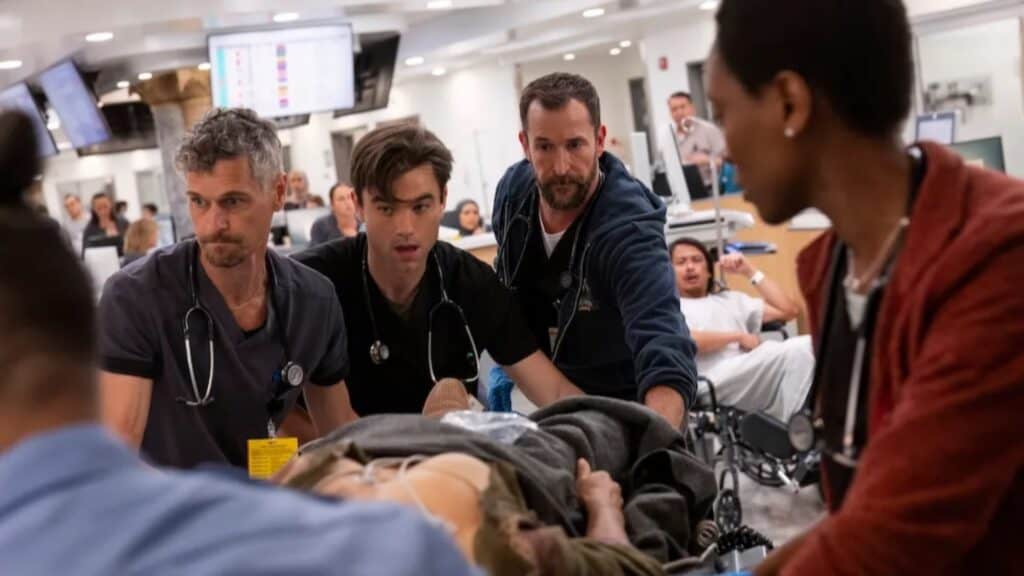
HBO’s The Pitt, now in its second season, has distinguished itself as one of television’s most realistic medical dramas, earning awards like an Emmy and Golden Globe for Best Drama Series. The show has received widespread praise for its clinical accuracy and emotional intensity. Created by ER alums Noah Wyle, John Wells, and R. Scott Gemmill, the series unfolds in real time, with each episode covering a single hour of a high-stakes emergency room shift over the course of one relentless day. That lived-in authenticity is no accident. It’s rooted in the firsthand experience of the medical professionals shaping the show, both behind the camera and on screen.
One of them is Ned Brower, who portrays ER nurse Jesse Van Horn across the series. Brower brings rare dual credibility to the role: in addition to being an actor and musician, he is a practicing emergency room nurse in real life. He grew up in the Bellevue-Redmond area during the ’80s and ’90s, attending Bellevue High School, and had a childhood that he describes as “Stranger Things–like”—filled with BMX bikes, forests, and endless outdoor exploration. His early curiosity and energy eventually found an outlet in the arts: in middle school, he landed a role in The Sound of Music through an open call at Seattle’s Fifth Avenue Theatre. In high school, he and his friends helped build a DIY all-ages music scene out of a converted firehouse in Redmond, organizing concerts and creating a community that shaped both his creativity and passion. Brower later rose to prominence as a member of the band Rooney, touring extensively, before eventually pivoting toward medicine and earning a Master’s degree in Nursing from UCLA.
The actor, nurse, and musician recently spoke with Seattle magazine about his work on The Pitt and the lessons he’s learned from balancing careers in the arts and sciences.
You’re based in L.A. now but do you still make it back to Washington often? And what are your favorite places to eat?
I try to go back about once a year, though I’d like to do it more. We have a family place near Icicle Creek, close to Leavenworth, so when I’m back in the Northwest, I’m usually up in the mountains. I’ll also usually spend a day or two in Seattle to see friends I’m still in touch with. I really love it. It’s the best place in the world.
Honestly, most of my favorites are from my teenage years, so it’s probably very teenage food. I still love stopping by Dick’s Burgers, and I’ll always get chowder from Ivar’s.
The Pitt showcases a lot of mentorship and how learning comes from doing. Is there something from nursing school that you still use today? And on the flip side, what’s something no amount of schooling could really prepare you for once you started doing the work for real?
A great example from nursing is starting an IV. As an ER nurse, that’s a huge part of the job. You train endlessly—rubber arms, dummies, all of it—but eventually you’re standing in a hospital room with a real human being, and you have to put a needle in their arm.
There are good ones and bad ones. I’ve missed. I’ve struggled. I’ve also landed ones I never thought I’d get. Even now, five or six years in, it’s still a rush. Everyone’s anatomy is different. Starting an IV is a mix of science and art. You learn the angles and the technique, but it’s also intuitive.
It’s like that scene in Star Wars where Luke puts the helmet on and Obi-Wan tells him to close his eyes—you’re not looking with your eyes, you’re feeling it. That’s nursing. You might not see the vein, but you feel it. It becomes a sixth sense.
You bring so much real-world medical experience into The Pitt, but is there anything you have to recalibrate because you’re doing it for camera and not real life? Even though the show wants medical accuracy, are there moments where you have to adjust because it’s not actually happening?
I do things very realistically on The Pitt. That was a big reason I got this role—they wanted that authenticity. Most of the time, I’m just doing things the way I would in real life, and that actually helps the acting.
The biggest difference between real life and TV is in the big trauma scenes. Those become more like a dance. We spend a lot of time choreographing them to make them look chaotic. There’s timing, rhythm, flow. Trauma care in real life is already a kind of dance, but on TV it’s choreographed instead of improvised. You have to make sure things are visible on camera, that you’re not blocking someone’s line, that a moment sweeps through the frame the right way. So it becomes this carefully constructed chaos.
Were there any props or procedures on the show that impressed you in how realistic they were?
Everything the practical effects team does is unbelievable. The special effects makeup is mind-boggling. That opening trauma scene in the first episode of season two, where we open the chest, was insane. They custom-built a gurney with a hole in it so the actor’s top half could come through while his body was underneath. The layers they created were stunning: skin, tissue, organs, vasculature…everything was there.
At one point I was looking down at the patient’s foot and noticed they’d added a wart. There was body hair and freckles. It never ended. I remember thinking, “I don’t know how we top this.” They even had a beating heart, with puppeteers off camera operating pumps for the chambers. Up close, it looks completely real.
Sometimes it’s even simpler stuff. There was a scene in season one where we were doing a trach on a patient. I’d been standing a foot from this guy’s neck for two hours. Then they cut into his neck and I realized—oh, that was a fake neck the entire time. I had no idea. Huge props to the props team.
Since you bring so much knowledge to the set, were there still medical terms or procedures that caught you off guard or that you had to learn specifically for the show?
All the time. There are tons of things I’ve never seen. Procedures like “spinning the lung,” those are rare. I’m still learning constantly.
I’ve only been a nurse for about five and a half years. I’m not a baby nurse, but I’m also very humble about what I don’t know. Other actors ask me questions, and sometimes I can answer them, but sometimes I have to say, “I’m not sure, but I’ll help you find out.”
What’s interesting is realizing how much has sunk in. When I read the scripts, I understand most of the medical language right away. In season one, I joked that I was the “numbers guy.” I knew what those numbers meant and how to deliver them so the audience could feel whether things were stabilizing or getting worse.
How would you describe the overlap and differences between you and your character, Jesse?
That’s a great question. No one’s really asked me that before. I see Jesse as very experienced, way more than me. I imagine he’s been working there for 20 years. He’s old school, breaks the rules, rough around the edges, but he’s too good to fire. When things get intense, Jesse’s the guy they call, so they tolerate his sarcasm and grouchiness. That’s where we differ. I’m actually pretty friendly and upbeat. Jesse’s more gruff. But there are things from me that have started to seep into the character. They’ll throw in little lines like something about my drum set.
We also build relationships that aren’t necessarily on the page. The character of nurse Dana and I are friends, so I imagine Jesse as her enforcer, her right-hand guy. With the other male nurses, there’s camaraderie of fist bumps and shared looks. I picture Jesse and Dr. Robbie grabbing a beer after work. Those imagined relationships start to feel real, just like in a real ER.
You’ve had a passion and career in the arts before going into nursing, and now you’re on a show that blends science and creativity. A lot of people see those worlds as opposites or mutually exclusive. What does it mean to you to be living in both?
When I was younger, I started bands, went to film school, did more bands, moved to L.A., started acting. When I first got here, I started getting work. I got a couple lucky breaks that I built on. Then my band Rooney took off and we got a big record deal. I sort of put acting on the back burner for a long time. Those credits transfer. Performing in a band, you’re kind of playing a character too. So to me, those are all the same through line.
My dad’s a doctor. I have lots of doctors in my family, no nurses, ironically. I don’t think any of them ever thought or expected me to become a doctor or nurse, because that’s just not the person I was, or the interests I had when I was younger. But it was a practical matter for me. When my band ended, I didn’t really know what I was going to do next, and I was left kind of unemployed after a long 12 or 13 years in the arts. At that point life changed. I had a baby and a wife and a mortgage.
When I went back to nursing school and was on a focused pursuit, I was getting straight A’s in microbiology and physiology. It was a long journey. I gained the stability of nursing, which is what I was looking for, but also this new quest for knowledge and learning that’s really stimulating. It made me feel energetic, like a second wind in my sails. It also enabled me to not hold on so tight to the arts, but have time to pursue all those things. I love both because art is my passion. It’s what I do as a hobby, as a job. It’s all of it. I still make music, I’m still making records, still making things. And then, obviously, The Pitt has been out of this world, especially seeing the appreciation from audiences and the medical community.
I go to work and see people with real problems, and a lot of times I’m able to help solve them. It puts things in perspective. Our time is precious. It makes me appreciate my family’s health, my friends’ health, and my own health. And it just feels great to be able to help people during those tough moments. That helps me come home and sleep great at night. And it feeds the art, and then the art feeds the medicine. It’s this cool symbiotic circle that I feel so much gratitude to have.
The show has been praised for its medical accuracy and for humanizing healthcare workers. As both an actor and a nurse, what impact do you hope The Pitt has?
I love that we’re telling real healthcare stories—not just the wild, rare cases, but the smaller, everyday ones. The sickle cell storyline really stands out to me. I worked at Children’s Hospital Los Angeles, and we treated those patients all the time. Seeing real stigmas portrayed in a digestible way is powerful.
Healthcare can make you jaded. High patient volume and constant stress. It’s easy to build a shell. I hope the show cracks that open, not just for viewers, but for people already working in medicine.
And honestly, I hope it inspires people to enter these professions. After ER in the ’90s, there was a huge spike in emergency medicine careers. If The Pitt inspires even a small number of people to become nurses, especially ER nurses, I’d be really proud of that.
Follow Us

Fave Five: Early Signs of Spring
Where to go when everything starts waking up.
March and April always blend together in my head. Around here, there’s still plenty of rain, but it feels a little more manageable as the green sprawls and the crocuses unfurl right before our eyes. This is the time when things respond to moisture and attention, and when getting back into it feels better than…

An Ear For Good Design
Integrated design firm Mithun creates impactful spaces through a culture of listening.
At design firm Mithun, communication plays an indispensable role in the workplace culture. It doesn’t have a single discipline—the practice encompasses architecture, landscape architecture, interior design, and urban design. It doesn’t have a single specialty, with projects spanning educational, cultural, civic, and business sectors. And it doesn’t have visual trademarks: each project is hyper-tailored to…

Curmudgeonly Hope
The UK punk heroes Mclusky have returned, loud and pointed as ever.
When you listen to the sardonic, whip-smart, and perennially ornery UK band Mclusky, you get a certain impression of the type of person that must be behind it all. Frontman and founder Andrew Falkous was just home from having seen his daughter perform at a choir recital when he got on the phone, and he…

Rearview Mirror: Spring Tea, an Arty Anniversary, and a New Look for Woodinville Whiskey
Things I did, saw, ate, learned, or read in the past week (or so).
Last Weekend to See Red Angels Every once in a while, a piece of art comes along and metaphorically knocks your whole world akilter. It becomes a kind of touchstone for other work, and something you come back to again and again in your head. For me, one of those pieces is Ulysses Dove’s Red…