
Seattle’s WALK DONT RUN Festival is a Major Success for Downtown
Featuring more than 100 local artists, the 2-mile route drew thousands throughout the day.
 By Rachel Gallaher September 26, 2025

Last week, Seattle’s streets were abuzz with creativity during the inaugural WALK DON’T RUN art marathon. Inspired by NEPO 5K—an art event organized by local artist Klara Glosova in Chinatown International District and Beacon Hill—WALK, DONT RUN wound through the heart of the city, with dozens of installations, performances, pop-ups, open galleries, and merriment along the way. Kicking off in Occidental Square with musical and drag performances, as well as a peppy sendoff from Seattle Cheer (they roamed the route throughout the day, encouraging art walkers with chants, smiles, and pom-pom shakes), programming happened on a rolling basis through four neighborhoods: Pioneer Square, the downtown core, the Pike/Pine corridor, and Belltown, with the finish line at Bell Street and Second Avenue.
“Coming out of the pandemic the past few years, and out of this period of isolation really reminded me and many of my colleagues of the recovery years after the Great Recession,” says art consultant Kira Burge, who organized WALK DONT RUN along with Alice Gosti, Steven Severin, Philippe Hyojung Kim, Meli Darby, Olivia Neal Howell, and Jennie Kovalcik. Burge moved to Seattle in 2010 and found connection and community through gatherings happening in artists’ residences and studios. “We weren’t just going to galleries and First Thursday,” she says. “We were going to Klara’s house, and chicken coop shows, and Sierra Stinson’s apartment in the El Capitan building.”
Looking to capture some of that same creative spirit and bring people together through the positive influence of art—especially in a climate where everything feels so divided—Burge approached Glosova about reviving NEPO 5K. Glosova demurred, but gave Burge her blessing to run (or, in this case walk) with it. To fund the one-day festival, Burge applied for an Office of Arts & Culture’s Hope Corps grant (which she received). Paired with sponsorships, donations, and 4Culture grants, much of the money raised went towards paying artists involved for their time and work.
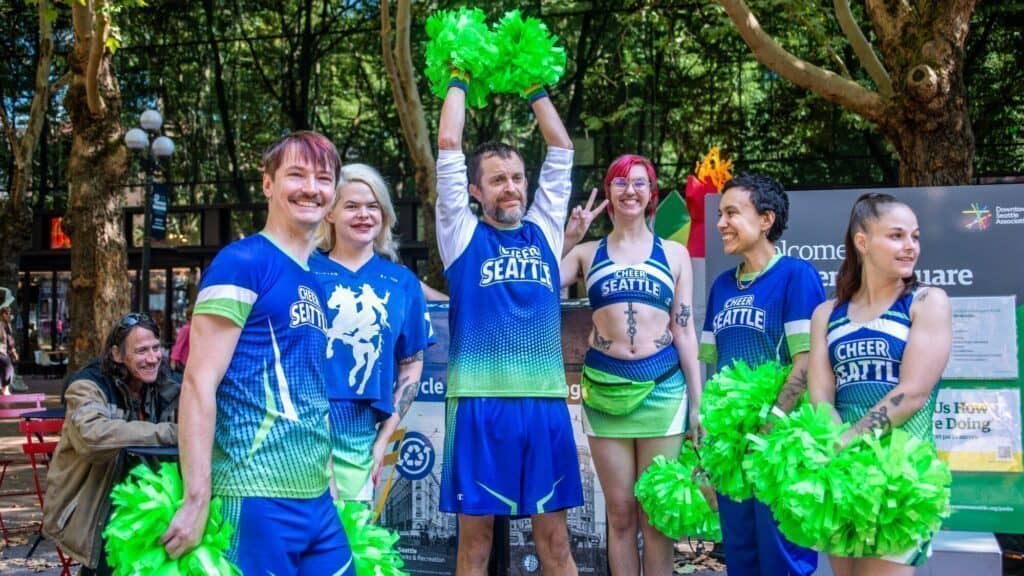
“The goal is to contribute to downtown Seattle’s revival through fun, creative activities that showcase the art and culture that is the lifeblood of our city,” Burge said in a call before the event. “It’s what gets people to go out to dinner before a show—art is commerce on its own, but it’s married to the bigger ecosystem.”
More than 100 artists—visual, dance, music, performance—participated in WALK DONT RUN, activating streets, alleys, sidewalks, and public spaces covering more than 20 city blocks. Moseying along the route, which was marked by blue sidewalk paint, QR codes, and colorful ribbons tied on poles, marathoners could be spotted by their “race bib” stickers, distributed from a booth in Occidental Square, on which they wrote cheeky sayings, nicknames, or art puns. (The best one I saw: “The only marathon I’ll ever qualify for.”)
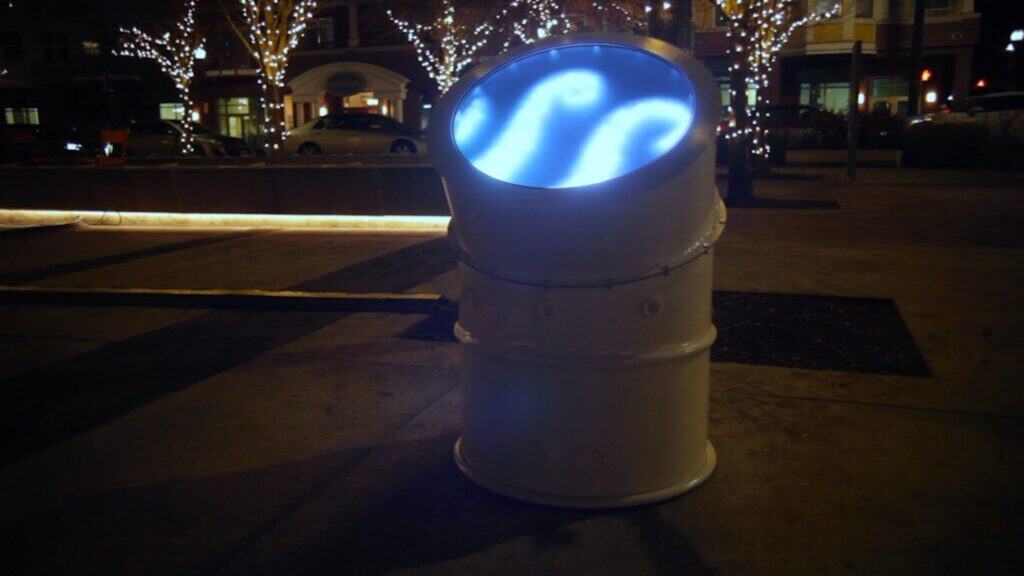
“Seeing art in an unusual context can change the way we feel about both the art and the context,” says artist Britta Johnson, whose sculpture, Making Kin, was installed in a parking garage on the corner of Third Avenue and Virginia Street. Made from a modified oil barrel with a mini screen of LED lights, it displayed a strange, ghostly octopus waving its tentacles through what looked a porthole. “I hope visitors will experience beauty, strangeness, delight, etcetera, and get to see the city in a new way,” Johnson said a few days before the event.

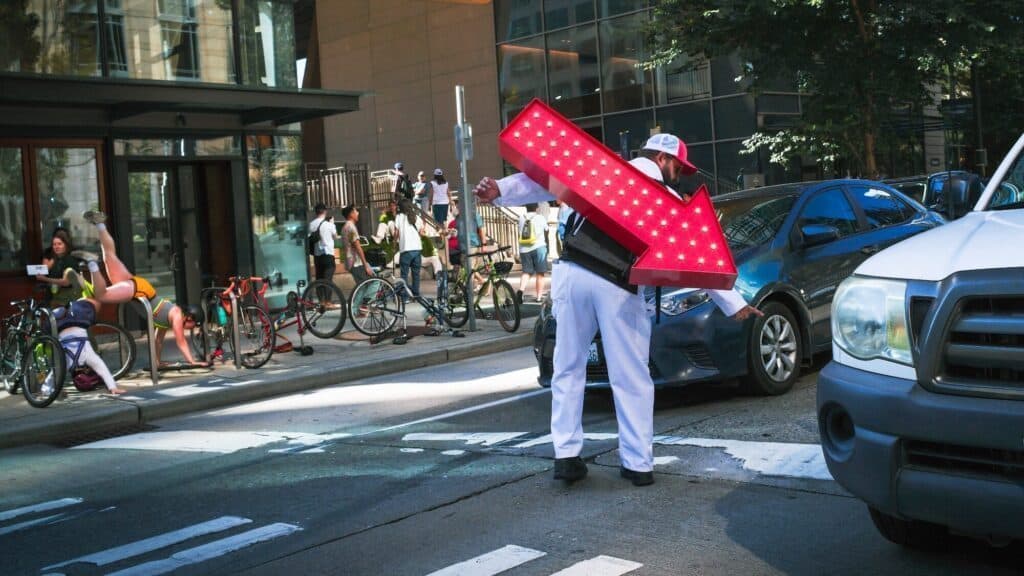
Discovery was part of the fun—big names mixed with emerging talents, and roving groups such as SuttonBeresCuller (in their infamous all-white jumpsuits, each with a lit red arrow on their back) brought moments of delight and irreverence as you turned a corner or crossed a street. We ran into one assemblage around the Pike/Pine corridor—a participatory performance created and ideated by Lorraine Lau—in which each member held a papier-mâché salmon on a stick, gleefully “swimming” them down the street. Longtime Seattle artist Margie Livingston reprised her “art dragging,” in which she connected more than a dozen wood-framed paintings to straps on a harness and hauled them around the sidewalks, eroding the surfaces, but imbuing each work with something from the city, the participants, and the event itself.


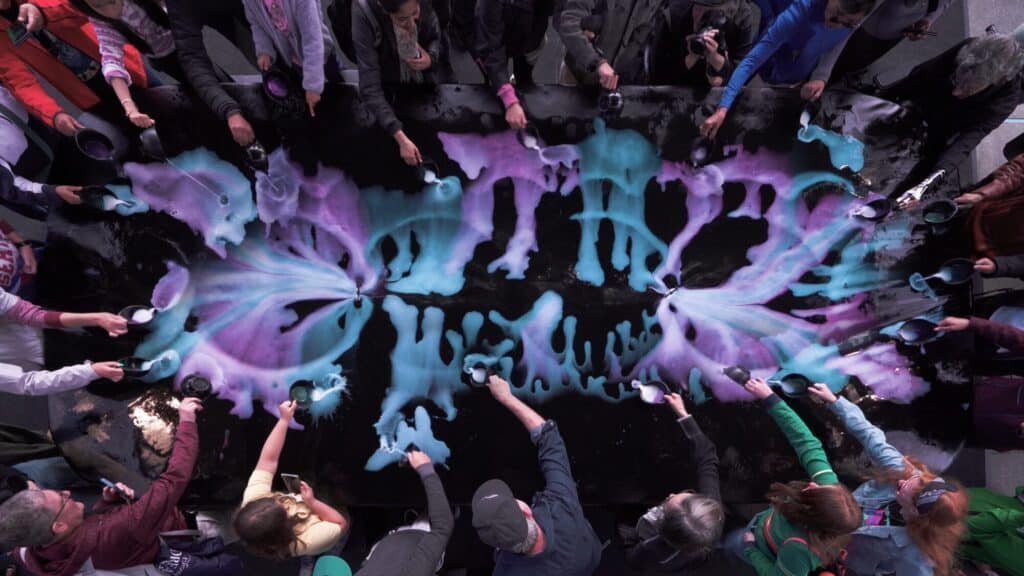
Live performance took over the 2+U courtyard at Second and University Avenues, including a live duet by Danielbi Perdomo and Leah Russell. At the center of it all, Jesse Higman offered up his interactive paint pours, called “The Collaborative Landscape,” in which large groups of people, often strangers, come together to pour cups of iridescent mica flakes suspended in water onto a 16-foot horizontal canvas, resulting in a shimmery, ephemeral constellation.
“From my vantage point I watched people arriving in Occidental Park excited for the event,” says local curator Jeremy Buben, who served as an Art Concierge, rolling a podium stacked with art books around town, ready to answer any and all questions. “I also posted up in Pioneer Place Park, and at the finish line on Bell Street. Each location greeted me with participants seeking directions, recommendations, information on scheduled activities, and a few existential art questions. It was also a real pleasure seeing many friends who had turned out to walk the event.” Buben plans to return next year, if there is a round two—something that everyone along the route is championing. “I’m excited to see this event continue and grow,” he says. “What a great opportunity for Seattle’s artists, musicians, and performers to create an exciting reason to explore downtown.”

WALK DONT RUN was the perfect kick-off to fall. It helped that the day was absolutely gorgeous: sunny, clear, and topped with radiant blue skies. For me, the event felt like a reconnection with Seattle’s vibrant creative scene, and an opportunity to further explore my own neighborhood, see faces I haven’t seen in a while, and celebrate those in the community who believe enough in the city to keep showing up for it—not only during WALK DONT RUN, but every single day.
Follow Us

82 Million Tons of E-Waste by 2030. Now What?
Smart ways to handle old electronics after a holiday upgrade.
Every holiday season, our houses fill with upgraded gadgets and the promise that we’ll deal with the old stuff later. Meanwhile, the drawer of mystery cords multiplies, and some items just get tossed out. Most of us mean well, but those castoff electronics often end up somewhere they really shouldn’t. And with about 59% of…

Going to the Mountains This Winter? Read This.
A new online tool breaks down avalanche basics for anyone planning snowy fun off the beaten path.
I’m a rule follower when it comes to the outdoors. This summer, my family did some backcountry hiking in Whistler and made sure to do everything by the book—texting friends our plan and location, and wearing a bear bell even though it felt a little dorky. It’s reassuring to know you’ve covered the basics before…

Historic Flooding Prompts WA Governor to Declare Emergency
Rivers are surging around the state amid days of heavy rainfall.
As floodwaters swelled around Washington, threatening low-lying communities along rivers, Gov. Bob Ferguson signed a statewide emergency declaration on Wednesday. Ferguson says he’ll also seek an expedited emergency declaration from the federal government in response to the flooding, which is the result of an atmospheric river that has dumped multiple inches of rain in parts…

Barnes & Noble Is Coming Back to Downtown Seattle
The bookseller will open a new flagship at 520 Pike, marking the largest retail lease in downtown Seattle since 2020.
Barnes & Noble is returning to downtown Seattle for the first time since early 2020. The national bookseller has signed a 10-year lease for a new flagship at 520 Pike Street, a 29-story tower, taking over 17,538 square feet on the corner of Pike and 6th Avenue. The store is expected to open in the…