
Tracing Lineage
Glass, fiber, and clay become vessels of cultural memory in Priscilla Dobler Dzul’s museum debut at the Frye.
By Yeshe Lhamo October 22, 2025

For the past decade, Tacoma artist Priscilla Dobler Dzul has been steadily gaining the attention of the Seattle art world. From a solo show at the now defunct Mad Art in South Lake Union to winning the Neddy Award in 2022, Dobler Dzul’s career has continued to blossom. Water Carries the Stories of our Stars, which opened on Oct. 18, marks Dobler Dzul’s expansive museum debut at the Frye Art Museum.
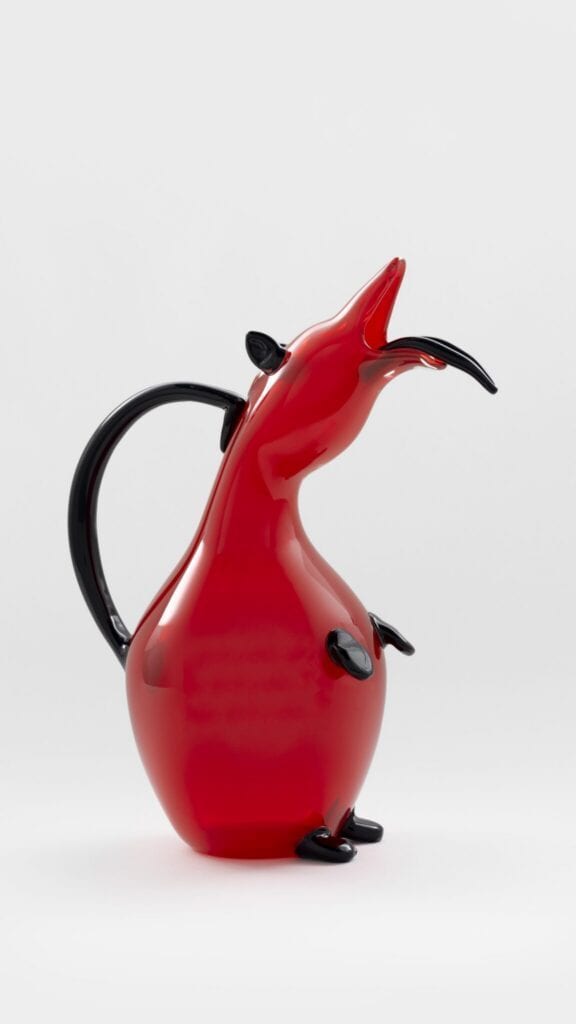
For her exhibition, Dobler Dzul produced an entirely new body of work spanning glass, ceramics, video, weaving, and embroidery. Working with Tacoma’s Museum of Glass, the artist partnered with expert hot shop technicians to create blown-glass vessels from her drawings of animal-like beings connected to Maya cosmology. An armadillo and piglet are represented in pitcher-like vessels bearing local waters from Chambers Bay and Flett Creek, while possum and jaguar adorn the transparent glass lids of containers that hold blue pigment, cochineal, and precatorius and ojo de venado seeds. Elsewhere, thorny vessels display hand-dyed henequen threads used for weaving.
Her reverence for materials echoes German artist Wolfgang Laib’s displays of jarred flower pollen and natural pigment in his shows. But in her exhibition, Dobler Dzul points the viewer’s attention toward ancient technologies from the more-than-human world, to go beyond an aesthetic display of the artist’s materials to remind us of where cultural memory and lineage reside.
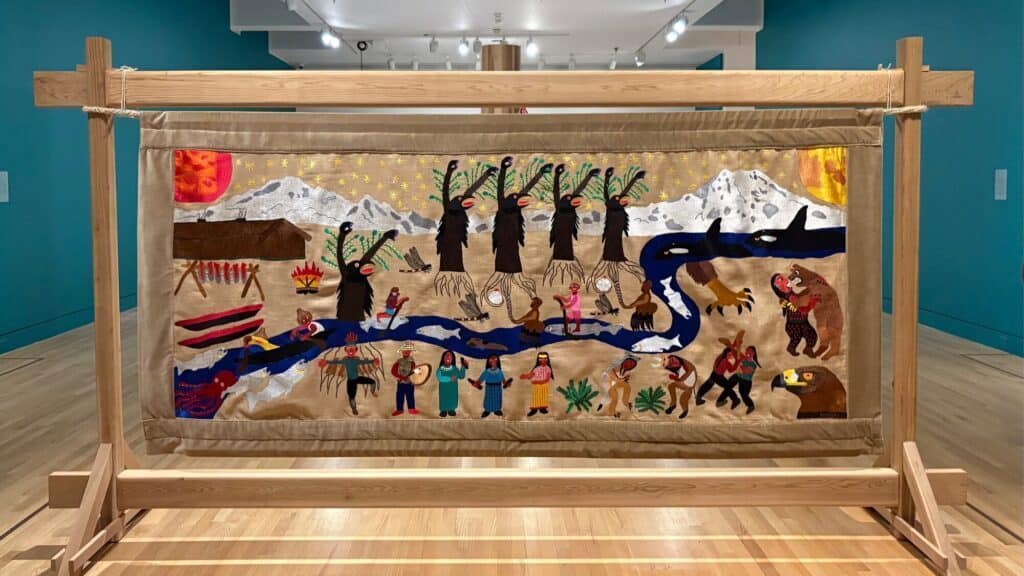
The exhibition continually interrogates cultural memory as a major theme. Visitors entering the gallery are confronted with two massive, double-sided wall-sized textiles mounted on individual standing looms, inspired by looms Dobler Dzul’s grandmother and mother used to weave hammocks. Each machine-embroidered textile, represents the history of places that are key to the artist’s identity, whether her home in Tacoma or Yucatán. The Yucatán loom reimagines creation stories in the artist’s own visual language, while the Tacoma loom documents the Puyallup creation story and speaks to present-day realities of environmental violence. As visitors circumambulate the textiles, past and present converge into uneasy stories of destruction and extraction.
Just past her textiles, the focal point of the show is The four winds gathered around Tree and her threads—a series of red clay sculptural vessels that evoke the female form and have been shaped by a memory of the artist’s body and impression through touch. The vessels are tethered by henequen straps to woven hammocks anchored by a Western red cedar tree, in a shape that evokes the practice of backstrap weaving with a portable loom. Dobler Dzul made the twill, tartan patterns in two of the weavings to honor her Scottish grandmother. The red and black hammocks were made in collaboration with master weaver and environmental educator Doña Brigida Lopez and cultural advocate and community organizer Daniela Mussali Meza.
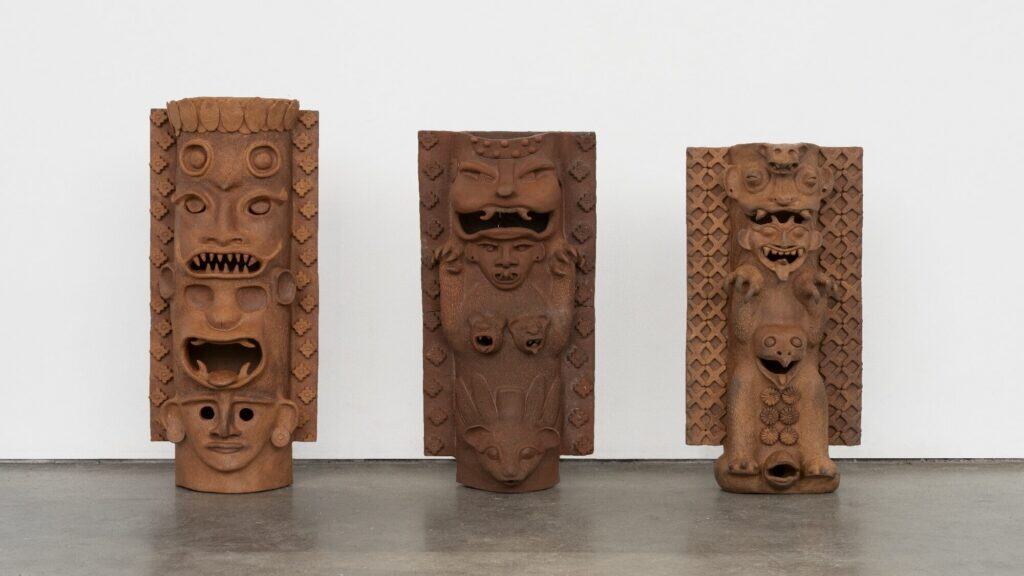
The guardians remind us of what we have forgotten features a wall of four red clay figures inspired by ritual Maya censers. The fierce visages watch over the space. While working with the University of Washington as an artist in residence, Dobler Dzul created these larger-scale pieces using the art school’s ceramic studio and kiln. Inspired by the intricate decorative styles of the Classic Maya period, the backgrounds of each sculpture feature patterns from different architectural sites. The figures represent spirit dwellers and protectors.
The show also features a video viewing station with two films that bring together her reflections on ecological decline in both the Yucatán and Tacoma. The artist worked with Iva Radivojevic to create a film that reflects on the impacts of the construction of the Tren Maya railway on the Yucatán Peninsula. Henequen thread production is depicted, showing the colonial history that continues to exist and contribute to the destruction of the connection and history that Maya people had with this plant through displacement, development, and land privatization. Dobler Dzul moves through the landscape trailing literal threads of her ancestral lineage behind her.
An additional film, made with A.J. Lenzi and Jonathan Jacobson, mourns the loss of water to industrial expansion in Tacoma. Dobler Dzul appears in the film carrying 70-pound ceramic vessels filled with water and lugging a rake she uses to return seeds to the earth. During filming in Tacoma, Dobler Dzul tore a ligament. Filming took place over three days across five seasons in both early morning and nighttime conditions. Throughout both films, Dobler Dzul grieves environmental injustice while invoking ancestral memory rooted in water to explore liberatory possibilities for reimagined relationships to the elemental.

The Frye Art Museum will host “Interwoven: Panel & Weaving Demonstration” on Sunday, Oct. 26, from 1:00 p.m. to 3:30 p.m. Priscilla Dobler Dzul will be in conversation with her collaborators Doña Brigida Lopez and Daniela Mussali Meza. The event is moderated by curator Tamar Benzikry. Following the panel, there will be a live demonstration of backstrap weaving—an ancient technique highlighted in the exhibition.
Water Carries the Stories of our Stars will be on display through April 19, 2026.
Follow Us

Rearview Mirror: An Oyster Party, Money for Art, and Mac & Cheese at 30,000 Feet
Things I did, saw, ate, learned, or read in the past week (or so).
We Partied for Art I love a party, and I love art, so when the Henry Art Gallery invited me to its annual fundraising gala, it was paddle’s up from the get-go. Held on the floor of Pioneer Square’s Railspur building in a space managed by Rally, Angela Dunleavy’s latest venture (read all about it…

Urban Grit Meets Wild Beauty: Inside Seattle Art Museum’s Beyond Mysticism
Seattle’s history is rooted in its fascinating juxtaposition of industry and nature, inspired by the region’s dramatic landscapes and rapidly changing cityscape. Seattle Art Museum’s current exhibition, Beyond Mysticism: The Modern Northwest, invites you to meet the artists who captured that tension and transformed it into a bold new vision of Modernism. Modernism, Made in…

Our March/April Issue Has Arrived!
Inside you’ll find Best Places to Live, a packed spring arts guide, and more stories from across the region.
The future’s bright, and so is the cover of Seattle magazine’s March/April issue! Featuring a mural by local artist (and 2023 Most Influential pick) Stevie Shao, the colorful cover is a snap from Woodinville, one of the six “Best Places to Live” featured inside. While we usually focus on Seattle neighborhoods, this year we expanded…

Supporting Roles
Three women in the Northwest are helping local artists through newly launched residencies outside of Seattle. Here, we take a look inside these thoughtfully designed spaces, and learn what drove their founders to become cornerstones in the creative community.
Iolair Artist Residency Eastsound, WA Years ago, after studying photography and earning a Bachelor of Fine Arts at the University of Washington, Pacific Northwest native Linda Lewis realized that she didn’t want to spend the rest of her life behind a camera. “The minute I graduated from school, I was far more inspired by the…