
Studio Sessions: Lauren Boilini
Seattle artist Lauren Boilini talks about animal behavior, field research, and the whale fall installation she counts among her proudest works.
 By Sarah Stackhouse April 9, 2026

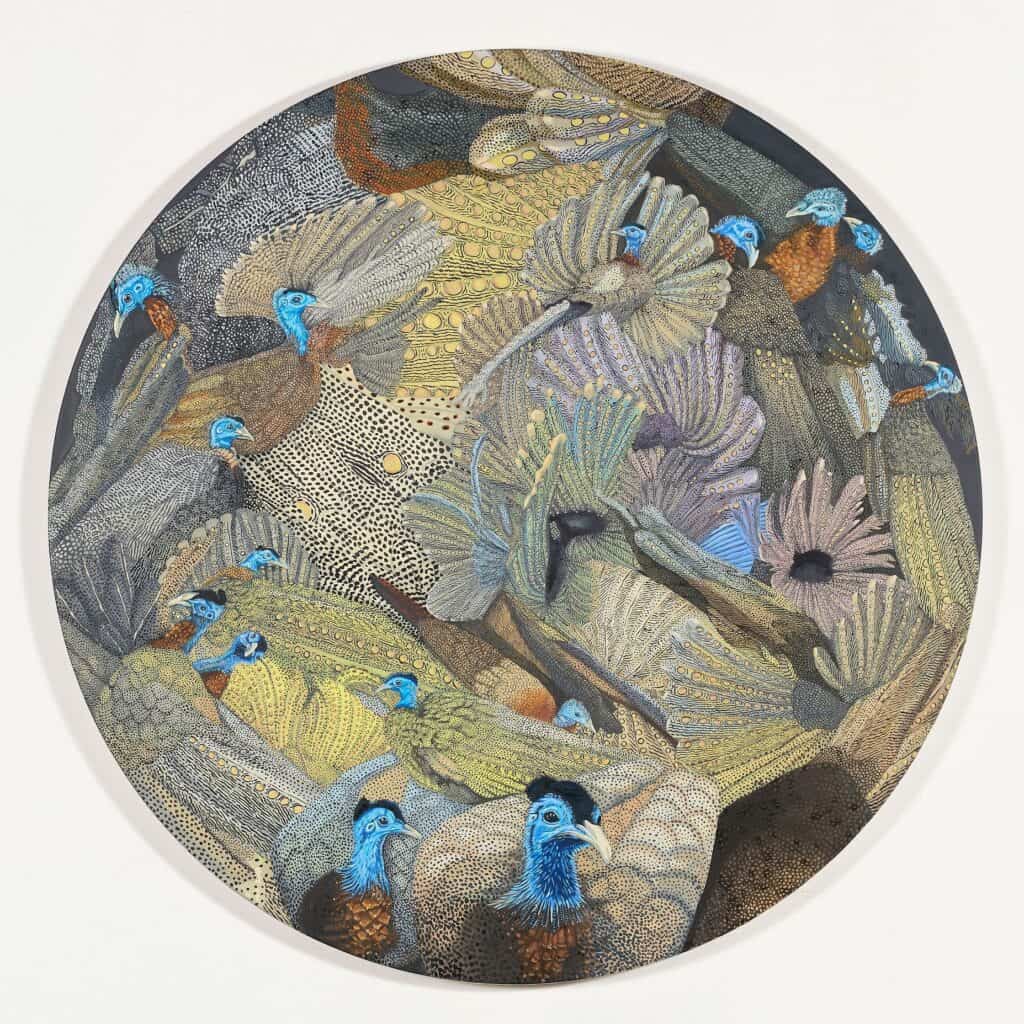
Lauren Boilini has spent years building dense, teeming painted worlds full of animals, movement, and tension. Her work often starts with close observation—time in the field and conversations with scientists—and turns that research into large-scale paintings that feel charged, layered, and alive.
Born and raised in Bloomington, Indiana, Boilini studied painting and art history at the Kansas City Art Institute before earning her MFA at the Maryland Institute College of Art. Now based in Seattle, she teaches painting and drawing at The Evergreen State College and works across painting, installation, and public art. A 2025 Neddy Award finalist in painting, she has made research an increasingly important part of her practice, especially in recent years, through residencies and fieldwork that have brought her into close contact with biologists, insects, coastal ecosystems, and animal behavior.
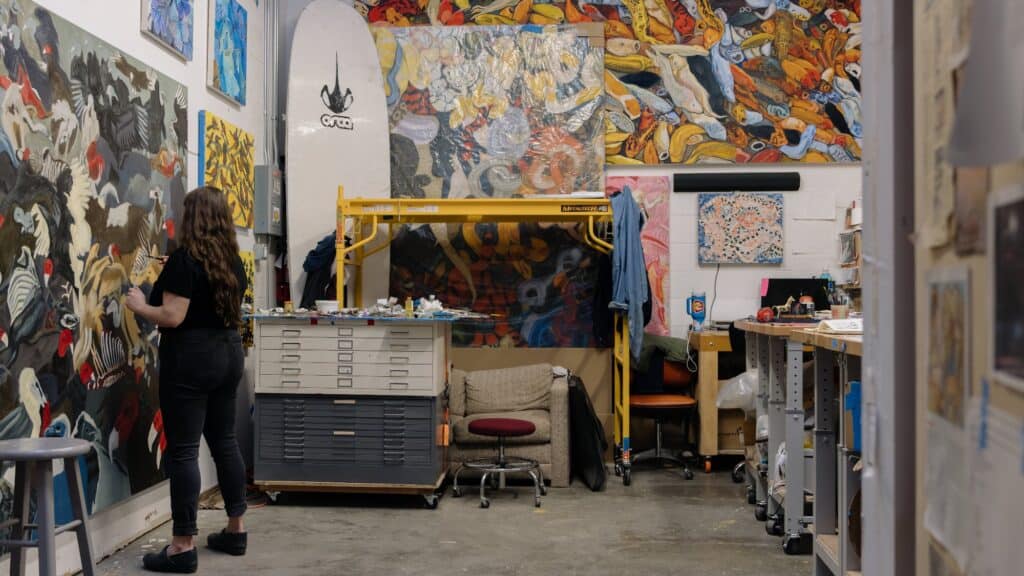
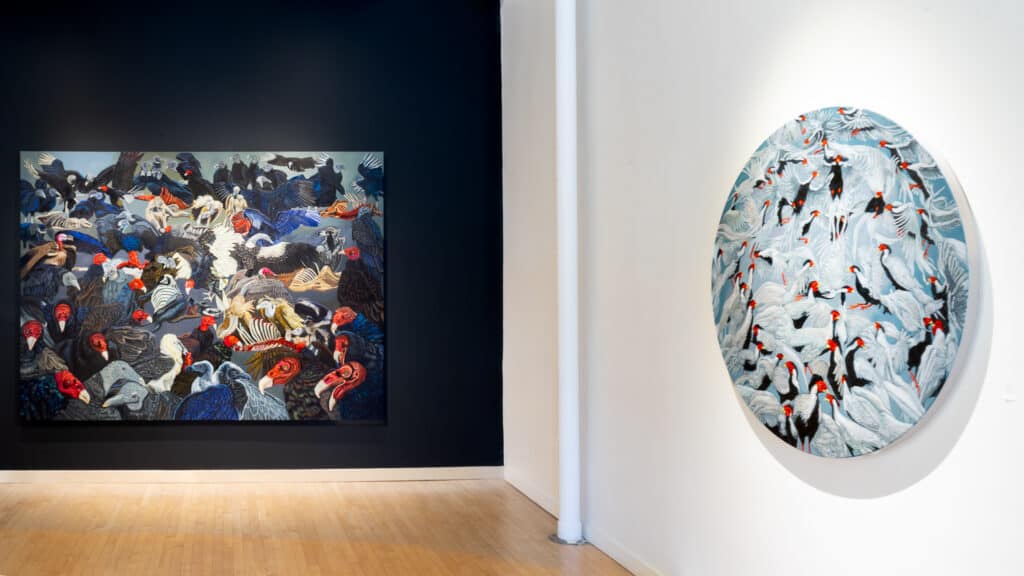
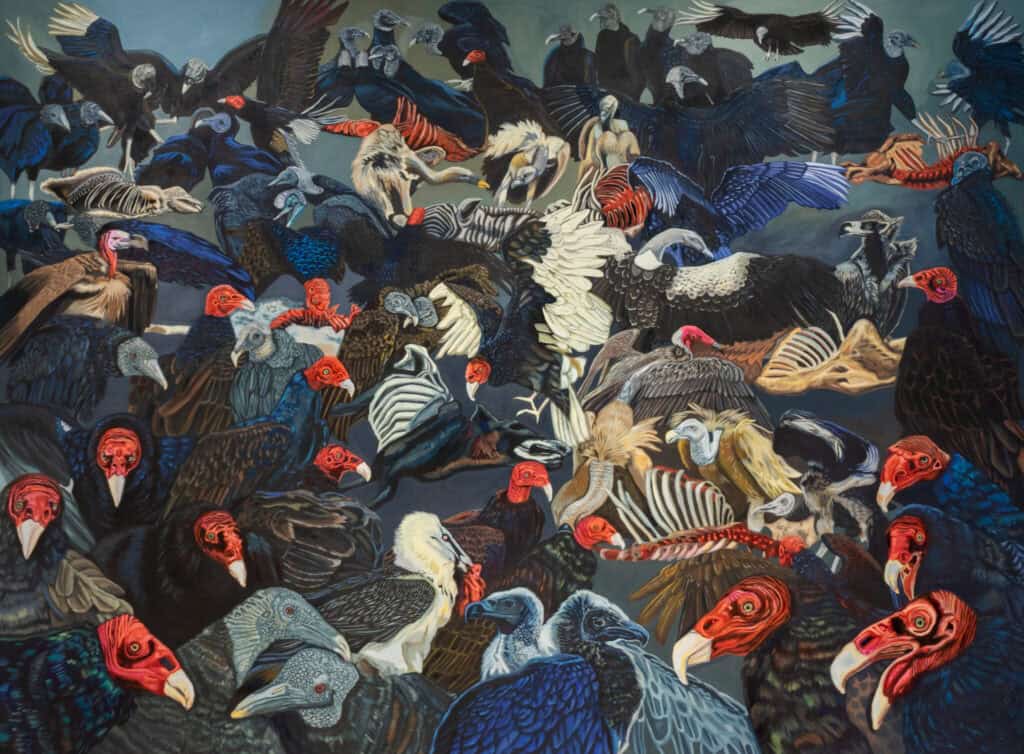
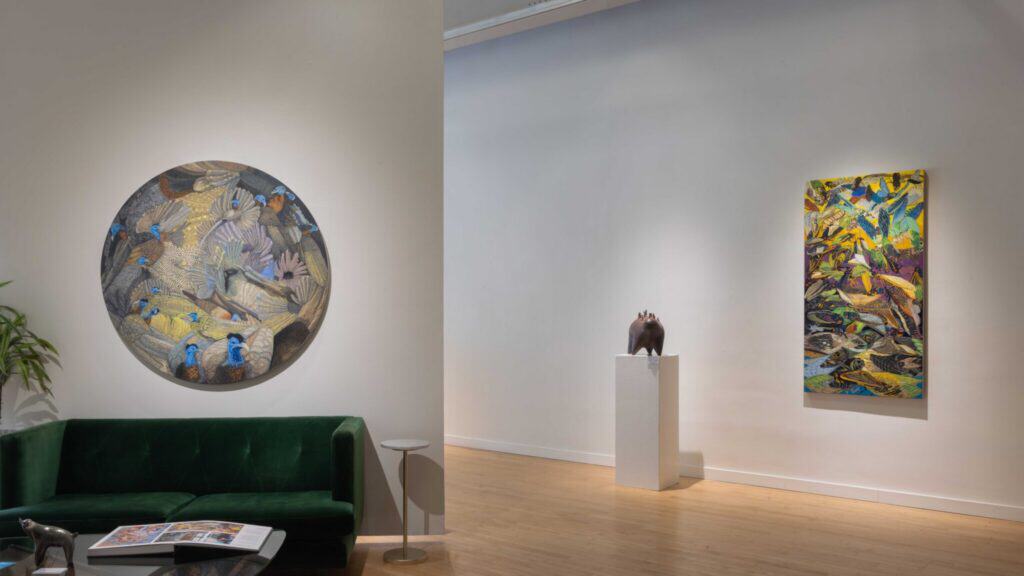
This spring marks a big moment in her career. Boilini recently opened both her first museum exhibition, at the San Juan Islands Museum of Art, and her first solo show at J. Rinehart Gallery in Pioneer Square, where The Good Death is on view through April 29. An artist talk is set for Saturday, April 18, at 1 p.m. In the show, Boilini brings together animals in dense, overlapping scenes that blur the line between struggle and pattern.
Hometown
Bloomington, Indiana
Discipline
Painter
Favorite Spot in Seattle
Bizarre Brewing in Industrial Magnolia (owned by my sister, Colette, and her partner)
Describe your work in three words.
Colorful. Large. Frenetic.
Where do you find inspiration?
This summer I participated in two research-based residencies, spending two weeks at University of Virginia’s Mountain Lake Biological Station and then traveling to Texas A&M’s Center for Coastal Studies where I spent five days at their off-grid Laguna Madre Field Station, working alone on a dredge island. Both opportunities were incredibly fruitful and allowed me to meet many passionate biologists, and I spent a lot of time drawing and taking numerous photographs. In 2023 I was the first artist-in-residence at the Missoula Butterfly House and Insectarium, working alongside their entomologists and bug ambassadors for a month, directly inspiring my current work. Studying animals and animal behavior with a hands-on approach has become an important part of my practice, and has helped me with world-building and understanding the human condition.
You teach art at The Evergreen State College—what feels most important to get across to your students?
I have been teaching painting and drawing at the college level for nearly twenty years. As an educator, I feel strongly that I should pay it forward by making the professional parts of being an artist more transparent, so I have been teaching portfolio development and professional practices courses for many years. I try to remind my students that making art is both a marathon and a sprint.
What are you working on now?
I just installed both my first museum exhibition, at the San Juan Islands Museum of Art (open until June 1), and my first solo exhibition with my gallery, J. Rinehart, in Pioneer Square. I am preparing for a show in Texas in the fall, and a public art project in Renton through Sound Transit.
Tell us about your proudest moment as an artist.
In early 2020, directly before the pandemic hit, my studio neighbor and frequent collaborator, Henry Cowdery and I installed a site-specific project at Oxbow (now closed) in Seattle. Henry and I met in 2016 working for the large-scale sculptor, John Grade, fabricating a number of public art pieces together. We applied for a residency at Oxbow about nine months before our installation date, using the time leading up to it for fabrication. The residency itself was five weeks in length, and we spent almost every waking minute in the space. After working together for four years, solving the ever evolving challenges of large-scale sculpture, it was immensely rewarding to execute our own vision. The installation itself was a reimagining of a whale fall.
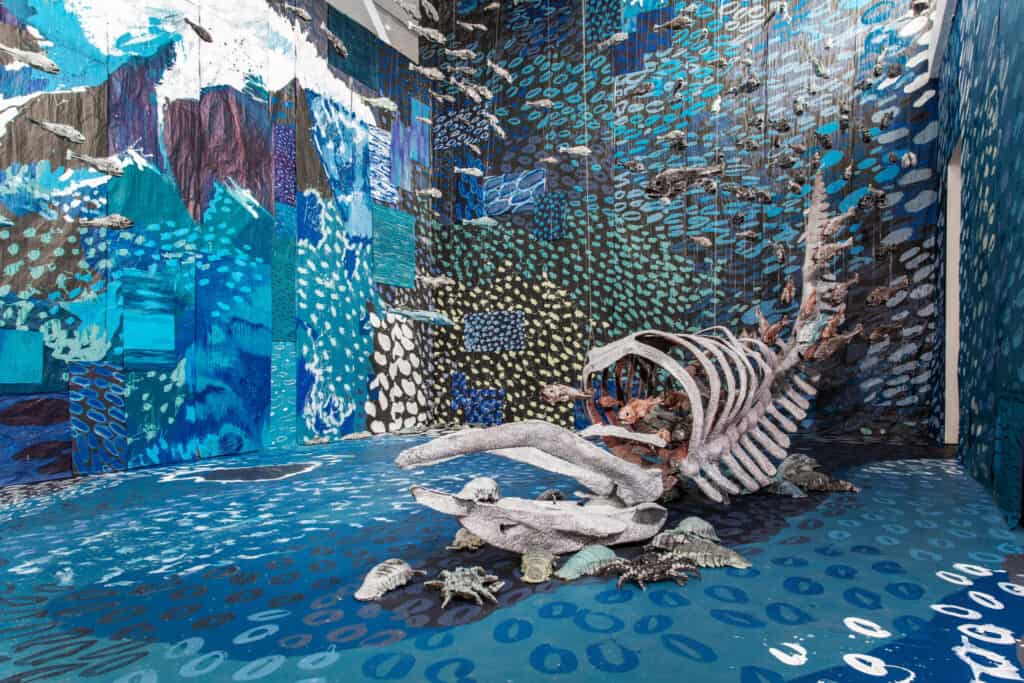
When a whale dies, it falls to the floor of the ocean and decomposes, becoming food for countless organisms, similar to the nurse logs we see here in the Pacific Northwest. We wanted this immersive installation to be something our viewers could enter into and experience as if they were walking onto the sea floor, surrounded by death providing new life. We called the show Underbelly.
As a designer and sculptor, Henry drew models of new species of fish, crab and isopods, printing them on his 3D printer, casting the positives with silicone, and then filling the negatives with a mixture of recycled paper pulp (blow-in insulation) and wax. We spent months casting these creatures, dying them different colors, creating a menagerie of decaying sea life. Once we entered the space at Oxbow, I built a false floor, painting it and the walls to create an elaborate underwater atmosphere. We suspended the hundreds of fish from wire grids on the ceiling and began fabricating a paper-maché whale directly in the space, enlisting a couple of friends to assist. Throughout the residency period we had open studio hours, where anyone from the community could enter and watch us work. After five weeks, the piece was complete. We had a closing reception and removed the entire installation the next day.
This turned out to be one of the last things we would do as a community since the pandemic hit not long after and we all needed to remain isolated. At the end of that challenging year, Henry and I were reunited with our whale, which we brought to the beach during the winter solstice, lit it on fire and watched it burn down to ash on the sand.
I learned a tremendous amount from this collaborative project and I loved every minute of it. Henry and I still see each other every day and are developing a large project for Sea-Tac Airport’s South Concourse Evolution, slated for 2034.
What has been the biggest industry change you’ve noticed since the start of your career?
I finished both my BFA and MFA without much social media presence. Instagram was not a factor in the careers of artists yet, and I did not get a smart phone until years after finishing graduate school. We had websites, but a different relationship to self-promotion. I think there are pluses and minuses to the social media phenomenon in terms of your career as a working artist. It has the potential to broaden your audience exponentially, but it can also be like trying to drink out of a firehose.
What do you still hope to accomplish?
So much! I am looking for more opportunities to collaborate and always searching for ways to build community. My studio practice is a bit “all gas, no brakes”, but I love it—it gets better and better, and easier and easier as I go. I am headed to Alaska this summer for a 6-week fellowship at a remote lodge, so I am looking forward to how that experience influences my work.
If you weren’t making art, what would you be doing?
I cannot really imagine doing anything else, to be honest. My father was a musician and I have always wanted to make music videos for other artists, but in all reality that is just a creative pull in a slightly different direction.
Follow Us

The Story Behind the Bing Cherry
A new picture book follows Ah Bing from orchard history into folklore.
Seattle illustrator Julia Kuo first came across Ah Bing in a history book. She was reading The Making of Asian America: A History when a detail caught her attention: the Bing cherry, the most popular sweet cherry in the United States and a signature fruit of the Pacific Northwest, was tied to a Chinese immigrant….

Staying in the Pocket with True Loves
The Seattle funk powerhouse heads to Jazz Alley for five soulful nights.
If you were to pull aside any casual music fan and ask them to cite quintessential Seattle music, you’d get a lot of grunge, the indie-rock explosion and folk revival of the ‘00s and ‘10s, and maybe some of the hip-hop that came bursting from the underground in the last 15 years. Your average person…

Rearview Mirror: Cool Jewels, a Record Store Relocation, and the Book the Internet Can’t Stop Talk About
Things I did, saw, ate, learned, or read in the past week (or so).
Book Buzz If you’re in certain circles of the internet—or frankly, a follower of the New York Times—you’ve probably stumbled upon the recent discourse surrounding Lindy West’s new book, Adult Braces: Driving Myself Sane. I read and enjoyed her 2016 memoir, Shrill: Notes from a Loud Woman, which essentially cemented her place in the pantheon…

Woven Wonders
Coast Salish weaving, past and present, on view at the Burke Museum.
On display now at the University of Washington’s Burke Museum of Natural History and Culture, Woven in Wool: Resilience in Coast Salish Weaving examines the traditional art form and its importance to Coast Salish communities. “This exhibition broadens the definition of American art by incorporating Indigenous voices and artistic practices historically marginalized due to biases…