
Seattle’s Prince of Plastic
Artist Anthony White’s work offers deep, and sometimes uncomfortable, cultural commentary
 By Rachel Gallaher December 9, 2022

This article originally appeared in the November/December 2022 issue of Seattle magazine.
Overheard conversation at artist Anthony White’s current exhibition at the Seattle Art Museum plays out like a zeitgeisty spoken-word soundtrack that weaves between the past and present, hitting various cultural milestones along the way.
“Is that Lindsay Lohan?” “Look, Nintendo!” “Do you notice the Greek columns?” “Ah, Lisa Frank!” The joyful cacophony is a reaction to the eight large-scale works that make up “Limited Liability,” a solo show conferred to White, along with an unrestricted cash prize, as the 2021 Betty Bowen Award winner. The annual juried honor, founded in 1977 in the name of a local journalist and arts promoter, recognizes a Northwest artist for “original, exceptional and compelling work.”
It’s an apt description of White’s artistic output. At just 28, he is already known for creating large-scale paintings layered with hundreds of pop culture symbols [celebrities such as Kim Kardashian make appearances, as do characters from video games and TV shows, luxury brand logos and internet-era references] and chock full of social commentary. “Limited Liability,” which runs through Jan. 29, is a culmination of themes White has been exploring over the past decade: consumerism, politics, art history, sexuality, vanity, and the vice-like grip of social media on our time and psyche.
Mounted on the white walls of a third-floor gallery in the museum — a round red picnic table with four attached benches provides optional seating in the center of the room — the collage-like pieces are enticing; at first glance, their bright colors and cartoonish figures belie darker thematic undercurrents.
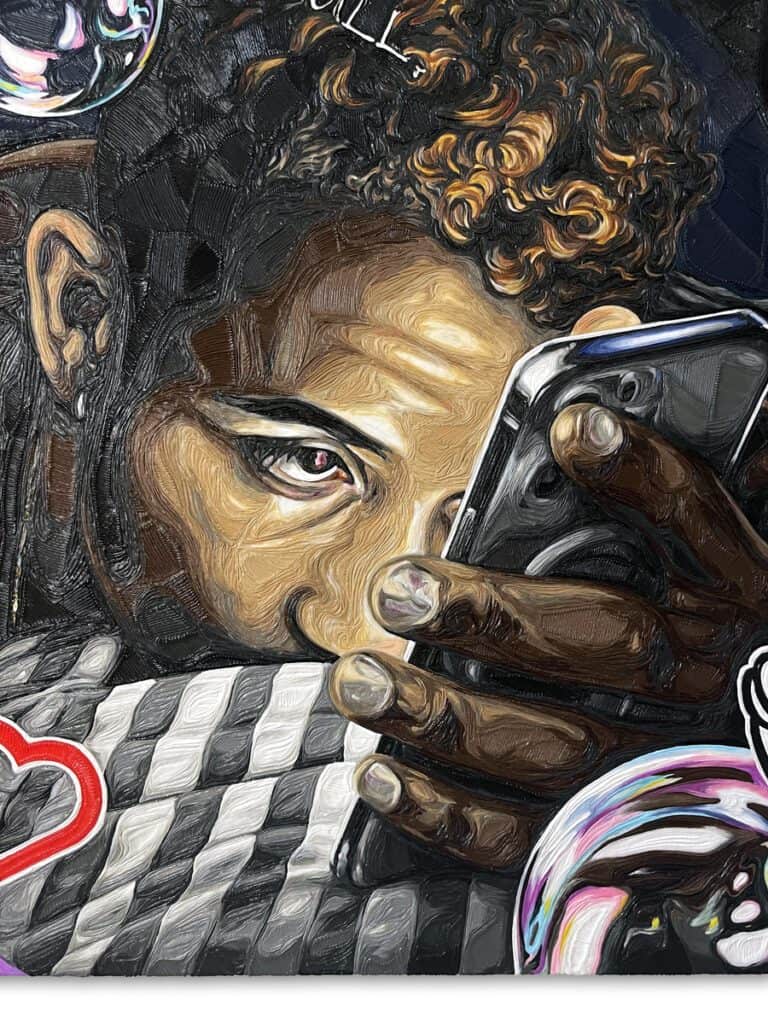
Although he calls himself a painter, White’s medium is plastic. He uses an electric pen-like tool, into which he feeds thin strands of colorful polylactic plastic, to create his drawings. The irony produced by the juxtaposition of the material’s connotations [cheap, mass-manufactured, pollutive] with the elevated history of portraiture hints at White’s nuanced artistic approach.
The “I Spy” nature of the paintings gives them a fun, gamelike quality, while the overcrowded canvases cause a sense of mental overwhelm — the work recreates the experience of navigating the full-throttle, consumeristic society we live in today. We hate ourselves for spending hours scrolling Instagram, yet we cannot put our phones down.
“That saturation of stuff we experience every single day, especially through social media and technology, that’s what I’m addressing in my work,” White says. “How all day, every day, we’re being bombarded with advertisements. Everyone is competing for your attention — all so they can try to sell you something. It’s not new, but the [methods] feel more insidious now.”
More than just a tossing-together of millennial cultural references, White’s paintings draw from a long history of artistic styles and modes. His earlier works included a lot of portraits, all featuring, as he puts it, “people from my community.” White identifies as Black and queer, and for him to elevate his subjects, who are mostly queer men, to positions historically reserved for nobility or aristocrats, is a powerful statement about who is worthy of being centered in art. Look closely at White’s work, and one can see the influence of Dutch still-life paintings, Picasso, the Impressionists and Andy Warhol.
“There are so many things that people can grab onto in my paintings,” White says, “and not just people in my age group! By providing many entry points to access the work, I hope we can have conversations around larger ideas about what it means to live today.”
Born in 1994, White has never lived in a time without computers, cell phones and video games. He grew up in Arizona, raised by parents who nurtured and encouraged his creative leanings. As a teenager, White became interested in tattoos. “My dad was covered in them,” he says, “and there was something I liked about a body telling a story of time and life with that art form.” White asked for a tattoo machine and received the gift for his 15th birthday. Soon after, his dad offered himself up, allowing White to practice line work on his body.
White enrolled at Santa Barbara City College, where he spent two years studying film before relocating to Seattle on a whim. “I didn’t know anybody in the city, but I got here and applied to Cornish [College of the Arts] the next week,” he says.
White was accepted, but the institution didn’t have a film department at the time, so he pivoted to visual art. It was here, during a sculpture lab, that White discovered 3-D printing and started to experiment with polylactic plastic, recontextualizing the material into works of art. White graduated in the spring of 2018, selling out his B.F.A. presentation and attracting the attention of local heavy-hitting gallery owner Greg Kucera, to whom he sent a cold-call email inviting him to see the show.
Kucera didn’t attend opening night, but he did see the work before it closed. Impressed with White’s fresh perspective, Kucera offered him representation, and White’s first exhibition with the gallery, 2019’s “Smoke and Mirrors,” sold out before it even opened.
A quick ascendance followed — a mix of solo and group exhibitions at the Frye Art Museum in Seattle, Sarah Spurgeon Gallery at Central Washington University, London’s Public Gallery and more — and a handful of prestigious awards have rocketed White to the forefront of the local art scene. In addition to producing his own work, White also curates shows that focus on emerging or underrepresented artists with a lesser chance of securing a platform. Curators [often older, straight white men] have long been the gatekeepers of the art world, so White’s possession of that mantle puts him in a powerful position to uplift overlooked individuals.
“You can’t ignore the way boundaries and hierarchy have impacted the art world,” he says. “Taking those two things into consideration has always been important in the way I curate.”
In addition to preparing for a February 2023 solo show at London’s Omni gallery, White will be putting together a group exhibition at Greg Kucera Gallery to open in October next year. He’s currently working on pieces for the London show — each canvas takes between 150 and 175 hours to produce — which will continue investigating ideas and themes from “Limited Liability,” as well as the ways that society shapes us.
“I’ll always be thinking about consumerism and media and how those things build our identities, or how we build our identities around what they feed us,” White says. “At the SAM show, there’s a note in one of the paintings that [says] ‘this is all just a fever dream.’ Things can seem like they mean everything in the moment, but really, they mean nothing at the end of the day.”
Follow Us

Rearview Mirror: An Oyster Party, Money for Art, and Mac & Cheese at 30,000 Feet
Things I did, saw, ate, learned, or read in the past week (or so).
We Partied for Art I love a party, and I love art, so when the Henry Art Gallery invited me to its annual fundraising gala, it was paddle’s up from the get-go. Held on the floor of Pioneer Square’s Railspur building in a space managed by Rally, Angela Dunleavy’s latest venture (read all about it…

Urban Grit Meets Wild Beauty: Inside Seattle Art Museum’s Beyond Mysticism
Seattle’s history is rooted in its fascinating juxtaposition of industry and nature, inspired by the region’s dramatic landscapes and rapidly changing cityscape. Seattle Art Museum’s current exhibition, Beyond Mysticism: The Modern Northwest, invites you to meet the artists who captured that tension and transformed it into a bold new vision of Modernism. Modernism, Made in…

Our March/April Issue Has Arrived!
Inside you’ll find Best Places to Live, a packed spring arts guide, and more stories from across the region.
The future’s bright, and so is the cover of Seattle magazine’s March/April issue! Featuring a mural by local artist (and 2023 Most Influential pick) Stevie Shao, the colorful cover is a snap from Woodinville, one of the six “Best Places to Live” featured inside. While we usually focus on Seattle neighborhoods, this year we expanded…

Supporting Roles
Three women in the Northwest are helping local artists through newly launched residencies outside of Seattle. Here, we take a look inside these thoughtfully designed spaces, and learn what drove their founders to become cornerstones in the creative community.
Iolair Artist Residency Eastsound, WA Years ago, after studying photography and earning a Bachelor of Fine Arts at the University of Washington, Pacific Northwest native Linda Lewis realized that she didn’t want to spend the rest of her life behind a camera. “The minute I graduated from school, I was far more inspired by the…