
The Queen of Neon
Bea Haverfield’s colorful signage helped define Seattle
By Brad Holden December 22, 2023

This article originally appeared in the November/December 2023 issue of Seattle magazine.
As someone who is always on the search for forgotten bits of local history, I never quite know where my research will take me. I have encountered all kinds of interesting people, in a variety of locations, leading to some truly remarkable discoveries. Perhaps one of my more memorable finds happened some years ago up in Skagit County.
It all started when I randomly stumbled upon a reference to a female artist who reportedly designed some of Seattle’s most iconic signs back in the 1940s and ’50s. Nothing substantial had been written about this person, but after some preliminary detective work, I was able to contact her surviving daughter, Kathleen Wolff, who was thrilled that someone had finally taken notice of her late mother’s work. During our initial phone conversation, she mentioned that she had possession of all her mother’s original sign sketches and invited me to see them up at her home in Anacortes. A few days later I was treated to a private viewing of some stunning artwork.
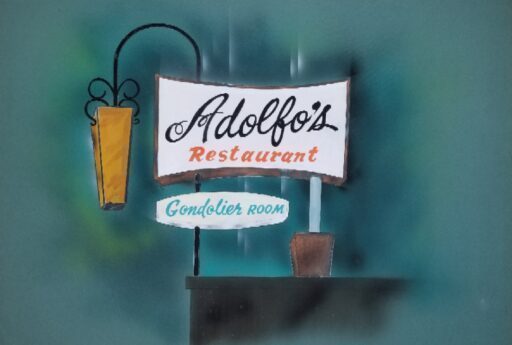
The artist of these signs was, of course, the so-called “Queen of Neon,” Bea Haverfield, whose iconic design work is recognizable across the local area. Upon my arrival, I finally had the opportunity to meet Kathleen in person. We chatted for a while, talking about her mother’s creative work, and at some point, we gathered in the living room where Kathleen pulled out a large cardboard portfolio. It had been sitting in storage for many years, and I was about to have the distinct privilege of being the first non-family member to see its amazing contents.
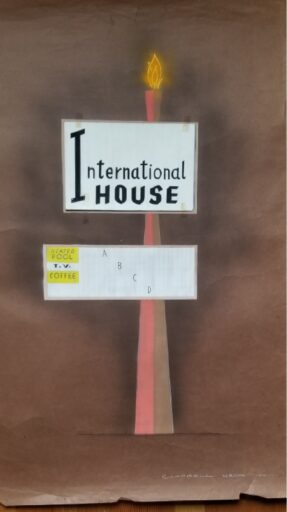
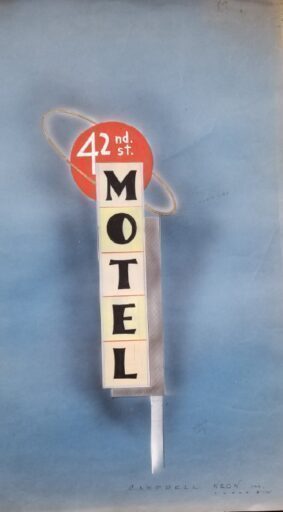
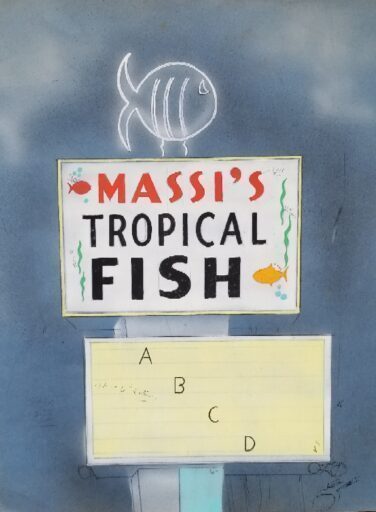
She carefully laid the portfolio down on the floor and opened the front flap to reveal a stack of large sketches dating back to her mother’s work in the 1940s. It was a remarkable visual anthology of bygone times. We spent a couple of hours flipping through the sketches that included the original designs for some well-known Seattle locations such as the Cinerama movie theater, as well as a host of old toy stores, motels, and jewelry shops. While looking through the collection, Kathleen was able to tell me more about the different chapters in her mother’s life.
During World War II, and prior to her career as a sign designer, Bea enjoyed a Rosie the Riveter phase of her life when she helped manufacture airplanes at Boeing that were being used for the war effort. After the war ended, Bea and her husband both went to work for Campbell Neon — one of Seattle’s top sign companies at the time — and for the next two decades, she would help transform Seattle with her incredible design work. As Kathleen explains, Bea had “a real fun and forward-thinking approach to signage and advertisement.”
One of Bea’s earliest jobs was designing a sign for a new fish-and-chips restaurant on the Seattle waterfront. The result was the famous Ivar’s sign that we still see today. Around the same time, she also created a sign for a newly opened surplus store that became the since-closed Seattle institution known as Chubby & Tubby. Following World War II, Seattle enjoyed a post-war economic boom and Campbell Neon’s services were in high demand. By this time, Bea had become one of the company’s lead designers and was responsible for several eye-catching signs, including one for the Hat ’n’ Boots gas station in South Seattle and a Sunny Jim Peanut Butter sign that once graced Aurora Avenue.
While many of these businesses have long since closed, a few are famously still around. These include a certain burger joint that was opened by Dick Spady in the 1950s. Bea was appointed as the lead designer for that project, resulting in the famous yellow and orange “Dick’s Drive-In” sign that can be seen at locations across the city. The cursive font used in that sign is Bea’s own elegant handwriting.
Soon after, Bea would design her most famous work — the rotating Elephant Car Wash sign that once illuminated the corner of Battery Street and Denny Way. The sign was important to Bea not just on a professional level, but on a deeply personal one, too, as the sign included four smaller elephants at the base that were a tribute to her four children. It eventually became one of the most recognizable and photographed landmarks in Seattle, appearing in commercials, TV shows, and even a few movies. Sadly, the longtime car wash closed in 2020, though the famous sign went to Seattle’s Museum of History and Industry (MOHAI), where it now joins other classic neon such as the Rainier ‘R’ and the Washington Natural Gas blue flame sign.
In the 1960s, Bea was involved in a serious car accident in which she sustained various injuries affecting the use of her hands, and her career as a sign artist sadly ended abruptly. A few years later, though, Bea accepted a job at South Seattle College, which unexpectedly granted her a new lease on life. Bea’s work at the school allowed her daily interaction with many of the young students, and before long, she quickly became a beloved maternal-like figure amongst the student body.
At the time, there were many antiwar and civil rights protests taking place across the city, which Bea started to become more involved in through her role at the college. She felt strongly about equal rights for all and that the war in Vietnam was a grave mistake, and began attending local demonstrations in support of these beliefs. She even joined some of the students on a cross-country train ride to participate in a large anti-war march in Washington, D.C.
In 1970, after a particularly raucous demonstration in front of downtown’s Federal Courthouse, members of the Seattle Liberation Front were placed under arrest after a grand jury indicted them on charges of “conspiracy to incite a riot.” They would famously become known as “The Seattle Seven,” and all the theatrics of the subsequent trial would become forever etched in local history. When they were first arrested, though, it was Bea who attempted to bail them out of jail by putting her house up as collateral.
Overall, this was a very rewarding time for Bea, providing her with a much-needed purpose in the second half of her life. While her earlier years were spent transforming the city through her design work, her later years helped to inspire transformation through social advocacy. Bea would later pass away in 1996, though her spirit lives on through her iconic signage that continues to illuminate our local streets.
Brad Holden is an amateur historian and is the author of two books: “Seattle Prohibition: Bootleggers, Rumrunners and Graft in the Queen City,” and “Alfred M. Hubbard: Inventor, Bootlegger and Psychedelic Pioneer.” Check out his Instagram page @seattle_artifacts for more interesting tidbits about Seattle’s history.
Follow Us

Rearview Mirror: An Oyster Party, Money for Art, and Mac & Cheese at 30,000 Feet
Things I did, saw, ate, learned, or read in the past week (or so).
We Partied for Art I love a party, and I love art, so when the Henry Art Gallery invited me to its annual fundraising gala, it was paddle’s up from the get-go. Held on the floor of Pioneer Square’s Railspur building in a space managed by Rally, Angela Dunleavy’s latest venture (read all about it…

Urban Grit Meets Wild Beauty: Inside Seattle Art Museum’s Beyond Mysticism
Seattle’s history is rooted in its fascinating juxtaposition of industry and nature, inspired by the region’s dramatic landscapes and rapidly changing cityscape. Seattle Art Museum’s current exhibition, Beyond Mysticism: The Modern Northwest, invites you to meet the artists who captured that tension and transformed it into a bold new vision of Modernism. Modernism, Made in…

Our March/April Issue Has Arrived!
Inside you’ll find Best Places to Live, a packed spring arts guide, and more stories from across the region.
The future’s bright, and so is the cover of Seattle magazine’s March/April issue! Featuring a mural by local artist (and 2023 Most Influential pick) Stevie Shao, the colorful cover is a snap from Woodinville, one of the six “Best Places to Live” featured inside. While we usually focus on Seattle neighborhoods, this year we expanded…

Supporting Roles
Three women in the Northwest are helping local artists through newly launched residencies outside of Seattle. Here, we take a look inside these thoughtfully designed spaces, and learn what drove their founders to become cornerstones in the creative community.
Iolair Artist Residency Eastsound, WA Years ago, after studying photography and earning a Bachelor of Fine Arts at the University of Washington, Pacific Northwest native Linda Lewis realized that she didn’t want to spend the rest of her life behind a camera. “The minute I graduated from school, I was far more inspired by the…