
Blueprints for Building Community
After tragedy struck a local restaurateur family, one of their daughters stepped in to complete the design for her brother’s unfinished home.
By Sean Meyers November 17, 2025

This article originally appeared in the September/October 2025 issue of Seattle magazine.
Although he was just 35 when a heart attack took his life, Khoa Pham’s imprint on Seattle’s international district was such that the city quickly designated April 21 as a memorial day in his honor. With his rescue pitbull, Pinky, by his side, Pham cut a colorful figure through Little Saigon and became well known for his passionate advocacy for the neighborhood, its people, and its businesses. The CFO of the venerable Pho Bac restaurant empire, Pham worked tirelessly to help competing cafe owners get and stay on their feet. He also made a mark on the community’s architecture, both commercial and residential.
Pho Bac was founded in 1982 by Pham’s parents, Theresa Cat Vu and Augustine Nien Pham, who had owned a coffee shop and other businesses in Saigon before the Sino-Vietnamese War forced them into a refugee camp in the Philippines. After arriving in Seattle, the couple spent two years saving money, and despite having neither a bank account nor credit, managed to purchase a building at the corner of Rainier and Jackson, opening a cafe that sold American-style sandwiches, convinced that most locals would be uninterested in Vietnamese food.
Seattle’s small but persistent expatriate community eventually convinced the entrepreneurs to offer pho bac, a hearty bone-marrow-steeped noodle soup that originated in northern Vietnam. Since no one else was selling the one-dish wonder locally, the Phams were dubbed “Seattle’s First Family of Pho.” Along came five children—Khoa and four sisters—three of whom earned economics or finance degrees and spent a generation growing the business.
Pho Bac’s flagship restaurant had long sailed rudderless on the high seas of uncertain architecture, having spent previous lives as an ice cream shop and a real estate office.
At some point, a boat-shaped attachment—formerly part of a float in the 2004 Vietnamese Catholic Church parade—was stitched on, creating the eatery’s iconic profile. Judging from the long lines awaiting service, customers of the fast-casual, James Beard-semifinalist restaurant didn’t mind the shopworn linoleum and quaint letterboard menu. But in a rage against complacency, Khoa rallied his sisters and led a mission-defining, glittery remodel of the landmark officially dubbed the Boat.
Energized by the renovation, Khoa was ready to tackle his next project—a forever home just a few blocks away in the Leschi neighborhood. The 1,000-square-foot building he planned to convert opened in 1927 as a studio for Louise Crow, one of Seattle’s first female impressionist artists, who lived with her family next door. In the 1940s, the studio evolved into a Baptist church, and decades later, Khoa Pham spent years eyeing the property before purchasing it in 2016. He was still in the early design stages when he passed in 2021, and his sister, Quynh-Vi, inherited the home.
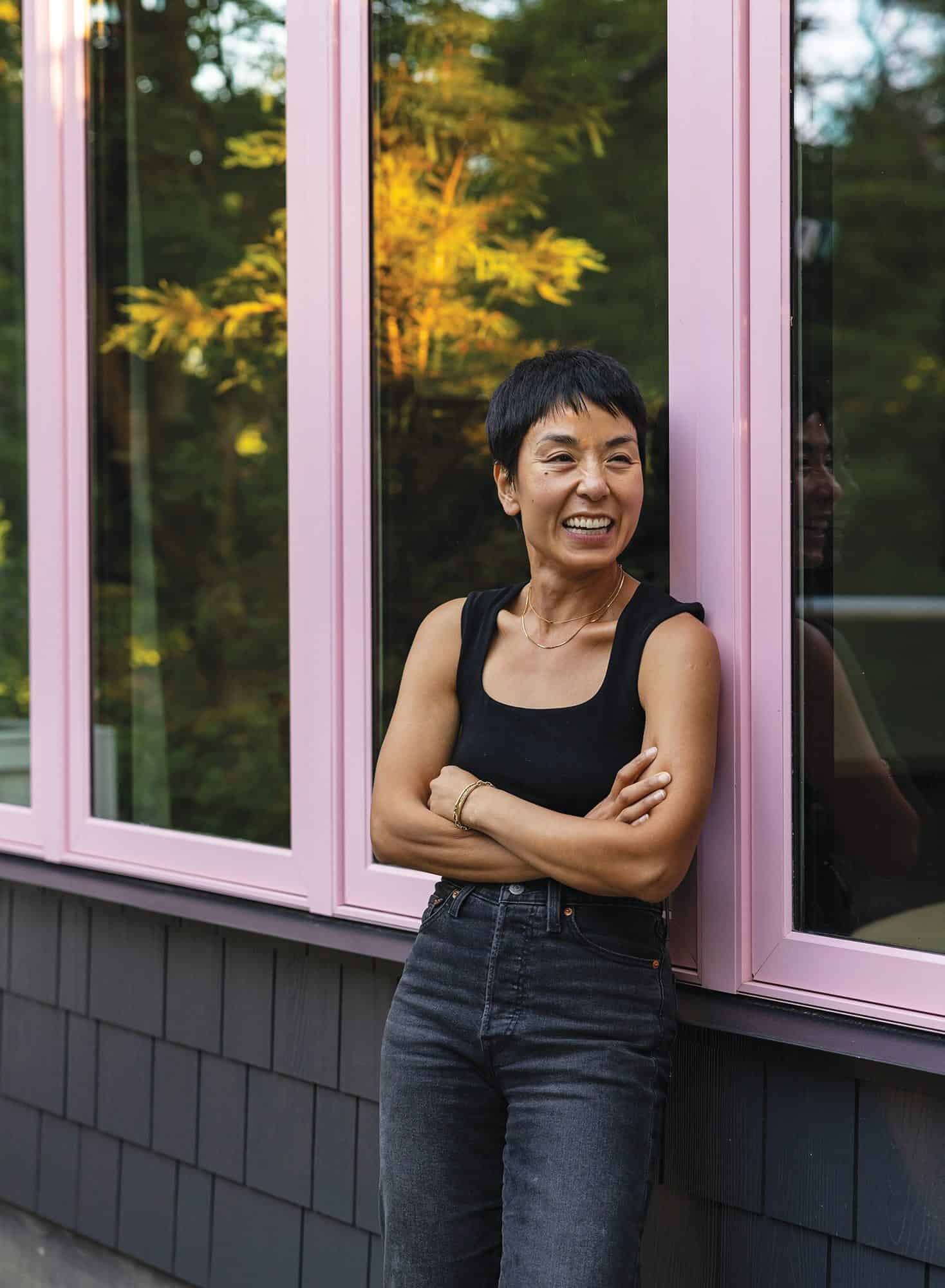
“He was a bachelor, so he was thinking of maybe a long stairway up to a bedroom loft,” she says. “He had painted the trim around the front window as a nod to the color theme of the restaurants. He was shooting for pink, but it turned out more like fuchsia.”
Like her brother, Quynh-Vi loves bringing people together. She needed more space for a primary residence but didn’t want to erase the former studio’s century of accrued charm and provenance. Since the lot was tiny, measuring just 2,835 square feet, any expansion would require a tricky bit of planning.
For help, Quynh-Vi turned to SHED Architecture & Design, a firm with an office that sits caddy-corner to the Boat, where its architects have refueled for decades.
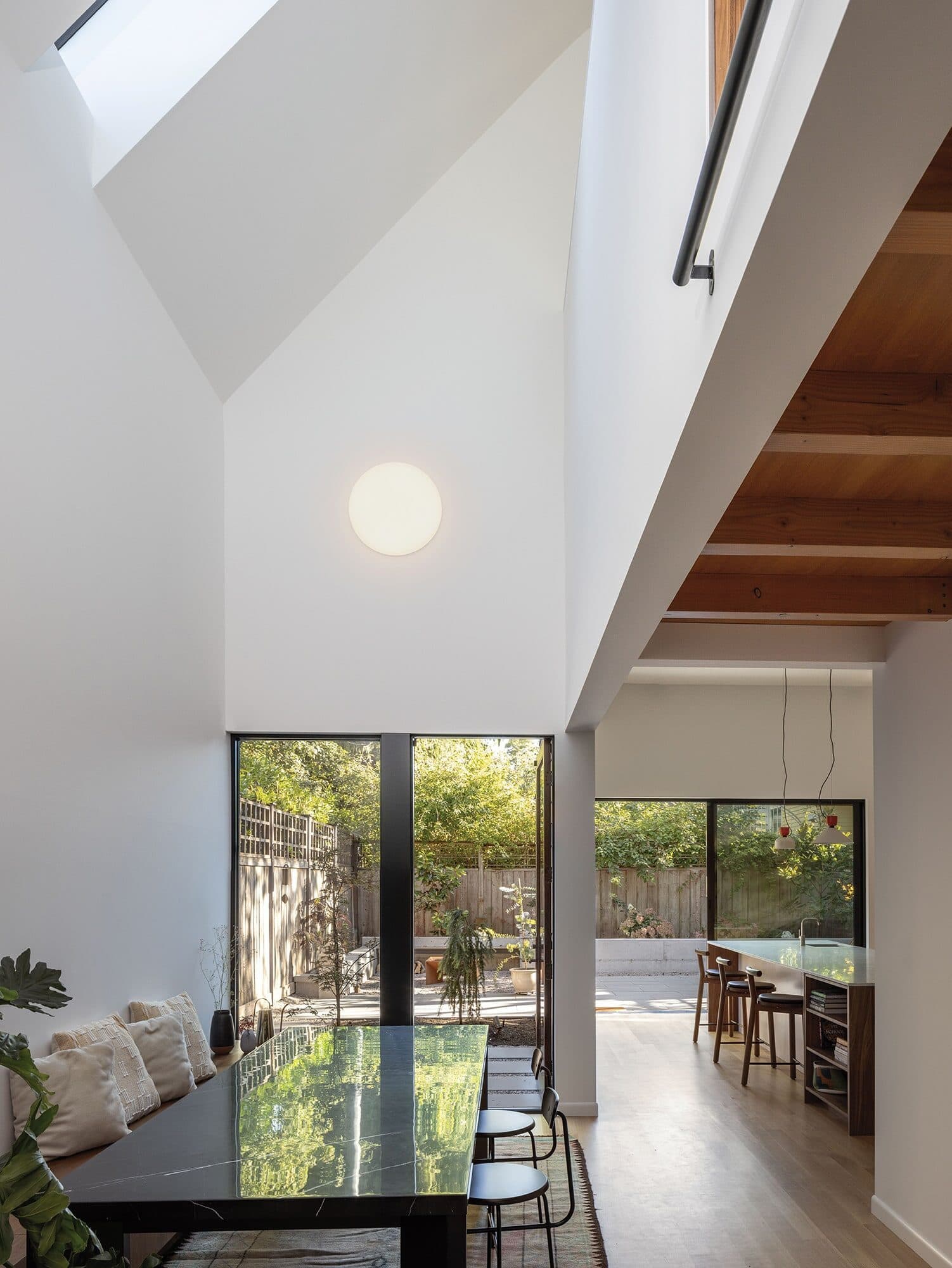
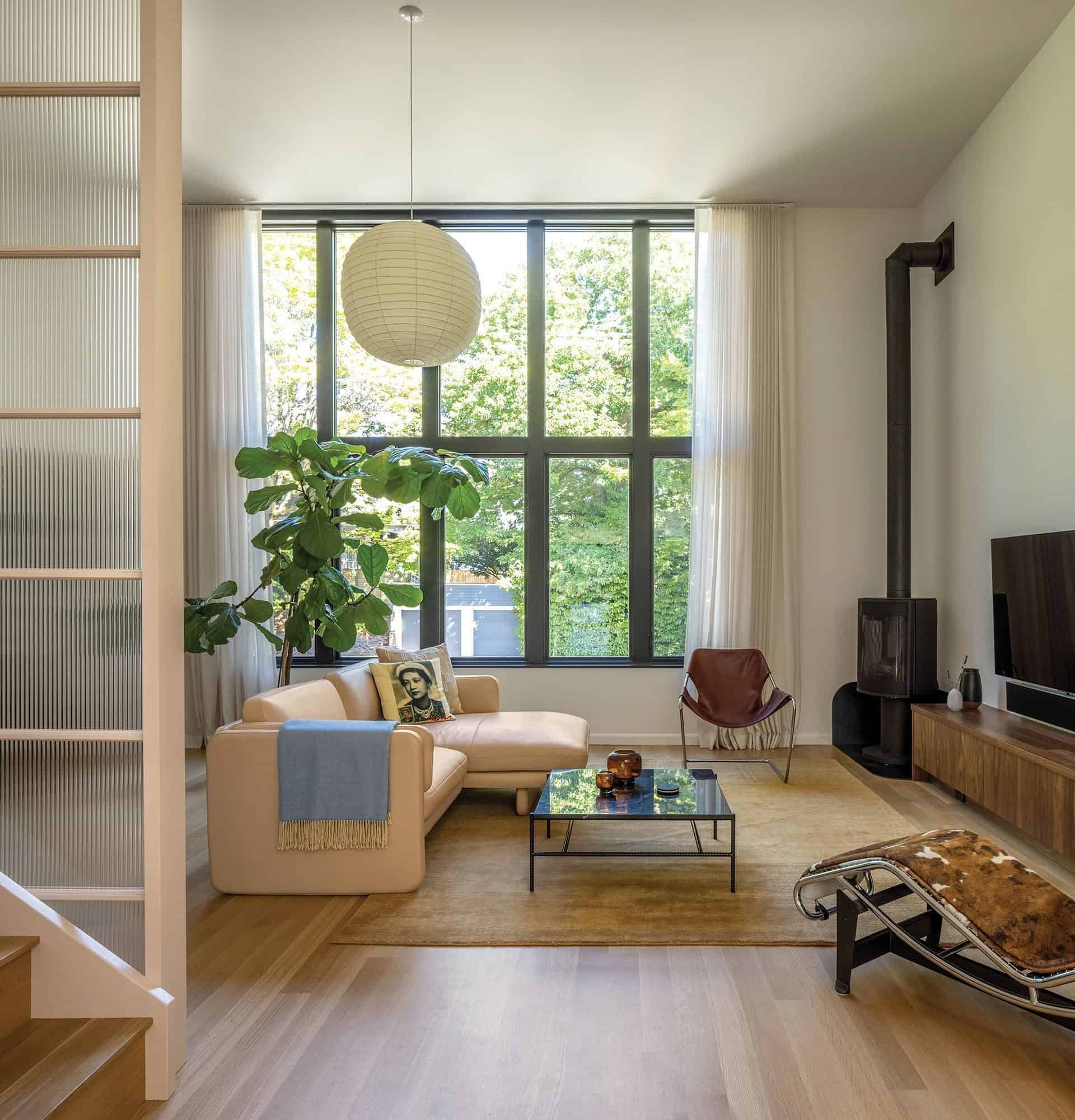
The home is a good example of how Seattle continues to transform, layering personal history, cultural legacy, and creative reuse within its evolving neighborhoods, explains Rebecca Marsh, SHED’s lead architect on the project. “Sitting in our offices, we see Quynh-Vi walk each day from her home to her business,” she says, “and we are reminded of what the neighborhood means to her family, and what her family has meant to the neighborhood.” Despite the meager-sized lot—and numerous daunting zoning restrictions—SHED cooked up a clever two-story, 1,858-square-foot floor plan that is modern, relaxed, welcoming, and eclectic, with a layout that creates new connections from the interior to the street, yard, and sky, including mountain views.


The kitchen and adjacent dining room form the unsurprising social hub of the restaurateur’s home, with the former featuring Space Theory cabinets in a dusty-rose color, a plumbed-in La Marzocco espresso machine, and a 12-foot-long counter punctuated with a beverage sink, where guests tend to loiter in hopes of being stung by a “Quynh Bee,” a blend of Song Cai floral Vietnamese gin, jasmine silver needle tea-infused honey, lemon juice, and a cinnamon flower. (While sister Yenvy is the cook of the Pho Bac partnership, Quynh-Vi is the master mixologist.)
Out of respect for the structure’s history, the overall design is a bit more conservative than Quynh-Vi’s personality might suggest. (She, like the rest of her family, doesn’t take herself too seriously.) To add a little humor and creative flair, SHED suggested playing with the first-floor powder room. Here, dark wallpaper depicts dragons locked in mortal combat and there is an unexpected look for the loo. “I always wanted a black toilet,” Quynh-Vi admits, going on to describe her “office” as the most useful room in the home. “It’s really for the dogs,” she says of her two Pomeranians, Charlie and Louie, “and the wine.”’

As the project drew to a close, she mused with the architects about how many guests she might comfortably accommodate. “I said, ‘Maybe I should host your holiday party,’” she recalls of the social and spatial experiment. “I did, and 30 people attended.”
For Quynh-Vi, the most meaningful result of the remodel is the house becoming a hub for her closely connected family. Theresa and Augustine, who recently returned from a visit to Vietnam and spend much of their time gardening, help with animal care, as does Yenvy, who lives nearby. Battle-tested and fiscally liquid, the Pham sisters are leveraging the softer post-pandemic market for commercial leases and expanding again.
Quynh-Vi often reflects on the changing nature of the neighborhood as she walks to work. “Today it’s denser,” she says. “There are so many more apartments, and there aren’t many empty lots. It feels like a more vibrant community.”
Follow Us

Your Land, Your Legacy: A New Way to Build at Suncadia
For those who believe that where you live should reflect how you live and how you’ll be remembered Suncadia invites a deeper kind of ownership. It’s an opportunity to create a home that is entirely your own, on some of the most desirable homesites in the Cascades, while benefiting from the ease, support, and long-term…

Settling In, Not Just Moving In: How Seattle Newcomers Find Their Footing
Photos courtesy of Royalty Moving & Storage Seattle. Explore: Seattle Relocation Resources Moving to Seattle is rarely just about transporting belongings from one address to another. For many newcomers, it marks the beginning of learning a city that operates on its own terms, shaped by distinct neighborhoods, changing weather, and an unspoken culture that locals…

Coasting Into Calm
After purchasing a weather-worn, ant-infested cabin on an Oregon beach, a Seattle couple hires a regional team to transform it into a stylish weekend retreat.
When architect Andrew Montgomery first pulled up to his clients’ house in Arch Cape, Oregon, there were logs in the driveway, courtesy of the sizable swells that come with the coast’s king tides. At just 28 feet above sea level and as close as you can get to the water without being on the beach,…

Tuft Stuff
Tuft Ruft turns fiber art into a social, hands-on experience in Pioneer Square.
It all started with a bout of pandemic boredom. Like many, when COVID-19 hit, recent graduate Carrie Xiao found herself stuck at home, with extra time on her hands. One day, while scrolling social media, she discovered tufting: a textile manufacturing technique that creates a garment or rug with a “pile,” or raised surface. After…