
I’ve Completely Slept on Shibuya HiFi
The Japanese-style listening bar is an absolute must-visit for music lovers.
 By Rachel Gallaher November 28, 2025

Every once in a while, I stumble upon something in Seattle that I either didn’t know about or knew about but didn’t experience for months (or years), and become completely, can’t-stop-telling-people obsessed with it. Some examples include the Lonely Siren bar, Kraken games, and Lagree Pilates.
My latest discovery is Shibuya HiFi, the Japanese-style listening bar in Ballard. Yes, I know it’s not new (the spot celebrated its two-year anniversary in September), but somehow I had not made it in yet. My fiancé surprised me a few weeks ago with a dinner date followed by a late spinning of the Arctic Monkeys’ 2013 album, AM. I wasn’t sure what to expect—I’d been to a listening bar in Tokyo—but the absolute reverence for sound here (no shoes and no drinks allowed in the lounge to prevent inevitable, distracting beat-tapping) creates a next-level experience.
Opened by hospitality industry mainstays Brian Rauschenbach and Quentin Ertel, Shibuya Hi-Fi plays between two and five albums a night, five days a week, in a purpose-built listening lounge with top-tier equipment, much of it sourced through Hawthorne Stereo. I’m no audiophile, but as soon as the smoky, groovy guitar riff of the first track of AM exploded out of the speakers, I felt transported: this wasn’t just another night sitting around someone’s living room tossing on records—it was a visceral, collective listening session. From that first song, I was hooked.
“We studied vinyl bars and jazz kissa concepts from Japan, but many of them still function as traditional bar settings with conversation and socializing,” says Rauschenbach, who has been a DJ for over 30 years and owns upwards of 18,000 vinyl records. “We wanted something different. Our vision was to create a true third space—communal, yes, but focused entirely on the music. A place where people with a shared love for an artist or album can experience it together, or where someone curious about music discovery can hear the stories behind the recordings. It’s about unplugging, getting grounded, and being fully present.”
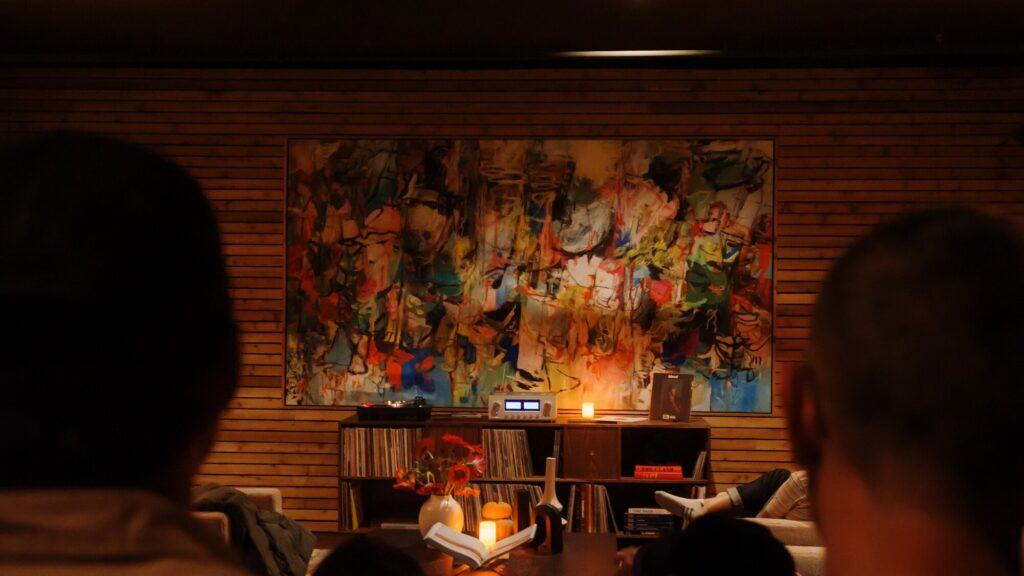
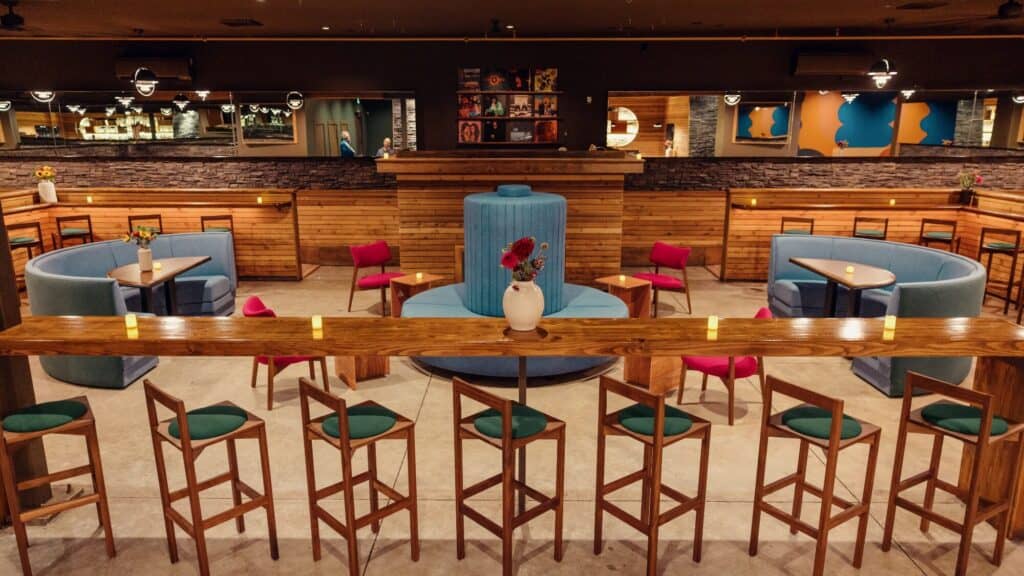
Part of the magic is the décor—warm-toned wood walls and floors, upholstered seating options (chairs, sofas, booths), and a giant hand-knotted rug underfoot. Above a low shelf holding hundreds of records and the turntable, hangs an abstract painting by local artist Christy Hopkins, who found inspiration for the piece in Miles Davis’ album Kind of Blue.
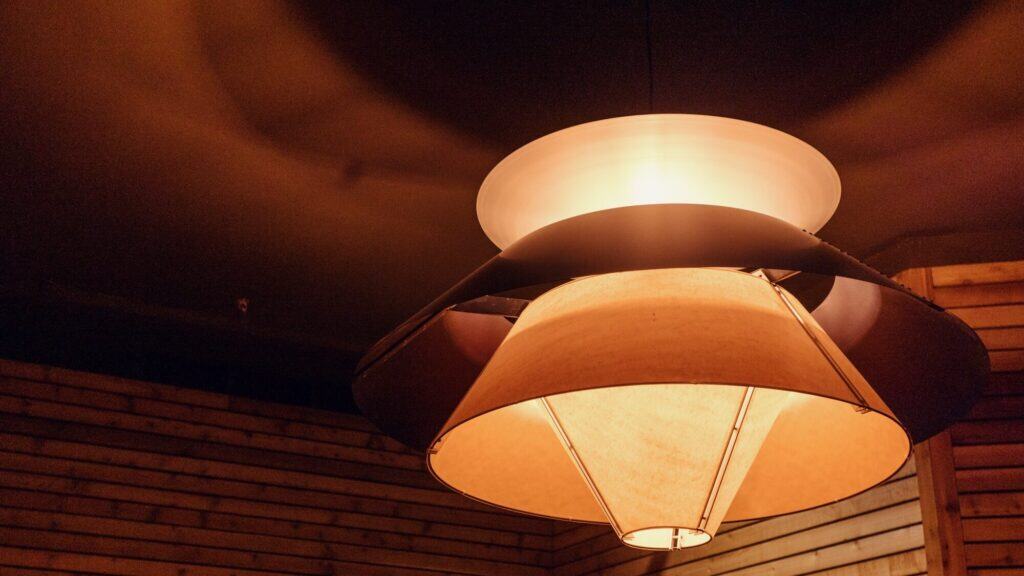
“It can take some musicians a year—sometimes longer—to make a record,” says Ertel, who has an interior design studio and crafted the listening room’s décor scheme. “An incredible amount of thought, effort, and resources go into what you’re listening to. My goal with the HiFi Room was to create a space that elevates listening to a level that honors the effort of the artist—and music in general.” He notes that the two oversized chandeliers, by Danish designer Louis Poulsen, used to hang in Benaroya Hall. “There are only ten in the world, and the only two in use are in the HiFi Room. To be around them is as special as it is to listen to an artist’s music—on vinyl.”
Of course, the real star here is the sound system, which features a pair of 1976 Klipschorn speakers, a Technics SL-1200G turntable with an Audio Technica AT-OC9XSH Stylus, and a Luxman L-505uXII amplifier. It sounds like a lot of letters and numbers, but for the uninitiated (myself included), all you need to know is that it makes music sound incredible. You can hear the layers, the warmth, the individual instruments in a way that cannot be achieved on run-of-the-mill equipment. It’s like sitting in on a live recording session—and it’s vulnerable. The music overwhelms in a way that allows you to tumble into your own slipstream of memories and emotions. People are bobbing, swaying, tapping out beats in the air. Eyes are closed, some heads lowered and lost in the story of whichever LP is making its loops. Take a look around, and everyone has slipped into their own world, yet the room is connected by music.
“Every time I’ve played a Marvin Gaye album, someone in the room gets emotional—triggered by a memory or experience,” says Rauschenbach. “I’ve cried in that room too, hit by a certain song or lyric when I wasn’t expecting it. That’s the beauty of what we’ve created: it’s a safe and protected space where our guests can be vulnerable. Music does that—it opens us up. We just created a room worthy of that experience.”
Back to those Klipschorn speakers—they have a local backstory. When Rauschenbach and Ertel decided they wanted a pair, they went to Hawthorne to ask them to keep an eye out for any that might come onto the market. The timing was serendipitous: a pair of Klipschorns had just arrived on consignment from Robert Entrop Jr., the son of Bob Entrop, the longtime Pacific Northwest distributor for Klipsch speakers.
“The story behind these speakers is incredible,” says Rauschenbach. “They were built by Paul Klipsch himself, and the legend goes that Paul, a licensed pilot, flew these speakers out to Bob personally. They lived in Bob’s home on Whidbey Island from 1976 until we purchased them. We really feel like we’re the ambassadors of these speakers now.”
I could go on and on, but in this case, all I have to say is go to Shibuya HiFi. It’s one thing to read about an experience, and another altogether to have that experience yourself. My fiancé and I have been back since our initial visit (for Doechii’s Alligator Bites Never Heal) and are already looking at our schedules to plan another return. We’ll likely never have Klipschorn speakers in our home, but as a testament to the power of good music listened to as the artists intended, we’ve already paid a visit to Hawthorne to look at turntable upgrades.
Tickets to a listening session are $21; see the December record schedule here.
Follow Us

Nordic Pop Comes to the Nordic Museum
An afternoon concert brings Seattle singers, strings, and percussion together for a dreamy midwinter dance party.
January in Seattle is a mood. The light is thin all day, and by midafternoon it starts to collapse into night. It’s the time of year when any plan that involves leaving the house has to earn its keep. This is where Nordic Pop comes in. On Sunday afternoon, January 18, Seattle musician and producer…

How a Local Teen Explained Auto-Tune to the World
High school senior Jason Zhou is among 30 teens recognized for a standout science explainer video.
A two-minute film on the math behind Auto-Tune has put 17-year-old Jason Zhou of Redmond in the running to win the Breakthrough Junior Challenge, an international contest where students explain complex scientific ideas with clarity and creativity. The challenge is open to students ages 13 to 18, and each video must come in at two…

Whitney Mongé’s Next Verse
The Seattle singer-songwriter who honed her craft busking at Pike Place Market is finding new creative ground in Nashville.
It’s a time of intense self-discovery for Whitney Mongé. “I’ve been playing guitar for a long time, but Nashville has forced me to become a better player,” says Mongé, fresh off her first full-band show at Analog at Hutton Hotel in Nashville. For the 38-year-old artist, the move to Tennessee caps a stretch of constant…

Finding Hope in Music
Twelve-year-old Emmy Cole of Puyallup turns her experience with cancer into a song that inspires.
James Cole can’t help but gush over his twelve-year-old daughter, Emmy. “She consistently amazes us,” says Cole of the tween who was just two years old when she was diagnosed with high-risk neuroblastoma. “We couldn’t be more proud of the young woman that she’s becoming. She unfortunately had to grow up a little too fast,…