
Rethinking Mental Health Post-Pandemic
A new normal: increased awareness and reduced stigma
By Danny O’Neil August 19, 2024

This article originally appeared in the July/August 2024 issue of Seattle magazine.
I am the one out of every five Americans who received mental-health care in the past year.
I wouldn’t say that I’m proud of this fact, but I’m not at all embarrassed by it, either. In fact, I’m more sheepish about having high cholesterol than I am about the fact that I spend an hour every week talking to a therapist. I first sought treatment in 2004. I began taking medication to treat depression in 2009. Three years ago, I resumed weekly meetings with a therapist because I was having a hard time with, well, quite a number of things, actually.
I had spent more than a year working remotely at that point and was feeling detached, less engaged. I was also preparing to leave a job I’d held for eight years. The fact that we’d experienced a global health crisis that had me wiping down my groceries with disinfectant to prevent the spread of Covid probably didn’t help, either.
I was struggling. I still am to a certain extent, and I’m not alone in that regard. “There has been a sharp increase in people seeking psychotherapy,” says Dan Crystal, a clinical psychologist in Seattle. “I think this has a lot to do with the pressures we all feel. Everything from anxieties around the pandemic to disorientation in the work-at-home versus work-in-the-office arrangements, as well as the rise in tech addiction.”
More Americans than ever are seeking help with mental-health conditions, partially because of the rapid rise in telehealth sparked by the pandemic. The National Health Interview Survey found that more than 19% of U.S. adults received mental health treatment in the past 12 months. This is a good thing in the sense that people are recognizing that caring for their mental health is just as much a part of their overall well-being as caring for their physical health.
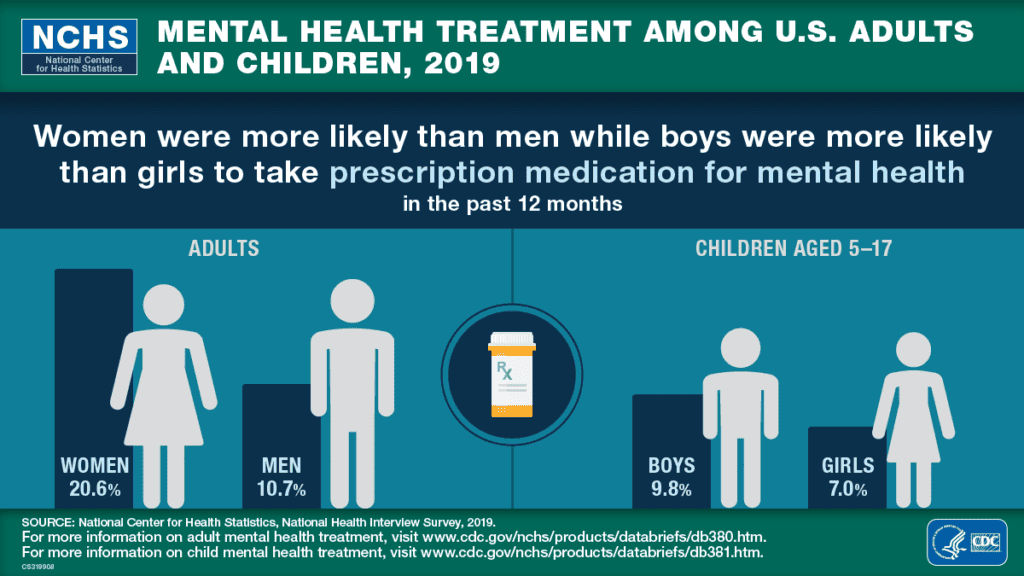
However, the fact that more people than ever are seeking help is also indicative of just how many people are hurting right now. The pandemic has been, at the very least, a uniquely disruptive event in our world. For many, it has been traumatic and downright tragic. We’ve all been affected to some extent, so it shouldn’t be surprising that so many of us are encountering these difficulties. That doesn’t make it any easier, though.
“Feeling overwhelmed and general burnout has greatly diminished people’s overall resilience and ability to cope with what we used to think of as ‘typical stresses’ in life.” – Brenna Bond, Licensed Mental Health Counselor
Sometimes it’s hard for people to even pinpoint what it is they’re struggling with, says Brenna Bond, a licensed mental-health counselor with an office in West Seattle: “The uptick that I’m seeing is that people are struggling with trying to identify what they’re struggling with. People are more disconnected from themselves.”
This tends to result in increased levels of anxiety and depression, which is exactly what providers are seeing.
“Through the pandemic, one of the things that we noticed was an increase in anxiety disorder, depression,” says Linda Coombs, executive director of behavioral health at UnitedHealthcare Community Plan of Washington. “I wouldn’t call it mild and moderate conditions, but historically with Medicaid, we focused on members with severe mental illness. There’s an increase in service needs for people who are now experiencing heightened levels of anxiety and depression, suicidal ideation along with substance use disorder.”
Ron Lehto began working as a mental-health specialist in the mid ‘80s. Now the chief business officer for Community Integrated Health Services, he still sees children and families as part of his weekly workload. In working with students over these past few years, he’s seen the need for mental-health care expand in the wake of the pandemic.
“We saw a lot of children. They weren’t adjusting to being back in the classroom,” Lehto says, “and they were also showing heightened levels of depression and anxiety, and these are children that had no mental-health history. This wasn’t the children that we were assisting before Covid. They were new children to the system.”
Common mental disorders diagnosed in childhood include ADHD, anxiety, and behavior disorders. A recent report from the National Center for Health Statistics found that 16.5% of children between the ages of 12 and 17 experienced a major depressive episode in the past year. Thirty-two percent reported anxiety after viewing their social media.
Kids aren’t the only ones who’ve been affected by the logistical changes of these past four years, and the truth is we don’t know the full weight of the impacts from the social isolation and economic uncertainty that we experienced. We’ve all been impacted to various degrees, and that adds to the reality that life wasn’t exactly easy before Covid-19 came along. Now we’ve had to stretch and strain to adapt to the changes wrought by the pandemic. That has taken its toll.
“All of this depleted energy,” Bond says. “Feeling overwhelmed and general burnout has greatly diminished people’s overall resilience and ability to cope with what we used to think of as ‘typical stresses’ in life.”
It’s why so many have sought help, and while I wouldn’t characterize anything as being a bright side to this situation, it is encouraging that we are getting better as a society when it comes to seeing mental health as a component of our overall well-being.
“I do think there has been an improvement in that,” says Thomas Patamia, a psychiatrist with Virginia Mason Franciscan Health. “More of an awareness and acceptance that this is an important part of our health in general, and it should be valued just as we value other parts of our health like our heart health and it’s equally as important and equally valid.”
The challenge is to increase the level of acceptance across the board.
“I really think of health equity,” Coombs said. “There are populations where they’re very open to the idea that this is just part of my health. I need to get the help when I need the help. It impacts both sides, but there could be a different group of people that have different life experiences and backgrounds that it’s still a huge stigma for them in accessing mental-health services.”
And even as we get better about understanding the importance of mental health, the needs are growing. The pandemic changed us in ways that we are just beginning to realize, and the providers in our region are adapting to provide the assistance that is critical.
“There’s so much innovation and motivation,” Coombs said, “to figure out, ‘How do we do better? How do we help people more? How do we get out there what these resources are?’
“I do feel optimistic that — especially in the state of Washington where there’s a lot of focus on behavioral health, which isn’t the same in every other state — we get the opportunity to really try to do our best work.”
How To Get Help:
If the situation is life threatening or it appears someone may be hurt, call 9-1-1.
The national suicide and crisis lifeline is 9-8-8.
If there is no immediate physical danger, call Crisis Connections: 206- 461-3222 or 866-427-4747. This is the best way to connect to local crisis-response services.
If you have health insurance and are seeking to access in-network care, one often-overlooked resource is to call the telephone number provided on your health insurance card. Your insurance company should have resources to direct you to mental-health resources.
Additionally, Psychology Today is a good reference for looking up therapists, psychologists, and counselors.
Follow Us

Floating with Friends
The benefits of sauna go beyond the physical, and Seattle’s newest wellness experience—which glides around the waters of Lake Union—equally taps into the non-tangible positives.
It only took a few minutes to settle in before I knew—these are my people. I met Emma Griffith, one of the founders of Wild Haus Floating Saunas, on a crisp, clear, late-summer morning to chat about the project she helped start last January. In simple terms, the team of eight created two saunas on…

Dog of the Month: Charlie
A would-be space traveler with a complicated legal history.
Charlie is about 10 months old, though his foster parent describes him as an “old soul.” He loves being around people and other dogs, but his social calendar has been limited after an unfortunate encounter with a skunk before he was found just outside Yakima. He is also the recipient of a lifetime ban from…

The Neighborhood Gym Effect
Inside Seattle Strength and Performance’s small-group training model and welcoming approach to fitness.
On a regular Seattle Wednesday morning, a little wet and dreary, I walk into a small gym feeling unsure of what I’ve gotten myself into. It’s late January, a time when many New Year’s resolutions are failing and motivation to keep exercising may be going out the window. I work out consistently—lifting weights, going to…

I Experienced a Skincare Treatment on the World’s Most Expensive Bed
A Hästens pop-up is currently running at Penelope and the Beauty Bar.
Last week as I was heading out the door for an appointment at Penelope and the Beauty Bar—the spa inside the Fairmont Olympic Hotel—my fiancé yelled up the stairs, “You better not fall in love with that mattress!” I was on my way to experience the spa’s Oxygen Dome Facial as part of a pop-up…