
The Secret Lives of Spiders
A new Pacific Science Center exhibit asks visitors to trade fear for fascination.
 By Sarah Stackhouse October 30, 2025

Every year, spiders kill about 20 people worldwide. That’s fewer than scorpions, lightning strikes, or hippos—and a tiny fraction of the 17.9 million deaths caused by cardiovascular disease. Yet spiders might still be the creatures we fear most.
Pacific Science Center’s new exhibition, Spiders: From Fear to Fascination, aims to change that. Created by the Australian Museum, the show opened last week and invites visitors to step past their reflexive shudder and see spiders for what they are: essential, complex, and surprisingly beautiful.
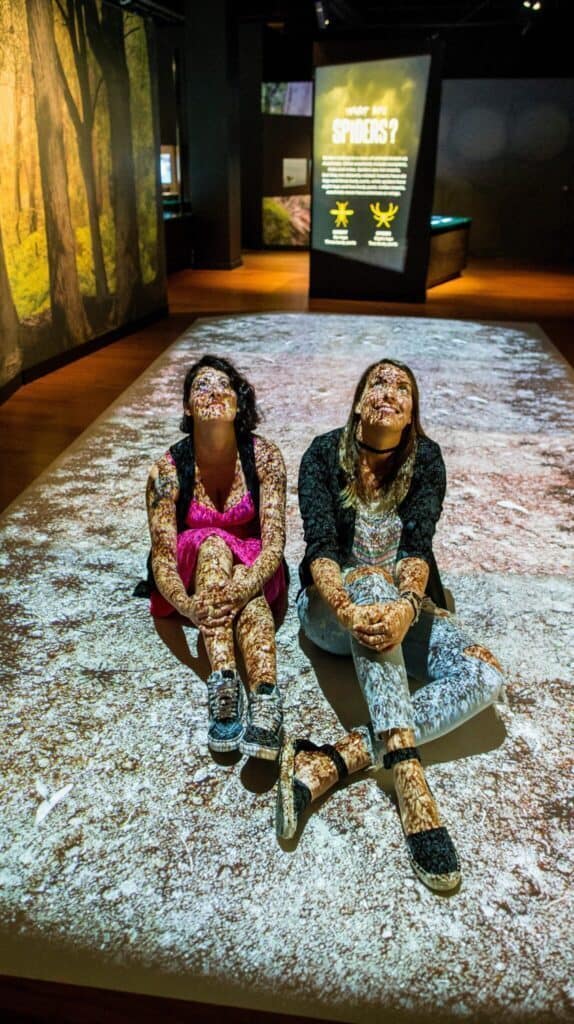
The exhibit is fully immersive, with live and preserved spiders, large-scale models, interactive experiences, and video installations. You can trigger an augmented-reality floor where virtual spiders scuttle at your feet, or try out the male peacock spider’s elaborate courtship dance yourself. Or, if you’re brave enough, you can get so close to living spiders that you feel the little hairs on your neck rise, and still find yourself wanting to know more.
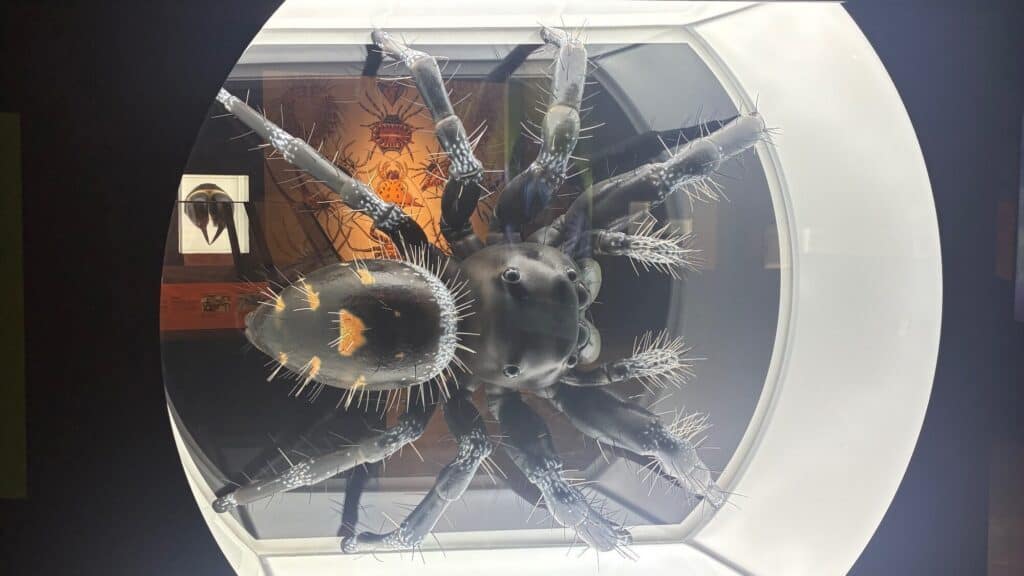
“I am so excited for our guests to have an opportunity to observe the incredible collection of live spiders on exhibit,” says Hannah Held, Pacific Science Center’s Living Exhibits manager. “The specimens highlight the wide range of spiders and allow us to look closer into what makes them so special. It is a truly unique opportunity to observe the behaviors, habits, and instincts of these remarkable creatures.”
Displays with living spiders highlight species like the Carolina wolf spider, yellow garden spider, and desert blond tarantula—each accompanied by bilingual panels describing how they hunt and burrow. Another display shows real molted tarantula skins. You can see the fragile shells, complete with leg holes where the spider pulled itself free, growing slightly larger with each shed. And a fossilized Talbragaraneus jurassicus, one of the oldest spiders ever found, connects the exhibit to the ancient world.
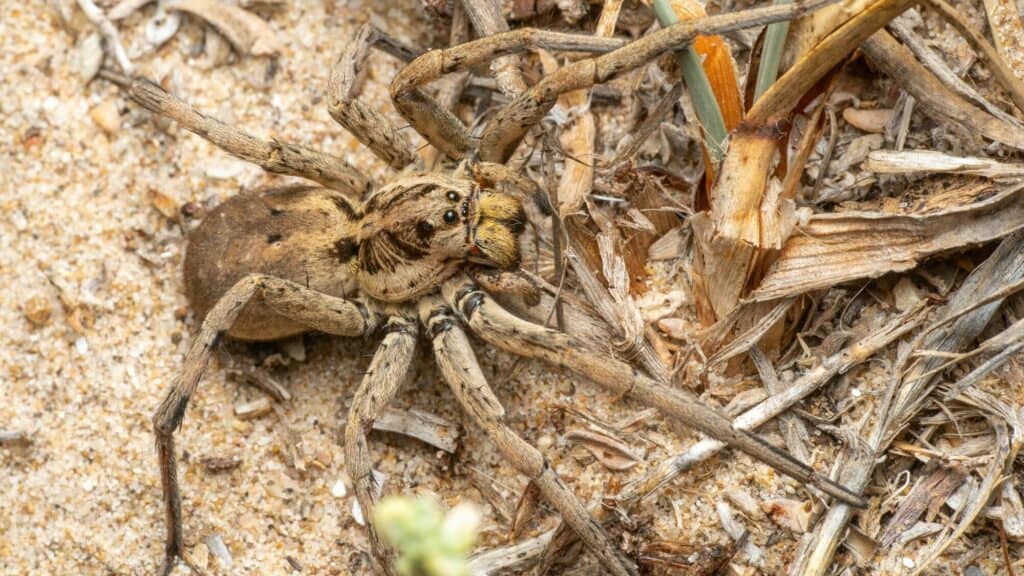
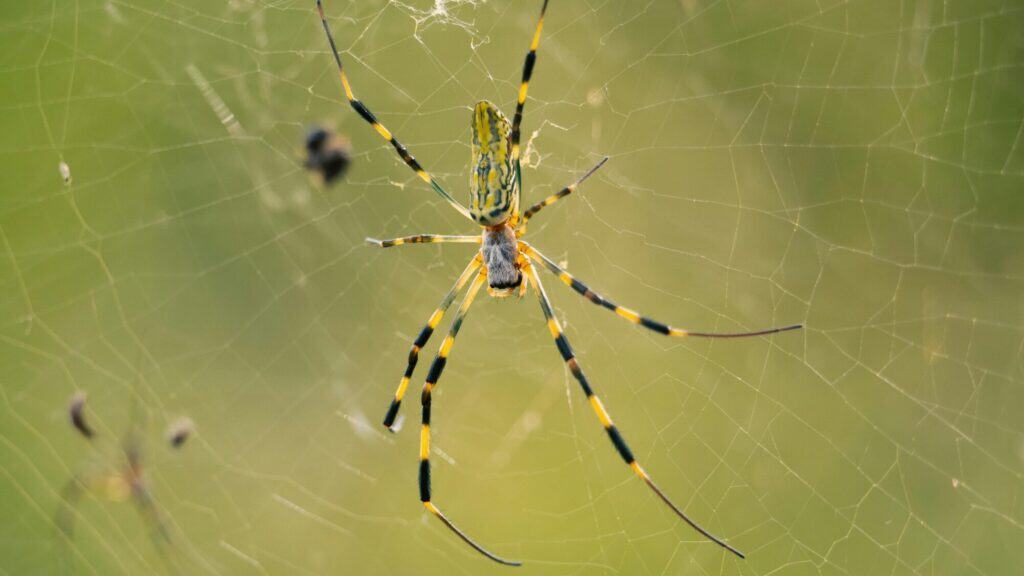
“For being such small critters, spiders have a huge reputation,” she says. “Most of us have been taught to fear spiders since childhood, and there are a lot of spider myths passed down through generations. Also, they’re fast, hairy, have eight legs, and at least six eyes. This exhibit provides a safe space to look closer. There is a whole spider world out there that we don’t get to see up close. When you aren’t being taken by surprise by an unexpected spider, you are able to be curious. When you take the fear out of the situation, spiders truly are fascinating.”
One of the most moving elements is a video showing a mother black lace-weaver spider feeding herself to her young. It’s an extraordinary act known as matriphagy. Another video comes from the Australian Bush Doctor program, where a Ngangkari healer describes using spider medicines in traditional healing, illustrating how spiders have long been part of both science and culture.
“It’s a strong exhibition and it hadn’t been shown in this part of the country before,” says Peggy Monahan, Pacific Science Center’s vice president of exhibits. “Seattle certainly has a lot of spiders, especially this time of year! This exhibit is a great opportunity for people to learn more about these creatures.”
The show also points to spiders’ growing scientific relevance. Researchers are studying spider venom and silk for their potential in medicine, sustainable textiles, and bioengineering. Some studies show orb-weaver silk has tensile strength comparable to (or in some tests greater than) steel of the same diameter.
“Spiders eat other kinds of bugs and are an important part of the ecosystem,” Monahan adds. “It helps us to know about them and recognize the role they play. That’s the way it is with science, isn’t it? There’s so much to learn about almost anything if you look closely enough.”
Visitors learn that spiders have been on Earth for hundreds of millions of years—long before the first dinosaurs appeared. And if you’ve ever heard one of those local legends about hobo spiders in Seattle, you might want to stop by before repeating it because the exhibit has a few surprises waiting on that front.
After walking through, you might find it harder to panic about the next eight-legged roommate that appears in your bathroom. Take a deep breath and try a catch-and-release. Spiders do plenty of good like, keeping other bugs in check, and like us, they’re just fascinating creatures trying to survive.
The exhibit runs through April 2026 at Pacific Science Center. General admission includes the spider show: adults $10, children $7 (special pricing through November 20).
Follow Us

Driftwood Dreams
Cascadia Art Museum uncovers the lost Surrealist who spent 40 years painting in Seattle.
One of the most compelling parts of Objects of the Elements: The Art of Elsa Thoresen at Cascadia Art Museum in Edmonds is a display case filled with the actual pieces of driftwood artist Elsa Thoresen used as source material, mostly in the 1930s and ’40s. They’re ordinary enough at first glance—knotted and gnarled by…

Sound To Summit: AANHPI Voices Rising in Seattle
Celebrate AANHPI Month in Seattle with art and cultural events
From the ornate pagodas in the International District to Japanese style-gardens, the influence of Asian and Islander cultures is visible across Seattle. Since its earliest days, Asian, Pacific Islander, and Native Hawaiian immigrants have been an inseparable part of Seattle’s fabric, influencing its cuisine, architecture, local businesses, and art scene. Just a decade after the…

Empowering Students through Photography | Sponsored
The arts are an important part of youth and education. Art teaches us to look at the world beyond ourselves and at the beauty of everyday occurrences around us and within each other. Started by high school photography instructors, the Washington State High School, Photography Competition (WSHSPC), believes all children should have the opportunity to speak…

Michael Nicoll Yahgulanaas’ ‘Carpe Fin’ Tells Its Story at Seattle Art Museum
Commissioned by SAM, the new piece is a 6-by-19-foot watercolor mural condensing a Haida folktale into one immense color-drenched panel
This article appears in print in the November 2019 issue. Click here to subscribe. Sensing an affinity between the iconography of his First Nation art tradition and the boldness and sweep of the Japanese film/graphic-novel visual style known as manga, Haida visual artist and British Columbia resident Michael Nicoll Yahgulanaas combines the two—“committed to,” as he puts it,…