
How a Local Teen Explained Auto-Tune to the World
High school senior Jason Zhou is among 30 teens recognized for a standout science explainer video.
 By Sarah Stackhouse December 5, 2025

A two-minute film on the math behind Auto-Tune has put 17-year-old Jason Zhou of Redmond in the running to win the Breakthrough Junior Challenge, an international contest where students explain complex scientific ideas with clarity and creativity. The challenge is open to students ages 13 to 18, and each video must come in at two minutes or less.
Zhou, a senior at The Bear Creek School, chose Auto-Tune because it brought together the things he loves most: art and science. He’s been making videos since middle school, so creating one for the challenge came naturally. “Since I had to do a video about science, I wanted to connect it to something that I like doing,” he says. “Film and music—they’re art forms that are super technology-based. The science just makes it possible.” He makes his own music and spends hours tinkering in GarageBand and Logic, where Auto-Tune first caught his ear.
The math behind it is called the Fourier transform—a calculation that turns a sound wave into its individual frequencies—and it was completely new to him. He downloaded research papers and watched videos to teach himself the concept. Besides learning how Auto-Tune works, Zhou discovered that the Fourier transform is used outside of music. “Even though Auto-Tune is like a musical instrument, the science behind it is used in everyday life,” he says, noting that the same concept underpins how radio stations identify frequencies.
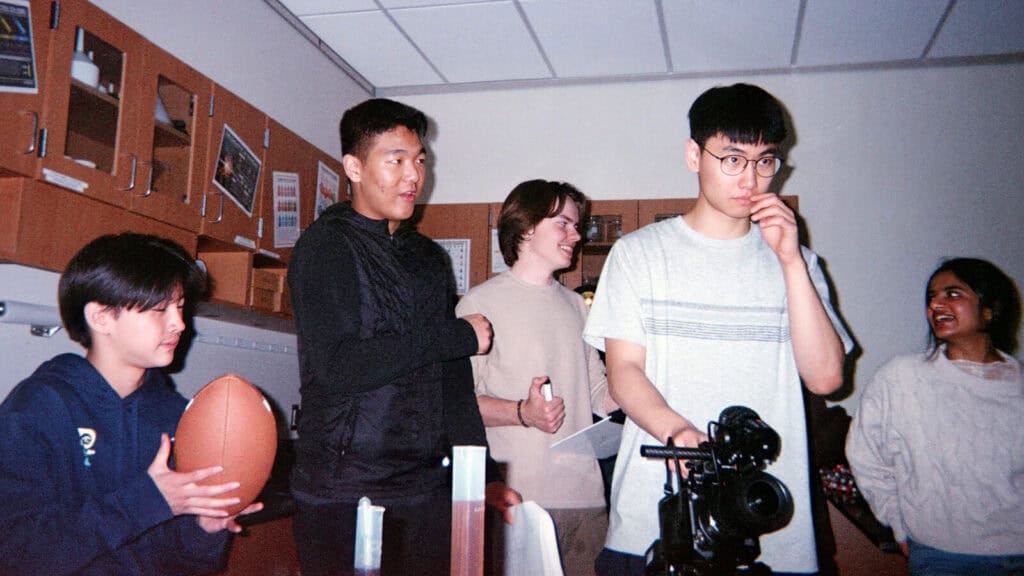
He filmed the entire video on his own with his green screen and edited it himself. It’s easy to follow and funny. Zhou says humor is really important to him and has always been part of how he works. “Comedy has this aura of not having much substance, but it has so much potential to say things.”
Right now Zhou is applying to colleges that let him combine art and technology. USC’s Iovine and Young Academy is high on his list, along with Brown University. He wants to keep making films, as he has since middle school (he cofounded a filmmaking club that now includes about 20 classmates), but he’s careful about how it fits into his future. “Film, it’s kind of like my baby,” he says. “I want to have fun doing it and not turn it into a profession.”
This year marks the 11th year of the Breakthrough Junior Challenge. Last year’s competition drew more than 2,300 applicants. After a mandatory peer-review round and a panel evaluation, the submissions are now narrowed to 30 semifinalists. Among those videos is one that explains thermodynamics through the question, “Why can’t we have a microwave that instantly makes things cool?” Another focuses on CAR T-cell therapy and how immune cells are reprogrammed to treat certain cancers. You can view all of them here.
The contest is now in its Popular Vote round. Likes on the Breakthrough Facebook post of each video, plus likes on the matching YouTube post, determine which entry advances straight to the finals. Zhou’s video is posted on both platforms for anyone who wants to support him. Voting is open through December 9. The winner receives a $250,000 scholarship, $50,000 for their teacher, and a $100,000 science lab for their school.
When he talks about the possibility of winning, Zhou says, “It’s a really big scholarship for anyone,” and the idea of a new science lab for his school makes him grin. “That’d be so cool.”
Follow Us

Nordic Pop Comes to the Nordic Museum
An afternoon concert brings Seattle singers, strings, and percussion together for a dreamy midwinter dance party.
January in Seattle is a mood. The light is thin all day, and by midafternoon it starts to collapse into night. It’s the time of year when any plan that involves leaving the house has to earn its keep. This is where Nordic Pop comes in. On Sunday afternoon, January 18, Seattle musician and producer…

I’ve Completely Slept on Shibuya HiFi
The Japanese-style listening bar is an absolute must-visit for music lovers.
Every once in a while, I stumble upon something in Seattle that I either didn’t know about or knew about but didn’t experience for months (or years), and become completely, can’t-stop-telling-people obsessed with it. Some examples include the Lonely Siren bar, Kraken games, and Lagree Pilates. My latest discovery is Shibuya HiFi, the Japanese-style listening bar…

Whitney Mongé’s Next Verse
The Seattle singer-songwriter who honed her craft busking at Pike Place Market is finding new creative ground in Nashville.
It’s a time of intense self-discovery for Whitney Mongé. “I’ve been playing guitar for a long time, but Nashville has forced me to become a better player,” says Mongé, fresh off her first full-band show at Analog at Hutton Hotel in Nashville. For the 38-year-old artist, the move to Tennessee caps a stretch of constant…

Finding Hope in Music
Twelve-year-old Emmy Cole of Puyallup turns her experience with cancer into a song that inspires.
James Cole can’t help but gush over his twelve-year-old daughter, Emmy. “She consistently amazes us,” says Cole of the tween who was just two years old when she was diagnosed with high-risk neuroblastoma. “We couldn’t be more proud of the young woman that she’s becoming. She unfortunately had to grow up a little too fast,…