
Underground Overhaul
Going low solves couple's woes
By Sean Meyers June 12, 2025

This article originally appeared in the May/June 2025 issue of Seattle magazine.
The Seattle underground is alive and well and living in Montlake, a close-knit community in more ways than one.
Dense suburban charm is what lures many families to Montlake. Dense suburban charm is also what forces many families to leave Montlake.
“The lots here are very small, with setback and height restrictions,” says architectural designer and local resident Tamara Engel.
The affluent Montlake neighborhood is an important sanctuary for historic Tudor revival homes. The National Parks Service estimates that 27% of the neighborhood’s homes are century-old Tudors, making it the predominant style.
Think of a Tudor revival home as a Victorian home that got into the cooking sherry. The movement arose in the U.S. in the 1890s as a nod to the rustic English Tudor cottages of the 1500s, and as a pushback against more starchy vernaculars. Tudors are distinguished by their eccentricity and asymmetry. No two Montlake Tudors are exactly alike, even in blocks built by the same developer.
Since they were mostly constructed in the roaring late 1920s, Tudors are sometimes called stockbroker homes. Their popularity, however, plunged with the markets. A typical Tudor has a steeply pitched roof and dominant front-facing gable; decorative half-timber framing; arched doorways; patterned or clinkered large chimneys; and tall, narrow window groups.
Chock-blocking zoning restrictions make expanding up or down the only viable options for many Montlake families experiencing growing pains. Kirt Debique and Ann Marie Mentis ended up doing a little of both. They loved the neighborhood and their storybook 1927 home, which featured old-growth mahogany trim, leaded glass windows and plaster walls, but faced form and function challenges.
“We were storing kitchen items in an unfinished basement, bathroom items in a hallway nook, and clothes in various rooms, given the limited closet space,” Mentis says. “There wasn’t a home for shoes and coats. Typical Tudor living.”
Their existing basement ceiling was just over 6 feet, common for the era but not for Montlake, where most are closer to a luxurious 8 feet.
“We decided to raise the entire house to elevate the finished basement,” she adds. “The extra square footage provided us with a mudroom, office, full bathroom, family room, and we even snuck in a small fourth bedroom. It’s a walk-out basement with high ceilings. I think it’s time we stopped calling it a ‘basement.’ It’s essentially our first floor.”
The couple engaged Engel, a friend and neighbor, to develop an expansion plan that preserved the historic face of the home. Its cedar lap siding was restored to last another 100 years, and the back of the second floor was subtly bumped to add a new primary bedroom.
As Engel says, “When I do a project in a historic neighborhood, my goal is for someone to walk by and never know that a remodel was done.”
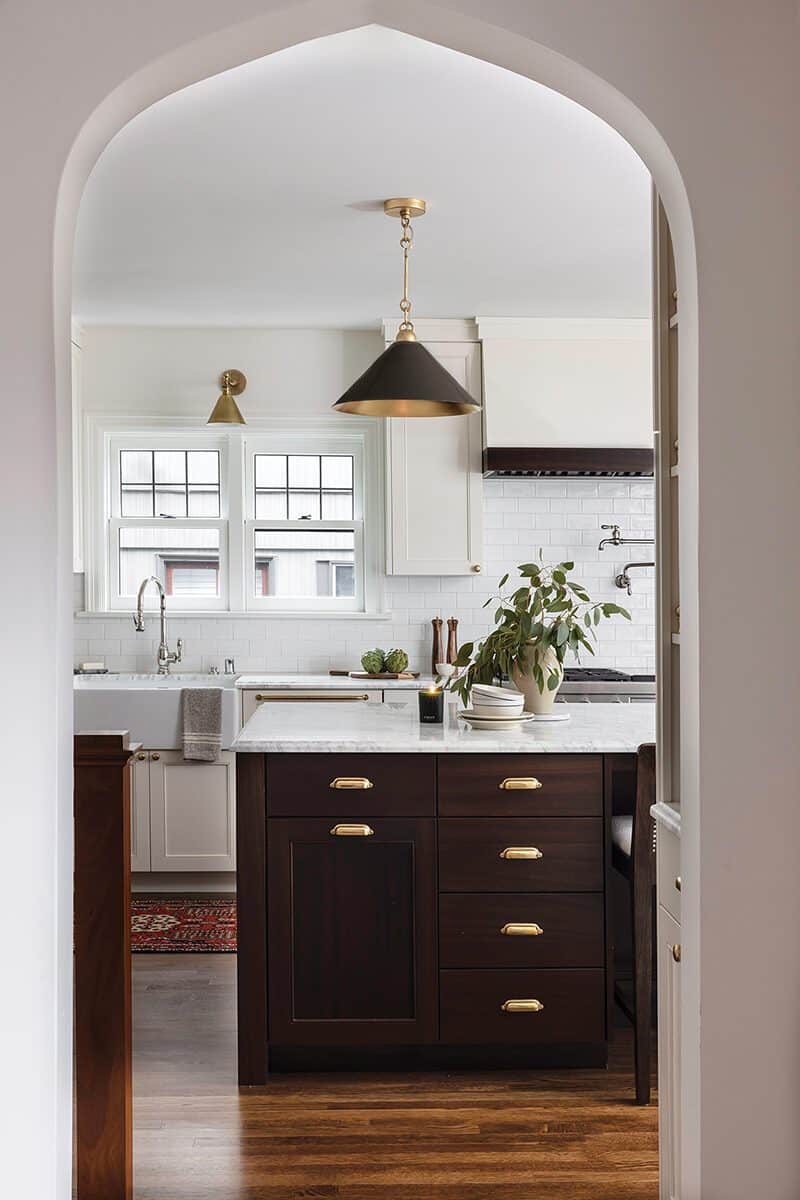
Tudor interior design is by definition a moving target. The tricky business of blending new world functionality with old world charm fell to Jennifer Gardner Design. In the kitchen, the stove had been isolated on a wall across from the basement stairs. The room’s flow was further interrupted by an oddly shaped peninsula. “They both love to cook, but they were tripping over each other,” Gardner says.
Two-hundred square feet was added, allowing for a large anchoring island, three cooking/prep stations and seating for guests. Calacatta gold marble countertops and custom cabinets were commissioned. Ferguson Plumbing Supply provided unlacquered, living finish brass and nickel fixtures.
Mentis researched vintage lighting (Rejuvenation and Visual Comfort) extensively, with Gardner advising on scale and finish.
The important matter of high-end ranges was thoroughly vetted. The best candidates seemed to sort themselves into opposing camps, often contradictory camps — high performance or high style. They chose high performance, a six-burner, dual-fuel Wolf.
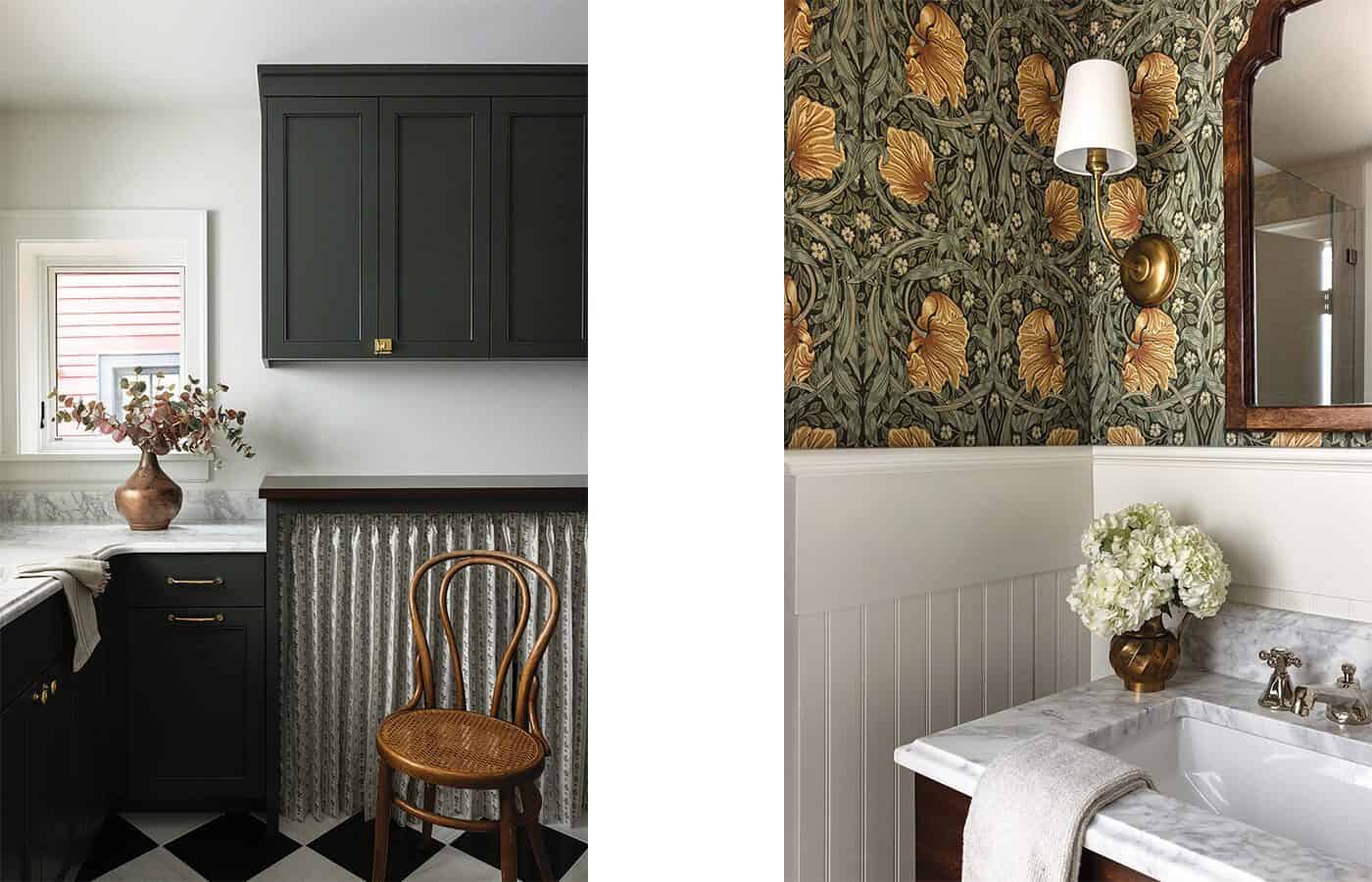
The kitchen is Debique’s favorite room, while Mentis cheerfully banishes herself to the bright and fully appointed underworld, where even the gruffest old-school Tudor owner might find solace after a hard day of routing peasants. Calming amenities include an elegant new bath with English floral garden wallpaper (William & Morris).
The main draw is the mudroom, which features marble countertops, black and white marble floors, green cabinets, a pink Dutch door that opens to the backyard, and the much anticipated and desperately needed beautiful cafe-curtained storage.
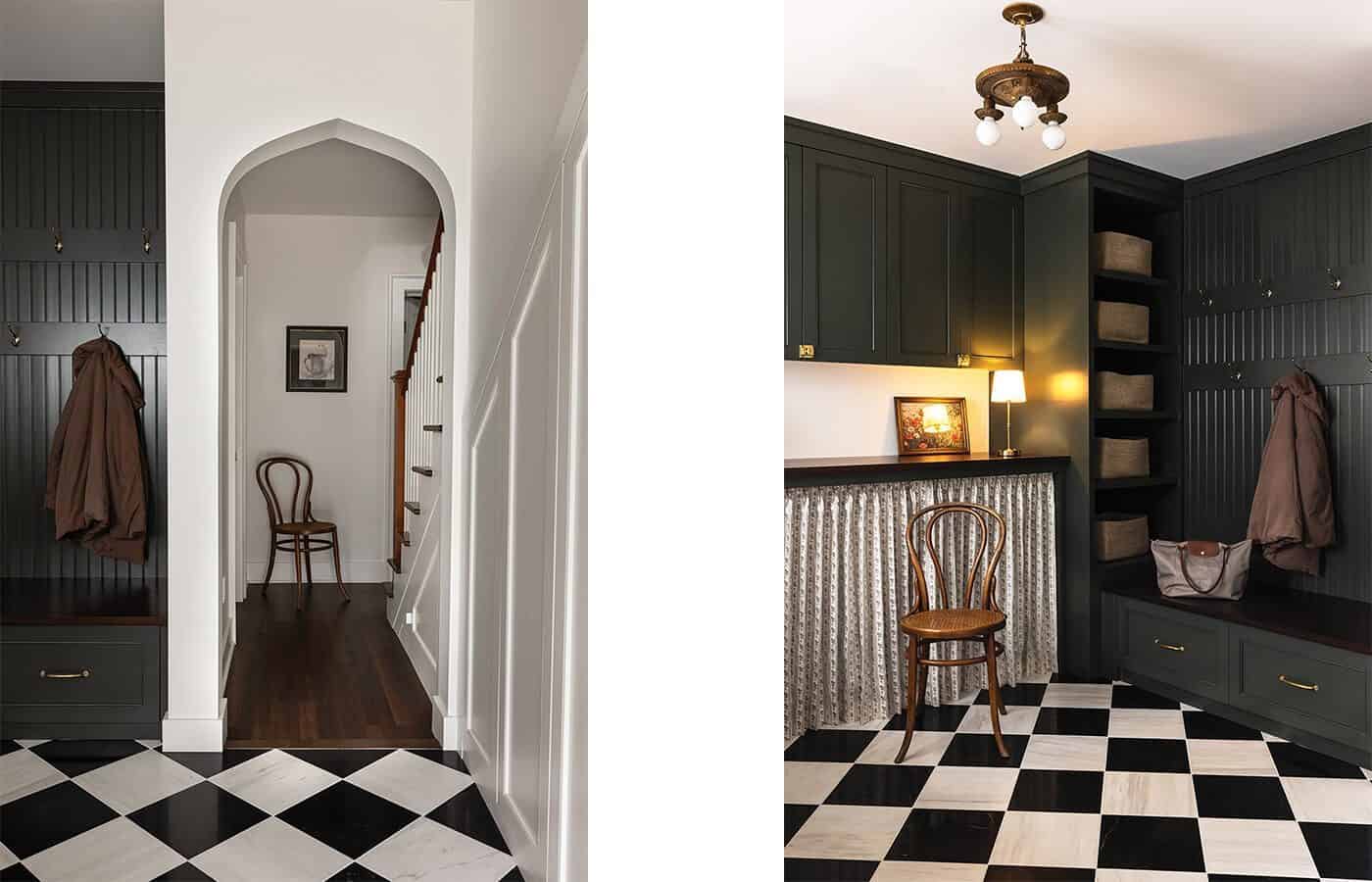
“It’s a mother’s dream,” Mentis notes. “As a stay-at-home, I joke that it’s my office. Yes, the brand new kitchen is glorious, but mudrooms are underrated. Every day goes significantly smoother now that we enter and exit via a mudroom.”
Seattle homeowners over the past decade have increasingly created more living space by going underground, says Jeremy Weiss, co-owner of WA Development Group, which served as general contractor for the project.
Water table and soil structure permitting, digging deeper is more common than lifting, which can cause plaster cracking and other problems in older homes. That was less of a concern here, since the upper floors were to be extensively remodeled after the lift.
“Modern homes are easy to lift. With earthquake codes, they’re bulletproof,” Weiss adds.
The precious windows were removed and the openings stabilized with plywood before the operation. The cost of lifting the home and setting it back down was $30,000. Costs for additional foundation work and basement remodeling range from $50,000 to $350,000 depending on the project.
Supply lines for remodeling materials have finally snapped back to pre-pandemic efficiencies, but costs have increased significantly, Gardner says.
“Three years ago, a kitchen remodel cost about $65,000 to $70,000,” he says. “Now it’s more than $100,000, and from what I’m hearing from contractors, that price is not going to come back down. People are having to make some tough choices.”
For some, that includes foregoing an interior designer, which Gardner doesn’t take personally. She admits that it’s an expensive service. The author of a popular design blog and a former educator, she has launched a step-by-step online design service, including a weekly video consultation.
The Debique-Mentis project was a big win for the neighborhood, says Engel, who lives across the street. “The small lots and close houses — most without a garage on the street — nurture a kind of community that is hard to replace. We were all so happy that they were willing to do the hard work to make the house right for them to stay.”
Follow Us

Your Land, Your Legacy: A New Way to Build at Suncadia
For those who believe that where you live should reflect how you live and how you’ll be remembered Suncadia invites a deeper kind of ownership. It’s an opportunity to create a home that is entirely your own, on some of the most desirable homesites in the Cascades, while benefiting from the ease, support, and long-term…

Settling In, Not Just Moving In: How Seattle Newcomers Find Their Footing
Photos courtesy of Royalty Moving & Storage Seattle. Explore: Seattle Relocation Resources Moving to Seattle is rarely just about transporting belongings from one address to another. For many newcomers, it marks the beginning of learning a city that operates on its own terms, shaped by distinct neighborhoods, changing weather, and an unspoken culture that locals…

Coasting Into Calm
After purchasing a weather-worn, ant-infested cabin on an Oregon beach, a Seattle couple hires a regional team to transform it into a stylish weekend retreat.
When architect Andrew Montgomery first pulled up to his clients’ house in Arch Cape, Oregon, there were logs in the driveway, courtesy of the sizable swells that come with the coast’s king tides. At just 28 feet above sea level and as close as you can get to the water without being on the beach,…

Blueprints for Building Community
After tragedy struck a local restaurateur family, one of their daughters stepped in to complete the design for her brother’s unfinished home.
Although he was just 35 when a heart attack took his life, Khoa Pham’s imprint on Seattle’s international district was such that the city quickly designated April 21 as a memorial day in his honor. With his rescue pitbull, Pinky, by his side, Pham cut a colorful figure through Little Saigon and became well known…