
The Shark Next Door
Des Moines is the Sixgill Shark Capital of the World
 By Sarah Stackhouse June 26, 2025

Every summer, something ancient and mysterious swims up from the dark and into Puget Sound dive logs.
Bluntnose sixgill sharks are deep-sea giants with fluorescent blue-green eyes. In the open ocean, they usually cruise thousands of feet below the surface. But between June and September, they rise into the shallows off Redondo Beach in Des Moines, Wash. They’ve been seen here since at least the 1970s, though sightings have picked up in recent years. Puget Sound is deep — often 600 to 800 feet, even right off Redondo Beach. What makes this stretch unique is the steep underwater slope, which drops quickly from 25 to 100 feet and mimics the deep-sea terrain sixgills prefer.
“Puget Sound is a nursery ground for them, so we generally see the smaller ones — around six feet and 400 pounds,” says Rus Higley, director of the MaST Center Aquarium and faculty member at Highline College. Most of the sixgills spotted at Redondo Beach are juveniles, but adults can reach up to 20 feet long and weigh about 2,000 pounds. Their lifespan is estimated to be around 11 to 14 years. “It seems they’re being born here and then hang out for several years until they grow up,” Higley says, “but none of this is completely clear.”
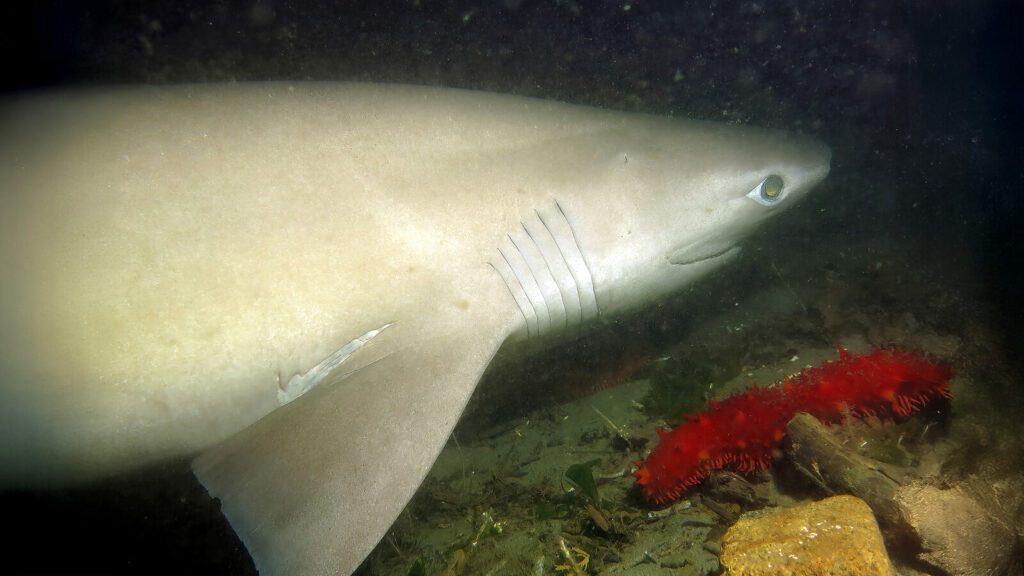
Sixgills are considered living fossils, with relatives dating back about 200 million years. Unlike most sharks, that have five gill slits, they have six. They also lack the big dorsal fin people tend to associate with sharks. “They’re a deep water shark that moves slowly and that fin isn’t necessary for stability,” Higley says.
There’s still a lot we don’t know, like why exactly they come to Redondo Beach, and what their global numbers look like. Seattle Aquarium is doing genetic research, but it doesn’t involve diving. A lot of what we know comes from firsthand encounters.
Still, most people think sharks are scary. “Eighty percent of shark attacks in the U.S. happen on a single beach in Florida — and it’s usually because someone steps on them,” Higley says. “It’s defensive. Around the world, only about two to five people die from shark attacks per year. You’re more likely to be killed by a cow or a vending machine.” He wants people to be fascinated, not fearful. Sixgills aren’t considered dangerous.
They mostly eat fish and crabs, but they’re scavengers too. When a whale dies and sinks to the ocean floor — a phenomenon called a “whale fall” — sixgills show up to feed. Their mouths are full of purpose-built tools: six rows of saw-like cutters on the bottom jaw, and smaller, razor-sharp teeth on top that can bust through whale skin.
Most sightings happen after dark. Sixgills are nocturnal, and the ones at Redondo Beach tend to cruise at night at depths between 60 and 100 feet. Visibility ranges from 10 to 30 feet, so divers don’t usually see the shark until it’s close. “You’re swimming along, and suddenly you see a shape coming out of the darkness,” says Higley, who dives there often. “They move slowly — maybe one mile per hour — but when you’re underwater with all your dive gear, that’s actually really fast. If I want to keep up, I have to really swim.” Sometimes they get close enough to gently bump, or “boop,” a diver out of curiosity. “They are harmless to divers and seem to just be curious,” Higley says.
“Divers are literally coming here to see this amazing animal. However, the general public has no idea that sixgill sharks, or the other 11 species of sharks found in the Puget Sound, live here.”
This thrilling possibility has turned an otherwise quiet stretch of Puget Sound into a magnet for underwater explorers. Redondo Beach is one of the only places in the world where recreational divers are spotting them regularly during peak season. “They’re seen at other locations around the Sound, but for some reason Redondo seems to be the best,” Higley says.
That’s how Des Moines ended up being the Sixgill Shark Capital of the World. “Divers are literally coming here to see this amazing animal,” he says. “However, the general public has no idea that sixgill sharks, or the other 11 species of sharks found in the Puget Sound, live here.”
To help get more people excited about these animals, the MaST Center Aquarium and Highline College are throwing a party. On Sunday, July 6, Des Moines will host the first-ever Shark in the Park at the Redondo Waterfront and Wooten Park. “Last summer, a group of stakeholders including the MaST, local divers, and fishermen met to discuss the sixgill sharks we’re seeing in Redondo and address a proactive concern about protecting and reducing impacts,” Higley says.
The event includes science demos, ocean-related activities, games, food trucks, exhibits, sixgill-themed shirts, and dive meetups for those ready to suit up and go in.
Want to help protect these fascinating predators? A cleaner Puget Sound means better conditions for bluntnose sixgill sharks and everything else that calls the Salish Sea home. Head to pugetsoundstartshere.org for everyday tips on ocean-friendly living, no-touch encounters, and how your choices can help sharks stick around.
Follow Us

82 Million Tons of E-Waste by 2030. Now What?
Smart ways to handle old electronics after a holiday upgrade.
Every holiday season, our houses fill with upgraded gadgets and the promise that we’ll deal with the old stuff later. Meanwhile, the drawer of mystery cords multiplies, and some items just get tossed out. Most of us mean well, but those castoff electronics often end up somewhere they really shouldn’t. And with about 59% of…

Going to the Mountains This Winter? Read This.
A new online tool breaks down avalanche basics for anyone planning snowy fun off the beaten path.
I’m a rule follower when it comes to the outdoors. This summer, my family did some backcountry hiking in Whistler and made sure to do everything by the book—texting friends our plan and location, and wearing a bear bell even though it felt a little dorky. It’s reassuring to know you’ve covered the basics before…

Historic Flooding Prompts WA Governor to Declare Emergency
Rivers are surging around the state amid days of heavy rainfall.
As floodwaters swelled around Washington, threatening low-lying communities along rivers, Gov. Bob Ferguson signed a statewide emergency declaration on Wednesday. Ferguson says he’ll also seek an expedited emergency declaration from the federal government in response to the flooding, which is the result of an atmospheric river that has dumped multiple inches of rain in parts…

Barnes & Noble Is Coming Back to Downtown Seattle
The bookseller will open a new flagship at 520 Pike, marking the largest retail lease in downtown Seattle since 2020.
Barnes & Noble is returning to downtown Seattle for the first time since early 2020. The national bookseller has signed a 10-year lease for a new flagship at 520 Pike Street, a 29-story tower, taking over 17,538 square feet on the corner of Pike and 6th Avenue. The store is expected to open in the…