
Why I Said Yes to Leading Theatre Off Jackson
The stage can be an epicenter for social change
By Susan Lieu July 9, 2025

There’s no other place in Seattle that has shaped me more as an artist than Theatre Off Jackson (TOJ).
It’s a small theatre in the Chinatown International District where I cut my teeth in the craft of performance, selling out shows, and building community. It has fundamentally changed my life, catapulting my arts career as a playwright, performer, and author. And now, as the new Interim Executive Director, I hope to do the same for the hundreds of artists who grace its two stages every year.
As a past co-producer, consultant to TOJ, and board president, I’m excited to apply my creative energy and entrepreneurial savviness (remember, I founded this as a teenager) to an arts and culture organization. I hope to arm the resident companies that co-produce here with the skills, resources, and space to amplify their work. And, dare I say, I want all the artists who perform here to make more money. When so much energy is expended into propping up a show, those seats should be filled so producing companies can pay their artists better and stash the cash to reinvest into future productions.
As a working artist myself, this is a top priority.

However, in an era when arts funding is drying up and inclusivity is under attack, theatres are on the front lines of a precarious culture war. I see creative expression as more of a public good, but not treated as such in our capitalistic society. Whereas in Ireland, there’s a universal basic income pilot happening for artists. In America, artists have to front-load the risk to conceive, produce, and perform a work before they even get paid one penny. This begs the question: Who gets to make art and is the art we consume reflective of actual reality or classist structures?

In the last eight years, Seattle has seen five theatre closures, two strategic mergers and partnerships among the arts scene’s well-known institutions (ACT Theatre and Seattle Shakespeare; Macha Theatre Works and Seattle Public Theater), and major layoffs sprinkled throughout the rest of the ecosystem. Even though TOJ has miraculously made it to its 20th birthday this year (theatre lifespans are like dog years), patrons and donors will single-handedly determine if third spaces like TOJ will exist next year. I see the stage as a pulse check on the mores of our community — if it can’t even exist as a space for expression, what does it say about the values of our society?
I see the stage as a pulse check on the mores of our community — if it can’t even exist as a space for expression, what does it say about the values of our society?
Since 2005, TOJ has been co-producing inclusive work with marginalized artistic companies that represent AAPI, queer/non-binary, burlesque, artists with disabilities, and more. The mascot is a unicorn, and for good reason. TOJ is one of the last theatres standing in the country that offers low-cost rates for producers to create experimental work in an artist-ready space with a chance of turning a profit.

I should know — in 2019 I took my solo show 140 LBS: How Beauty Killed My Mother on a 10-city national tour after my sold-out world premiere at TOJ. I experienced theatres who were unapologetic when they wrote over my light cues (imagine a show with just one light setting even when you planned a fancy setup that they promised to deliver), the projector broke ten minutes before curtain call (I had multimedia elements as part of the narrative), a speaker was broken but I was never notified, the performer toilet made me gag every time I used it, hundreds of my show programs went missing, my green room was a literal broom closet, and a cabaret beneath my stage was playing a loud number during my tender monologue.
When I returned, I had a newfound appreciation for Theatre Off Jackson. I didn’t realize how much the people running it respect the artist, the process, and the pay, until I hit the road. And since then, I have returned to TOJ as a guest performer, consultant, and board member because a gem like this cannot die.
The interplay of what happens between performer and audience is nothing short of a spiritual experience where hope, wonder, and connection are restored, even if only for a short 90 minutes with an intermission. At TOJ, we are curbing the loneliness epidemic, sitting side by side, remembering that when we show up — we belong.
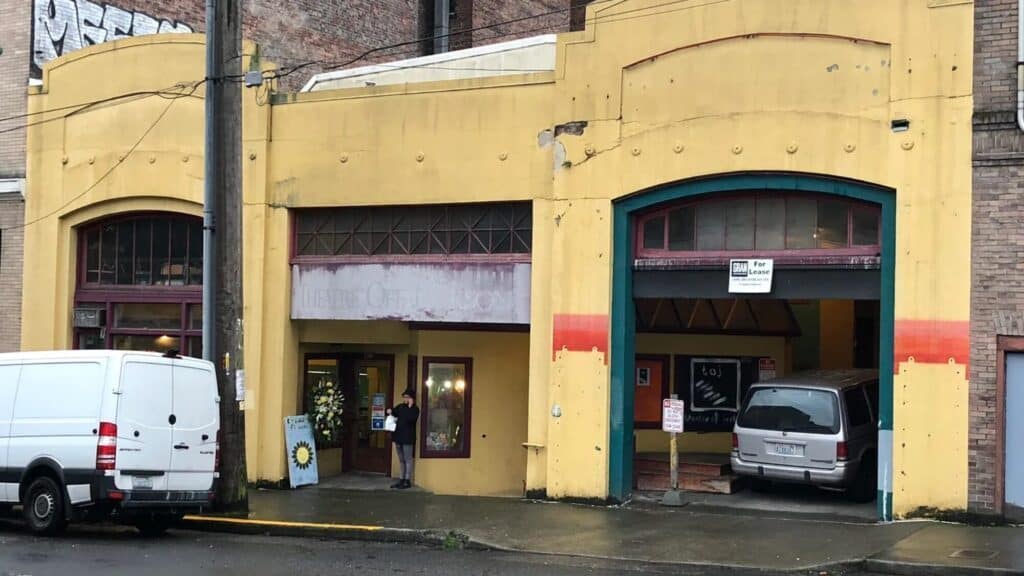
TOJ is one of the last standing theatres in Seattle that produces experimental work seating 140 in the intimate downstairs theatre and 140 in the expansive cabaret-style space. Never heard of the place? You may have driven by it a hundred times and never noticed because the front facade is in desperate need of repair.
As TOJ’s new Interim Executive Director, I will focus on transforming the external and internal spaces to be more inviting and usable for patrons and artists. With support from the Allen Family Philanthropies, we are in-process with renovations to reimagine and revitalize the space — and so much more can be done if we have more funding and partners interested in creative solutions.
Our mission is to be a hub for diverse and affordable artistic performances, creating a unique blend of theater, community, and creativity. If you believe in this mission too, there are so many ways to build this reality together:
Donate to sustain us.
An endowment would be transformative for this place. Staff should have healthcare benefits. We should have competitive salaries that compensate people for their talent and contributions. We should worry about the number of shows we can produce, not about burnout.
Sponsor our annual gala on September 27th.
Historically, it’s called the Big Damn Party and this year it’s our Big Damn Birthday with an oversized unicorn (our mascot) piñata featuring the best acts from the past 20 years. Tickets will be on sale soon if you want to attend. For more information, email us here.
Email me.
Let’s talk, dream, and find a way. Indeed, that’s the only thing that has ever changed the world. You can reach me here.
All right, I’ve consulted for nonprofits in the past. Now, it’s time to lead one — for the next generation to come. Stay tuned. Even better, share the risk and passion and collaborate with me.
Susan Lieu is a Vietnamese-American author, playwright, and performer. Her solo show 140 LBS: How Beauty Killed My Mother evolved into her memoir, The Manicurist’s Daughter (Celadon), which has been featured in the New York Times and NPR. She is a Harvard and Yale alumnae, co-founder of Socola Chocolatier, and was named one of Seattle magazine’s Most Influential People.
Follow Us

Rearview Mirror: An Oyster Party, Money for Art, and Mac & Cheese at 30,000 Feet
Things I did, saw, ate, learned, or read in the past week (or so).
We Partied for Art I love a party, and I love art, so when the Henry Art Gallery invited me to its annual fundraising gala, it was paddle’s up from the get-go. Held on the floor of Pioneer Square’s Railspur building in a space managed by Rally, Angela Dunleavy’s latest venture (read all about it…

Urban Grit Meets Wild Beauty: Inside Seattle Art Museum’s Beyond Mysticism
Seattle’s history is rooted in its fascinating juxtaposition of industry and nature, inspired by the region’s dramatic landscapes and rapidly changing cityscape. Seattle Art Museum’s current exhibition, Beyond Mysticism: The Modern Northwest, invites you to meet the artists who captured that tension and transformed it into a bold new vision of Modernism. Modernism, Made in…

Our March/April Issue Has Arrived!
Inside you’ll find Best Places to Live, a packed spring arts guide, and more stories from across the region.
The future’s bright, and so is the cover of Seattle magazine’s March/April issue! Featuring a mural by local artist (and 2023 Most Influential pick) Stevie Shao, the colorful cover is a snap from Woodinville, one of the six “Best Places to Live” featured inside. While we usually focus on Seattle neighborhoods, this year we expanded…

Supporting Roles
Three women in the Northwest are helping local artists through newly launched residencies outside of Seattle. Here, we take a look inside these thoughtfully designed spaces, and learn what drove their founders to become cornerstones in the creative community.
Iolair Artist Residency Eastsound, WA Years ago, after studying photography and earning a Bachelor of Fine Arts at the University of Washington, Pacific Northwest native Linda Lewis realized that she didn’t want to spend the rest of her life behind a camera. “The minute I graduated from school, I was far more inspired by the…