
Built Into the Trees
A new design-forward alpine retreat near Mount Rainier blends craft, comfort, and slow-living rituals into a year-round stay that’s hard to leave.
 By Sarah Stackhouse February 10, 2026

It was dark when we arrived.
Our family of four—my husband and our tween and teen daughters—left Seattle for a weekend getaway later than planned, the kind of Friday departure that feels optimistic when you pack the car and less so once you hit the slow crawl of traffic out of the city. We cruised behind red brake lights until Tacoma, but once we were off I-5 and closer to Mount Rainier, the road simplified until it was just trees and our headlights. The last stretch had us driving through a tunnel of evergreens.
Then the cabin appeared.
Fjellsangin, as it’s called, glowed against the forest, light spilling from the windows and the exterior lit just enough to be welcoming without breaking the darkness around it. After two and a half hours in the car, it felt like the place had been waiting for us.
The name translates to “mountain song,” a nod to co-owner and builder Lee Christopherson’s Norwegian heritage and the idea that the retreat should be in conversation with the landscape around it. Fjellsangin sits in Ashford, just outside Mount Rainier National Park, about 80 miles southeast of Seattle on the north side of the Nisqually River.
Inside, an alpenglow board was laid out on the counter—a grazing tray we’d pre-ordered, stacked with cheeses, fruit, nuts, cured meats, and local honey. It set the tone immediately: this was a stay you could customize as much or as little as you wanted. Jennifer Mager, Christopherson’s wife, co-owner, and the retreat’s interior designer, built the experience that way on purpose. “I want everyone to have all of the options so that they don’t feel limited,” she says. “Being somewhere you can come and relax and have all the possibilities to make it your own stay.”

Guests can pre-arrange full meals—breakfast, lunch, and dinner—all prepped in-house and ready to finish easily. It’s almost like room service at an Airbnb, though Mager says it’s about removing friction. If you arrive late, dinner is waiting. If you want to stay in after a hike, you don’t have to think about it.
We opted in for dinner, so two pizzas (fig and prosciutto, and marinated mushroom with ricotta) made by Mager were waiting on trays with baking instructions, along with a fully prepped salad, toppings portioned out and homemade dressings ready to go. There was even a pizza slicer. We slid the pizzas into the oven and turned on the gas wood stove with the flip of a switch (the wall panel lets you set it for 30, 60, or 120 minutes), poking around while dinner cooked.
There are two king bedrooms spread across two levels, along with two full bathrooms and a two-story great room that opens directly into the kitchen, so everyone can spread out without feeling disconnected. A sofa bed in the loft allows the cabin to sleep six comfortably.
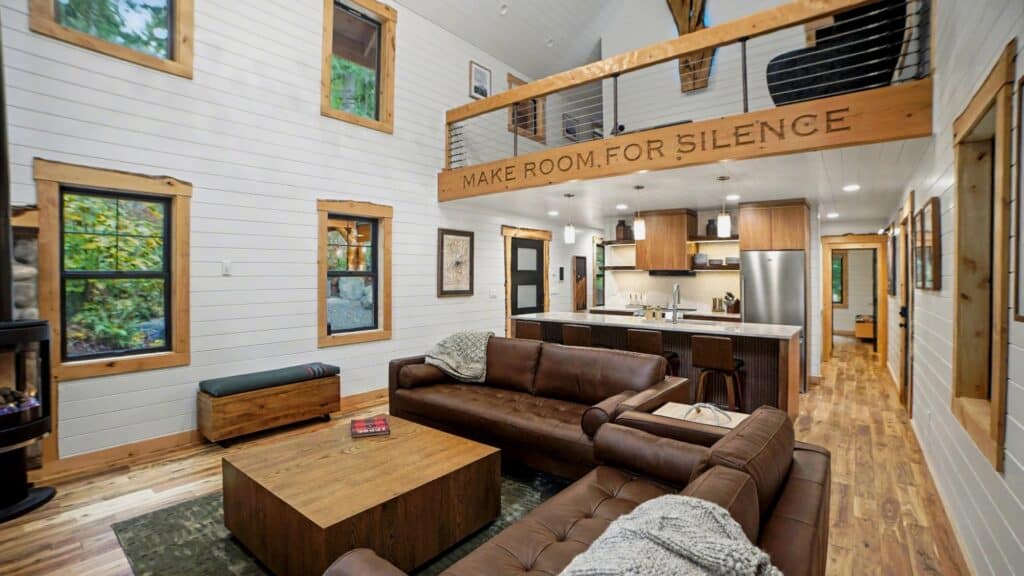
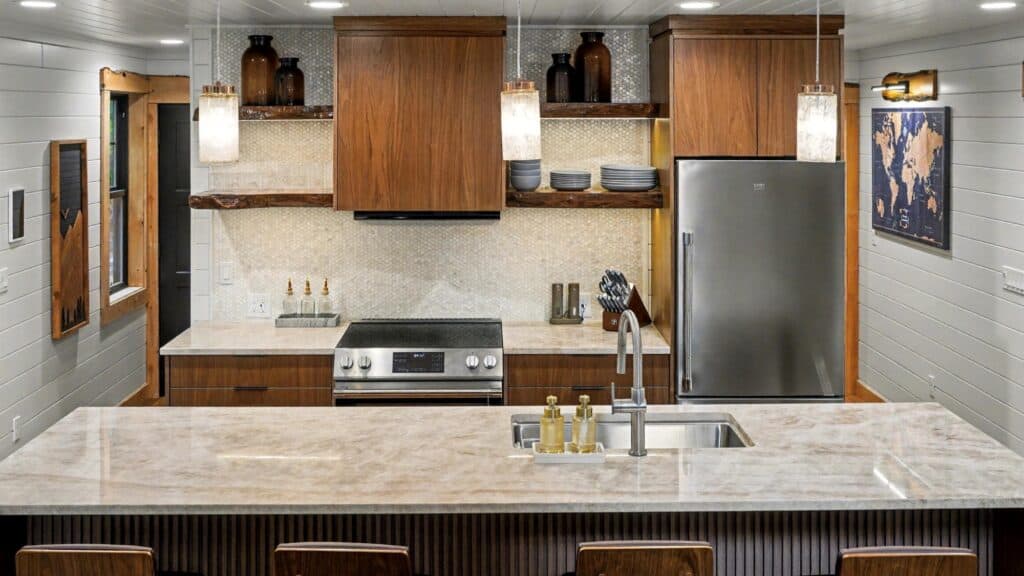
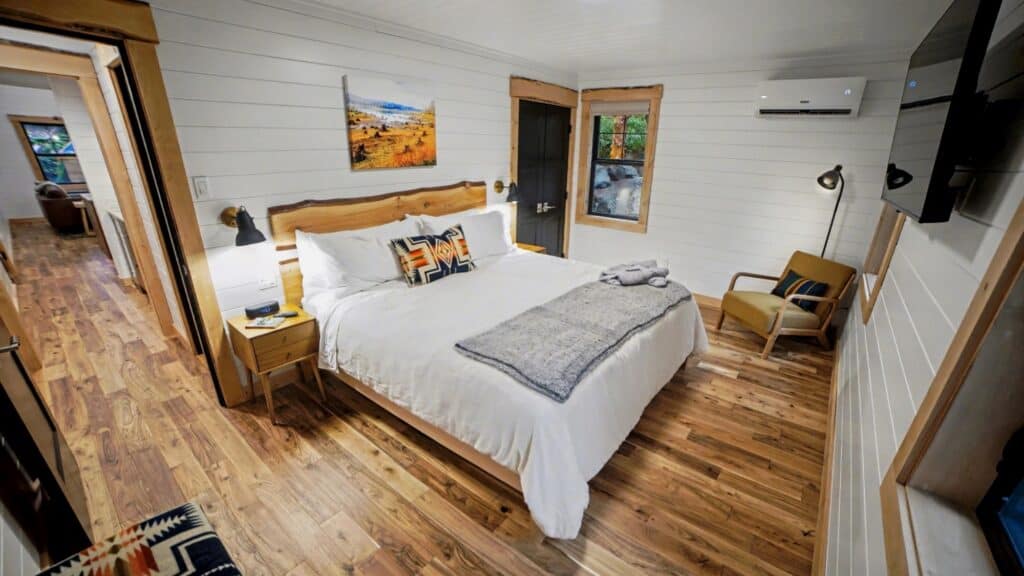
After dinner, we wrapped up in the robes laid at the foot of our beds and walked out to the hot tub, framed in a large cedar log pergola and strung with twinkle lights (there were even custom hooks for hanging towels).
As a nightcap, we came back inside to the sparkle bar, which was new to me—a nonalcoholic drink station built around a small carbonation system that turns the tap water fizzy. The water, which comes straight from the mountain glaciers, is the point, with local botanical syrups from Simple Goodness Sisters and recipe cards set out beside it. “I wanted to promote people not using bottled water here,” Mager says. “Our water is so good.” My kids immediately claimed it as their weekend ritual, mixing citrus and herb combinations like they were running a tiny soda bar. And after a few rounds of UNO!, the beds made it easy to give in to sleep.
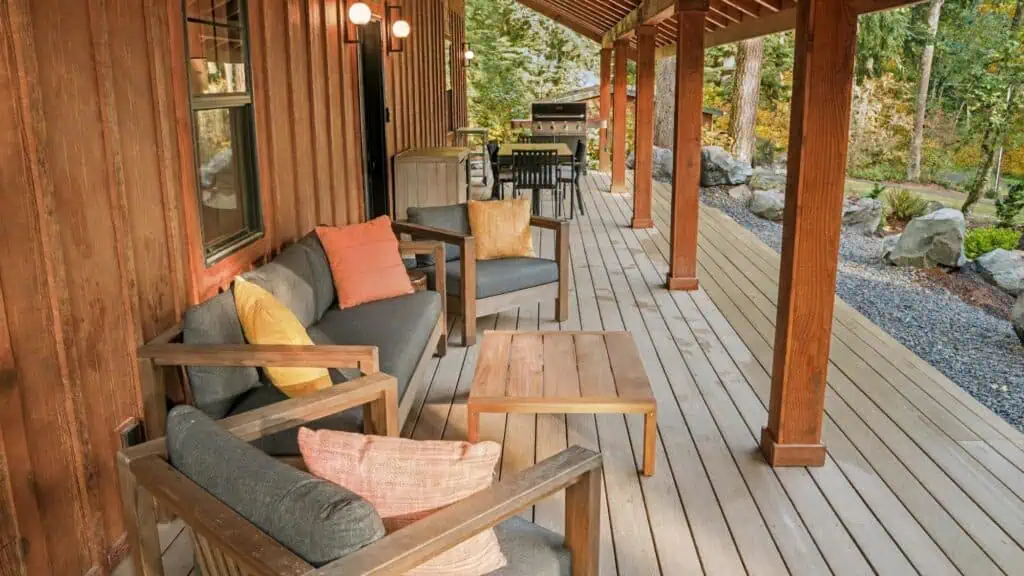
The next morning, my husband and I drank coffee from the coffee bar on the large front porch—French press or drip, with fresh cream waiting in the fridge (we were asked our preference before arrival)—and watched exactly one truck drive out and back in. Fjellsangin sits just off what used to be the main highway, an original stagecoach route to Mount Rainier, before a new highway replaced it decades ago.
Later, we drove into Mount Rainier National Park. Winter requires carrying tire chains, so we rented a set about five minutes away at Whittaker Mountaineering, then continued to the park for a hike that moved from snow-packed forest to open mountain views.
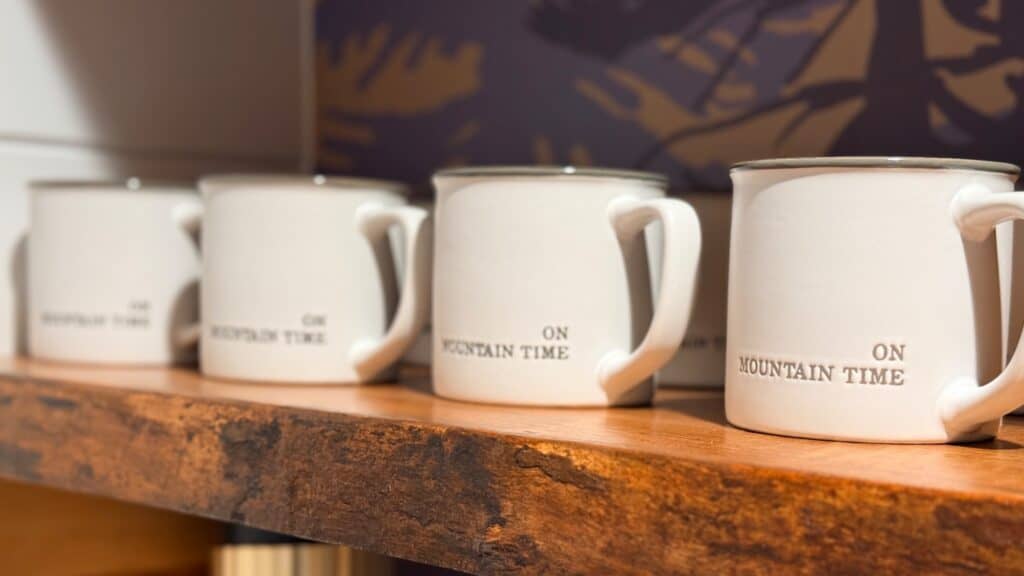
Fjellsangin grew out of Christopherson and Mager’s shared vision to build something sustainable and fully integrated into the landscape—a clean, low-impact retreat that reflects how much they value the land around them. Christopherson, born and raised in the Seattle area, has deep family ties to property nearby; relatives once operated a 130,000-acre cattle ranch at the base of the mountain through the 1940s, supplying Fort Lewis and training cavalry horses. After retiring earlier than expected, he moved to Ashford about 20 years ago. “I decided to build a cabin down here,” he says. “And the cabin got outta hand and sort of became a house.” That structure is now the home where he and Mager live. Fjellsangin followed later, created together with a sustainability focus from the start and built with contractor Keith Williams of Noble Remodeling in Packwood.
Mager, a Canadian interior designer who studied at Washington State and worked in Vancouver, led the cabin’s design—doing the drawings herself and shaping everything from layout to furniture and textiles—while Christopherson focused on structure, woodwork, and landscape. “I wanted it to feel calm when you walked in,” she says. “Like you didn’t have to figure it out.”
That calm extends into the materials themselves. Christopherson has worked with live-edge wood for nearly two decades, preserving bark, curvature, and irregular grain rather than cutting it away. “Bring the outside in and bring the inside out,” he says. “We want to have it blend together.”
You start to notice it the longer you’re there—the live-edge alder door and window frames, still wrapped in bark, thick maple shelving in the kitchen cut to follow the natural grain, and large sculptural slabs mounted as art: one cedar, one maple. The former rises alongside the staircase, the latter anchors the loft, both backlit to highlight the organic shapes and grain. “Everybody’s just in the habit of cutting all the cool stuff off and making it square,” he says. “That’s an art piece unto itself, don’t try to change it too much. Just let it be what it is.”
Outside, the landscape pulls from Scandinavian and Japanese garden traditions, inspired in part by visits to Kubota Garden in Seattle, with plantings that will grow into a Pacific Northwest Japanese garden over time. There’s a firepit for cooking and marshmallow roasting, and future guest experiences may include wood splitting and Scandinavian wood stacking—extensions of how they live on the land themselves.
I woke early on our last morning to use the cedar sauna, which Christopherson built just off the side of the house. It takes about an hour to heat, so I turned it on, had coffee on the porch again, then stepped in for a little more quiet time, alone with the forest right outside the glass.
By the end of the weekend, we didn’t want to leave. We could have stayed put the whole time—cooking, soaking, playing games—or used it as a basecamp for the mountain. It worked both ways. More than anything, we felt cared for, which is what made it so easy to sink into.
Fjellsangin is offering Seattle readers 10% off the nightly rate with code SEATTLEMAG10. (Applies to nightly rate only; excludes taxes, fees, and add-ons. Cannot be combined with other offers.)
Follow Us

The Secret Language of Tu Tu’ Tun River Lodge
A riverside retreat near Gold Beach where glass cabins and wood-fired dining set the pace.
There’s a place where Highway 101 gives way to a winding forest road outside Gold Beach, Oregon. Misty salt air shifts to a forest of Douglas fir and ponderosa pine while the ocean softens into the steady breathing of the Rogue River. It’s here, on land once stewarded by Native American tribes, that you’ll find…

Getaways & Gifts: Valentine’s Day & Lunar New Year
Seattle staycation ideas for gals, pals, and romance.
Valentine’s Day 2026 promises to be a long, merry weekend. Celebrate with loved ones, then tack on Lunar New Year, Mardi Gras, and President’s Day as well. Sounds like a staycation to us—one that accommodates gals, pals, couples, and anyone motivated by indulgent dining and late checkout. Here’s the roundup, with site-specific gift ideas. Alexis…

The Wanderer’s Guide to Portland’s Pearl District
Expect the unexpected in this consistently rewarding urban art oasis.
The first sound we hear at ILY2 gallery is not reverent silence, but astonished, contagious laughter. As we enter the room, a giggling couple bends down to grab a fish from a basket and load it into a giant cannon. The (rubber) salmon rockets through the gallery, thuds loudly against the opposite wall, and drops…

Cozy Coastal Escapes
Who says the beach is only for summertime fun? These six spots, from British Columbia to California, highlight the beauty of the West Coast, all year round.
It all began with a simple scene: a roaring fire at San Ysidro Ranch, a glass of wine within reach, and a card game unfolding on the table. A quiet evening moment that sparked the notion of a coastal winter journey, where the season’s most alluring escapes share one element: the dancing flame. Whether it’s…