
Lifting the Fog
Beyond Mysticism at Seattle Art Museum broadens the old story of Northwest art.
 By Sarah Stackhouse April 1, 2026

For a long time, Northwest Modernism got boxed into one idea: mysticism—a way of describing the region’s art as inward-looking, spiritual, and closely tied to nature. That goes back to a 1953 Life magazine story about Mark Tobey, Kenneth Callahan, Guy Anderson, and Morris Graves, the four artists most associated with the Northwest School. Beyond Mysticism: The Modern Northwest, now on view at the Seattle Art Museum, brings together more than 150 artworks, two-thirds of them from the museum’s own collection, and shows how much that old story leaves out.
“We took a deep dive into the collection, bringing things out of our vaults that we haven’t really seen before,” says curator Theresa Papanikolas, SAM’s Ann M. Barwick Curator of American Art. The show moves through several sections covering the city, nature, surrealism, and abstract expressionism—and what comes through is how much was changing. Midcentury Seattle was growing fast. The land was being altered. Artists were looking outward to larger movements in American and European art while staying rooted here.
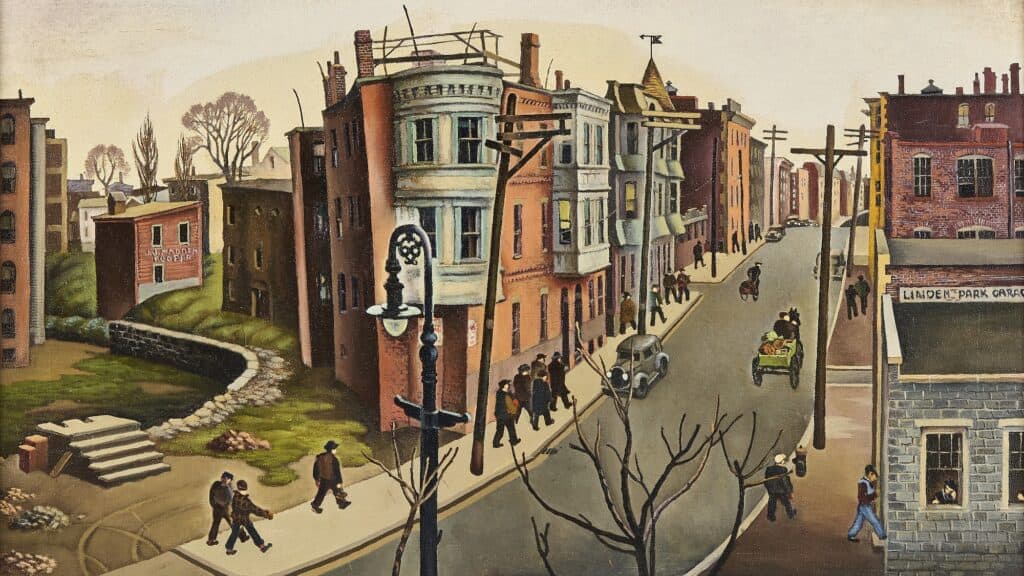
One of the best things about the show is how often Seattle appears. You see it in waterfront scenes, roadsides, neighborhoods, nightlife, and industrial views. And of course, Pike Place Market shows up, captured in its colorful, buzzy state—apparently how it’s always been. Papanikolas says that between 1880 and 1930, Seattle was “more profoundly and completely transformed than any other place in the United States.” If you live here, or have spent a lot of time here, it’s hard not to get a little thrill from seeing recognizable places and noticing how much of the city was already taking shape.
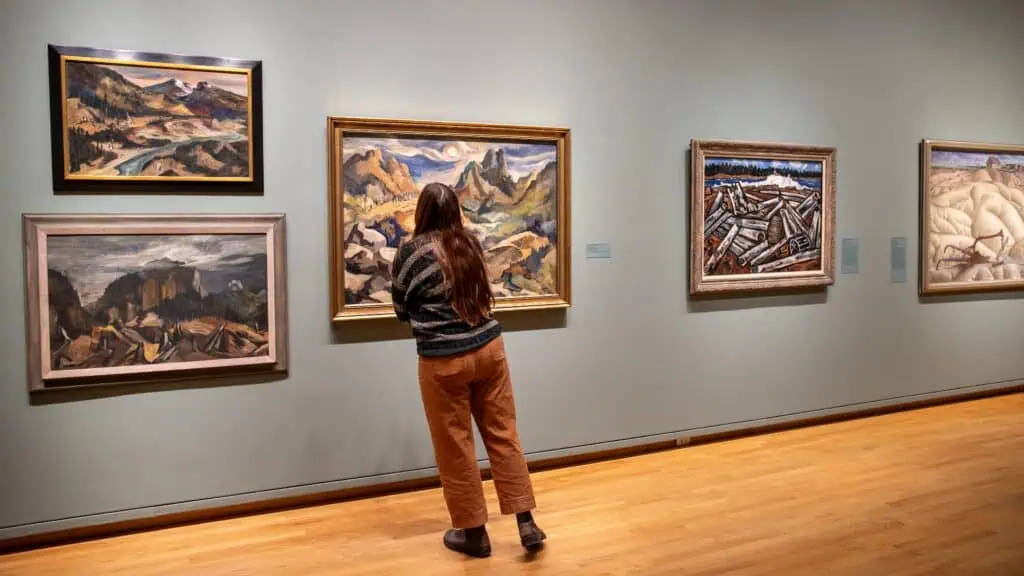
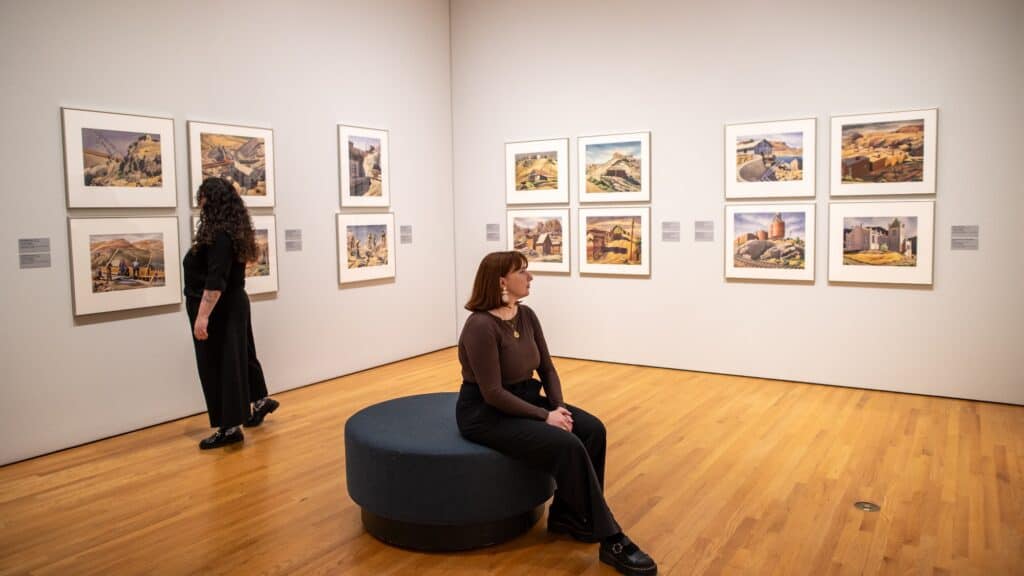
There’s a tension in how the land was changing as it was being developed, and how far that change would go before it became destruction. It feels especially resonant in Seattle, a city known for its natural beauty and for how much people want to be outside—skiing, hiking, playing in the water. You can see where that idea of mysticism originates, as artists working here tried to express both their connection to the land and their concerns about its future, long before overpopulation and climate anxiety became part of the conversation.
Kenneth Callahan’s paintings may read at first as lush mountain scenes people already associate with Northwest art, but each one in the Nature section includes signs of clear cutting. Once the broken tree lines come into focus, the paintings take on a different weight. “Steep hills were leveled in order to build roads. Forests were cut down to supply lumber for building, and tidal flats were converted into harbors for commercial fishing and shipping,” Papanikolas says. Morris Graves comes at the same unease from another angle. His work often centered birds and other animals whose habitats were being pushed apart by industrialization and urban development. The anxiety is palpable. Land is treated as something to develop, strip for resources, and reshape for profit, and that tension carries through as the show moves into questions of Indigenous forms and other ways of relating to place.
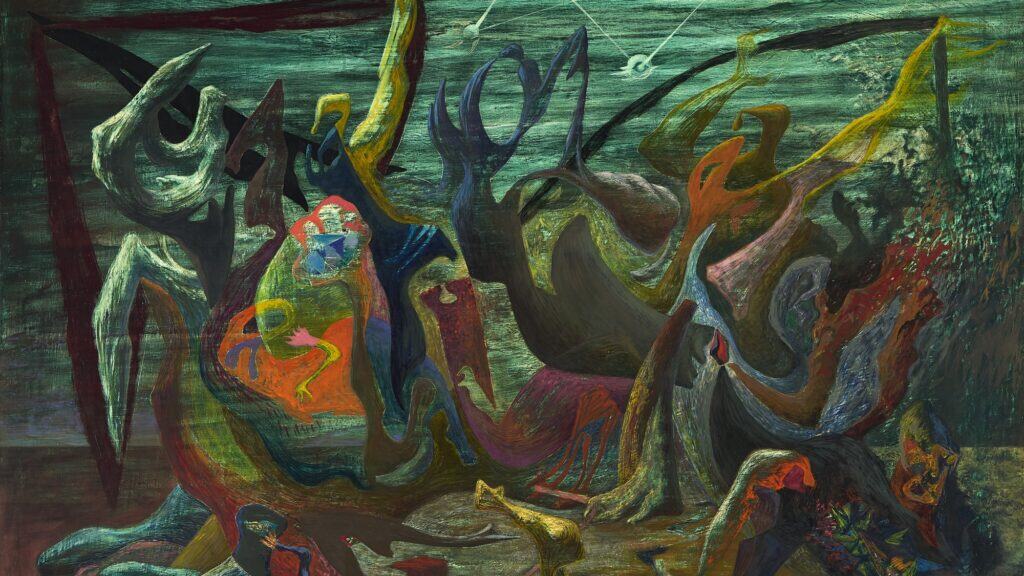
In the surrealist section, familiar forms start to feel eerie while still tied to recognizable places and imagery. There are also two works from Salvador Dalí, which are powerful to see in person, and they help show the larger surrealist tradition Northwest artists were working from, but the art never feels secondhand. It brings to mind a show this winter at Cascadia Art Museum in Edmonds featuring Seattle surrealist Elsa Thoresen, where her paintings let the viewer trace abstract, dreamlike landscapes back to pieces of familiar driftwood. However strange these paintings get, the real beaches, boats, shoreline, and sky still sit underneath them.
The show also examines who modernism has made room for. It looks closely at how Seattle artists drew from Asian and Native art, and doesn’t leave that as a vague story about inspiration. Mark Tobey’s sumi ink paintings draw on Chinese calligraphy and ink painting, and the exhibit is attentive to how those traditions were filtered through a Western modernist lens. It’s just as pointed about appropriation. In Esquimaux Idiom, Tobey pulls together imagery drawn from Northwest Coast Native art in a generalized, decontextualized way that reflects how Indigenous objects and styles were being displayed and consumed in Seattle and beyond at the time. The section keeps asking who was centered as modern and who was treated as background to someone else’s story.
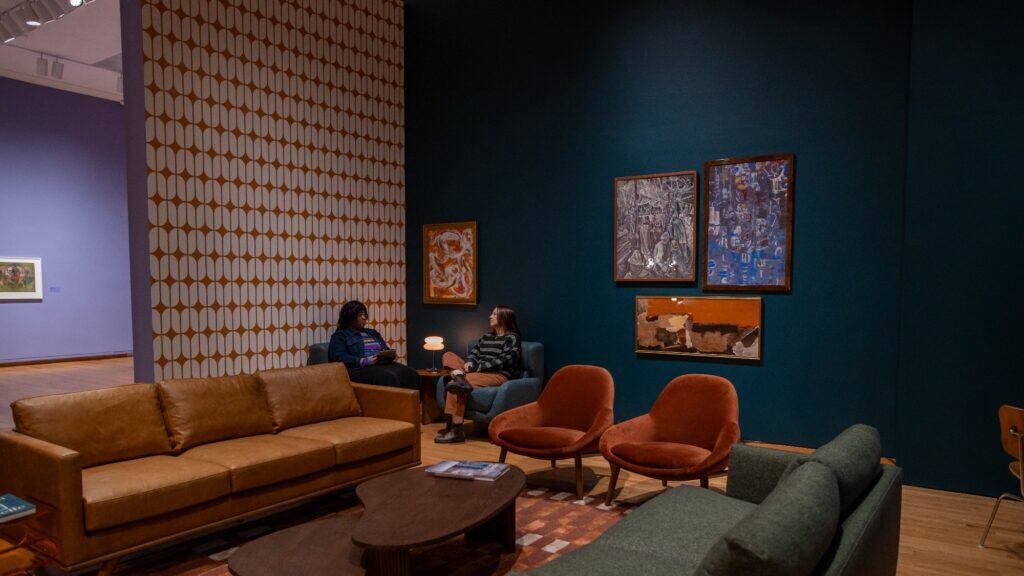
An interactive part of the show is a 1950s-style living room built into the galleries. Based on the homes where many of these artists gathered, it gives visitors a sense of the creative community that shaped Seattle’s early art scene. Much of that scene grew out of informal gatherings—artists meeting in each other’s homes to talk, share ideas, and make work together. There are books curated in partnership with the Seattle Public Library. The room is beautiful, but it also helps explain the social side of all this. These artists were in conversation with each other, with the city around them, and with a much bigger art world than the old mystic label suggests.
“I hope visitors leave with a more nuanced understanding of Northwest Modernism,” Papanikolas says. Beyond Mysticism places this work firmly in Seattle and in the larger art world moving around it.
Beyond Mysticism: The Modern Northwest is on view through Aug. 2. Find more information here.
Follow Us

Woven Wonders
Coast Salish weaving, past and present, on view at the Burke Museum.
On display now at the University of Washington’s Burke Museum of Natural History and Culture, Woven in Wool: Resilience in Coast Salish Weaving examines the traditional art form and its importance to Coast Salish communities. “This exhibition broadens the definition of American art by incorporating Indigenous voices and artistic practices historically marginalized due to biases…

Studio Sessions: Cristina Martinez
On the cusp of a new group show, Northwest artist Cristina Martinez reflects on storytelling, motherhood, and personal success.
Artistically inclined from a young age, Cristina Martinez was attending fashion school when she had a realization: Her passion wasn’t necessarily sparked by the clothes she was sketching, but by the stories behind her work. Drawing from her Black and Mexican roots, and from the lives, histories, and cultures of the community around her, Martinez…

Fave Five: Early Signs of Spring
Where to go when everything starts waking up.
March and April always blend together in my head. Around here, there’s still plenty of rain, but it feels a little more manageable as the green sprawls and the crocuses unfurl right before our eyes. This is the time when things respond to moisture and attention, and when getting back into it feels better than…

An Ear For Good Design
Integrated design firm Mithun creates impactful spaces through a culture of listening.
At design firm Mithun, communication plays an indispensable role in the workplace culture. It doesn’t have a single discipline—the practice encompasses architecture, landscape architecture, interior design, and urban design. It doesn’t have a single specialty, with projects spanning educational, cultural, civic, and business sectors. And it doesn’t have visual trademarks: each project is hyper-tailored to…