





Food & Drink
Read More ›
Decolonizing dining in Seattle
Hillel Echo-Hawk is at the forefront of Seattle’s Indigenous food movement

This article originally appeared in the March/April 2023 issue of Seattle magazine.
In 2022, an Indigenous-owned restaurant serving a precolonial menu — Owamni, in Minneapolis — earned a James Beard Award as the best restaurant in the country. Names like Sean Sherman and Crystal Wahpepah (respectively, a Beard award finalist for best emerging chef, and the first Native American chef to compete on the Food Network’s Chopped) are gaining recognition.
In Seattle, the conversation about Indigenous history, culture, and food sovereignty — the right to healthy and culturally appropriate food, and the right to define food and agricultural systems — is being led by Hillel Echo- Hawk, a Pawnee and Athabaskan cook, educator, and public speaker.
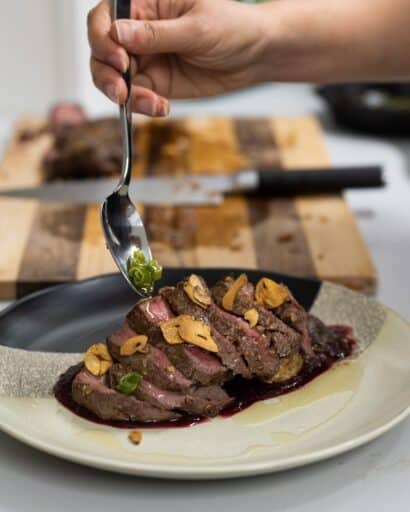
Echo-Hawk worked in several notable Seattle restaurants before quitting her job as a line cook to open catering company Birch Basket in 2018, where she uses ethically sourced, local and foraged ingredients from Indigenous purveyors. Echo-Hawk’s culinary ethos focuses on ingredients indigenous to North America before European colonization took away the rights, freedoms, and food sources of Indigenous people. She uses no dairy, chicken, wheat, beef or sugar, and focuses on wild-harvested ingredients such as salmon, berries, seeds, herbs, and wild rice.
Her approach was shaped as a child growing up in the interior of Alaska. Her influences include matriarchal chief and subsistence rights activist Katie John as well as her mother, who strove to make healthy, home-cooked meals for her and her six siblings.
Birch Basket’s catering clients have included Fred Hutch, the city of Seattle, the University of Washington, the Urban Indian Health Institute and many more. Echo-Hawk has been featured in media outlets around the world, including Bon Appetit, National Geographic, PBS, Vogue, Eater, and more.
Why are we just now talking about indigenous food when it is the root of all food?Part of what I think has brought (Indigenous people to the front of more conversations) is the farm-to-table movement, and people eating more local foods. But what is local food? Local as in grown [in a particular place] or local as in before colonization? For a really long time, there were just white farmers and white cooks talking about this. Then, I think people started to ask, “What was here before? And just how many of the foods are we actually cooking with indigenous ingredients?” I think that really took a big leap into indigenous foods and food-ways. But it has only been happening in the last 10 years.
What has contributed to the visibility of Native leaders in mainstream media?
There are amazing women (in Congress and the U.S. Department of the Interior) who walk into buildings that historically have not let Native people in, wearing traditional regalia, and bringing more awareness to Native people. How can that not be a conversation piece? Another thing that really pushed Indigenous people to the front of mainstream media was the conversation about mascots (for sports team nicknames). The name “Redskins” is a horrible, derogatory term. The background of that term is a government law saying for every savage scalped, you get five dollars. Part of having a Native mascot is like saying, “All Native people are this,” but we’re all very different, and every tribe has our own culture, government, language, and way of doing things.
What inaccuracies or omissions struck you most from history books you read growing up? There was never nice terminology connected to Indigenous people. It was “merciless savages.” Savage is a very carelessly thrown-around word in history books, and how the white man was so wonderful and kind. In reality, not so much. I have uncles and aunties who were in boarding schools where horrific things happened to them. But boarding schools, according to history books, are wonderful places. And history books don’t really say anything about commodity foods, which is a huge part of the Native diet now. And it’s causing so many health ramifications.
What gaps in our food system did you see during the pandemic?
When people were just taking stuff off the shelves in bulk (you could really see) a break in the supply chain — with trucks, suppliers, and workers — and you realized how integral food is. You can’t live without food and water, but we have become so used to all of these modern things, and don’t know how to survive. During the pandemic, people’s eyes were opened to how fragile and delicate the current system is. We can’t rely on these big supply chains. It’s not sustainable. Local farms, or even a backyard garden, are one of the keys.
What challenges did you face in launching your business? I had always either had a day job or would be adding a catering gig on the side. I had finally gotten enough jobs lined up for four to five months. So I quit and said, “Let’s do this. It’s gonna be awesome.” Then, three weeks later, the pandemic hit. Within two weeks, all of those jobs were gone. And then I started to have health issues. I’ve had epilepsy since I was 12, and started to have a lot of seizures and physically wasn’t able to cook.
What made you keep going then, and what keeps you going now? My maternal grandmother, Chaddie Kelly, was a pioneer in Alaska. She owned several businesses, and one of her crowning achievements was she was on the Businessmen’s Council in Alaska. She became the president for many years, and was the only woman. We had that spirit and that vibe around us all of the time of just like you have to keep going. You have to break these barriers because no one else is going to do it for you.
To learn more about food sovereignty and Indigenous food systems, visit the I-Collective (of which Echo-Hawk is a founding member); North American Traditional Indigenous Food Systems (an organization dedicated to reestablishing Native food-ways); or the Netflix documentary film Gather.
Follow Us

Restaurant Roundup: 3 Pearls and Restaurant Week Redux
Here’s what was served up recently in the Emerald City.
When something tastes good, you gotta go back for seconds—and that’s exactly what we’re doing for this fall’s Seattle Restaurant Week, Oct. 18-31. Building off a successful spring spread, this edition brings back curated menus at various price points ($20, $35, $50, and $65) at restaurants, bars, cafes, and pop-ups across the greater Seattle area….

House Special: A Taste of Ecuador at Bad Chancla
Chef José Garzón brings a coastal Ecuadorian classic to his 335-square-foot Capitol Hill kitchen, where he hopes to introduce more dishes from home.
There is not much room at Bad Chancla. The bright pink walk-up on East Olive Way seats a handful of people elbow to elbow, mostly outside, and the kitchen behind the counter is small enough that chef and co-owner José Garzón can talk to you while he cooks. Garzón grew up between Guayaquil and the…

Opening Night: GoodMart Makes Lunch Feel Like Luxury
Victor Steinbrueck, owner of Fremont’s acclaimed Local Tide, opens his second seafood-centric restaurant in the heart of Ballard.
On a Thursday afternoon I was able to walk right up to the counter at GoodMart on Ballard Avenue and order lunch, which surprised me. GoodMart is owned by Victor Steinbrueck, who opened Local Tide in Fremont during the height of the pandemic (August 2020) and built it into one of Seattle’s most acclaimed seafood…

Where to Warm Up With a Drink This Fall and Winter in Seattle
From swanky speakeasies to a cozy literary bar, these spots serve inventive cocktails and zero-proof options.
Seattle’s drearier days are slowly arriving, but it’s not all gray and gloom from here. Finding a cozy spot to warm up is part of the trick to enjoying the darker, colder months. The right place lets you bring a friend, a book, a journal, or simply yourself, and let time pass by. Whether you…