





Food & Drink
Read More ›
House Special: Adana Kebap at Hamdi
The restaurant’s signature kebap demands lamb minced by hand.

At Hamdi—the Ballard restaurant from Istanbul-born chef Berk Guldal and his partner and co-owner Katrina Guldal—you cannot miss the distinctive tool standing upright on the pass, where finished dishes leave the kitchen: a Turkish zirh, the wide, curved blade used specifically for Hamdi’s signature dish, the Adana kebap. Named after a city in southern Turkey, the traditional kebap is built with a precise ratio of lamb, lamb fat, and red peppers. Today, many of the kebaps you’ll find in Turkey are made using shortcuts like meat grinders, but at Hamdi, Guldal accepts nothing less than meat minced by hand with the proper knife.
“Everything done by hand tastes better than using a machine,” says Guldal. “Using the knife is a more delicate and gentle process, which helps the meat stay together rather than fall apart.”
A grinder’s auger can heat the fat and crush and smear the meat; the zirh, by contrast, cuts cleanly through fat and protein. The fat remains in distinct pieces distributed throughout the mince, helping it hold its structure over the fire without binders such as eggs, starches, or breadcrumbs.
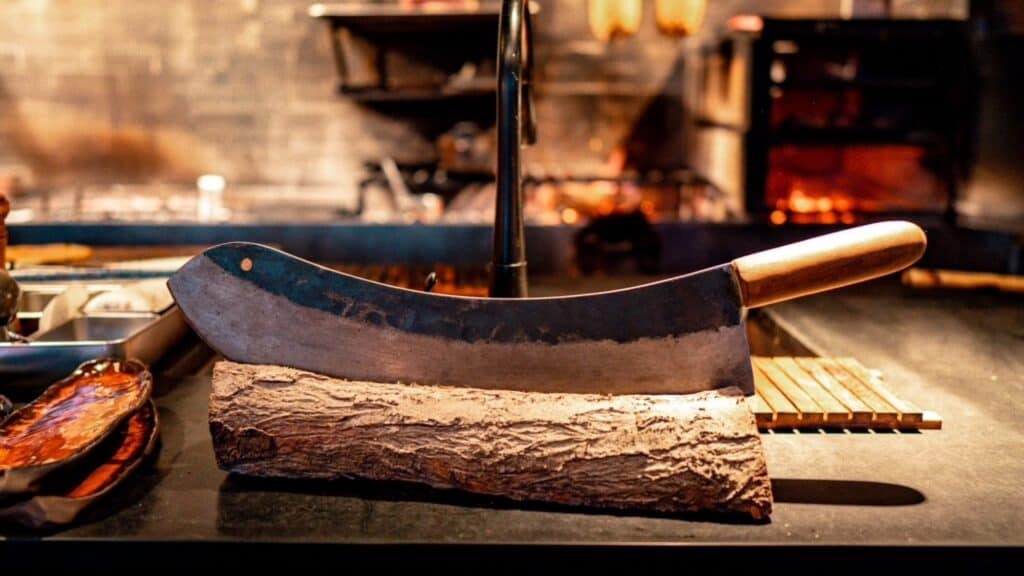
The kebap process at Hamdi takes roughly three days from delivery to plate. The team receives a whole lamb belly from a single source of grass-fed lamb. They break down the lamb belly, remove the silver skin and connective tissue, dice it, then add a fixed ratio of lamb fat to the mix. The crescent-shaped Turkish zirh rocks rhythmically across the cutting board, slicing through the coarse mix of meat, fat, peppers, and Turkish spices until the spices meld with the fat and the entire mix becomes a fine, cohesive mince.
Reproducing this dish in Seattle turned out to be less about the recipe and more about supply and staffing: finding a farm that raised lamb to Guldal’s standards and training a team to use a knife most of them had never seen. It is a dish that reflects countless hours of research, training, and unwavering dedication. He arrived at the formula and mastered the technique through extensive trial and error—experimenting with different cuts of meat and types of charcoal and adjusting the ratio of meat, fat, and peppers until the mince held together.
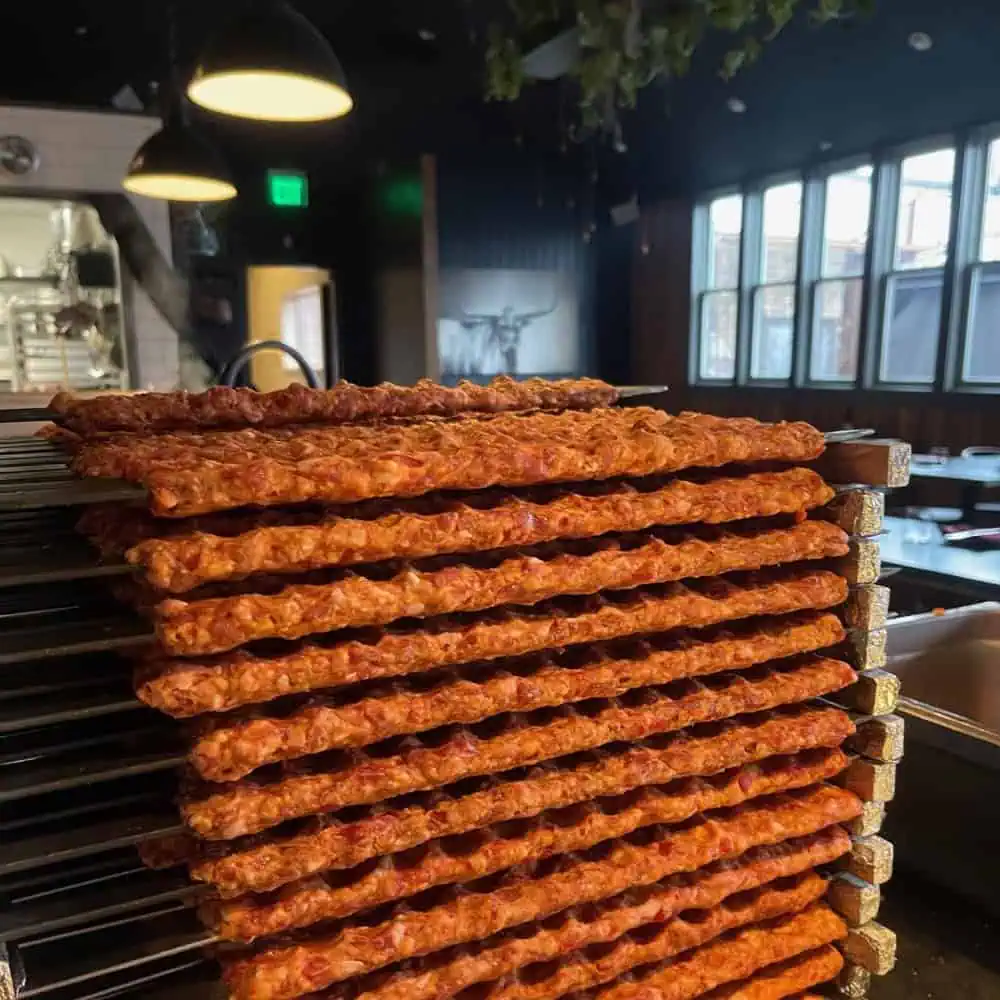
The mince is pressed by hand onto flat iron skewers and grilled over charcoal to medium. Like its hand-minced kebap, Hamdi’s open-fire cooking reflects the restaurant’s exacting approach. Dishes such as the Adana kebap take on robust flavors and a smoky aroma as flames lick the fat and protein.
“There are a lot of extra factors and costs that come with cooking over wood and charcoal, but it’s worth it because the flavors are incredible compared to the alternatives,” says Guldal. “It’s not as simple as turning on a switch and having heat—you have to learn how to read the fire and control it just by looking at it.”
Hamdi serves the Adana kebap simply, on housemade lavaş flatbread with a salad of sumac-dressed tomatoes and onion—just enough brightness and freshness to enhance the flavors of the lamb and the flame. The restaurant’s zirh sits upright on a wood block, and behind it, a bright orange flame burns slowly and steadily.
Tiffany Ran is a writer and the chef behind Babalio Taiwanese Pop-Up, a Taiwanese food pop-up, and the food editor of TaiwaneseAmerica.org. Much of her food exploration includes jumping between catering, restaurants, and the pop-up world. Her writing has been featured in Vice Munchies, Lucky Peach, Goldthread, JoySauce, Northwest Asian Weekly, and more.
Follow Us

Restaurant Roundup: 3 Pearls and Restaurant Week Redux
Here’s what was served up recently in the Emerald City.
When something tastes good, you gotta go back for seconds—and that’s exactly what we’re doing for this fall’s Seattle Restaurant Week, Oct. 18-31. Building off a successful spring spread, this edition brings back curated menus at various price points ($20, $35, $50, and $65) at restaurants, bars, cafes, and pop-ups across the greater Seattle area….

House Special: A Taste of Ecuador at Bad Chancla
Chef José Garzón brings a coastal Ecuadorian classic to his 335-square-foot Capitol Hill kitchen, where he hopes to introduce more dishes from home.
There is not much room at Bad Chancla. The bright pink walk-up on East Olive Way seats a handful of people elbow to elbow, mostly outside, and the kitchen behind the counter is small enough that chef and co-owner José Garzón can talk to you while he cooks. Garzón grew up between Guayaquil and the…

Opening Night: GoodMart Makes Lunch Feel Like Luxury
Victor Steinbrueck, owner of Fremont’s acclaimed Local Tide, opens his second seafood-centric restaurant in the heart of Ballard.
On a Thursday afternoon I was able to walk right up to the counter at GoodMart on Ballard Avenue and order lunch, which surprised me. GoodMart is owned by Victor Steinbrueck, who opened Local Tide in Fremont during the height of the pandemic (August 2020) and built it into one of Seattle’s most acclaimed seafood…

Where to Warm Up With a Drink This Fall and Winter in Seattle
From swanky speakeasies to a cozy literary bar, these spots serve inventive cocktails and zero-proof options.
Seattle’s drearier days are slowly arriving, but it’s not all gray and gloom from here. Finding a cozy spot to warm up is part of the trick to enjoying the darker, colder months. The right place lets you bring a friend, a book, a journal, or simply yourself, and let time pass by. Whether you…