
Ramie Shows Seattle What Vietnamese Cuisine Can Be
Restaurant reinvents classic dishes with a local twist
By Meg van Huygen August 25, 2025

This article originally appeared in the July/August 2025 issue of Seattle magazine.
Slightly more than a year ago, when Ramie opened in Seattle’s Capitol Hill neighborhood, owner Trinh Nguyen wasn’t sure the location was going to jive with what she had in mind. She’d found success with Ba Sa on Bainbridge Island, which she co-owns with her brother, Thai, but the commercial climate in the small seaside town of Winslow is a lot different from the urban jumble of Seattle. Her concept was totally different as well, and she had some pretty famous new neighbors — namely the list-toppers Spinasse and Artusi — to compete with.

Where Ba Sa does contemporary Vietnamese cuisine — that is, classic dishes restyled with Pacific Northwest seafood or other local ingredients — Ramie serves a completely bespoke menu from the school of Vietnamese fine dining, blending bold Southeast Asian flavors, Pacific Northwest produce, and refined technique into both cuisine and cocktails. The Nguyen siblings named their inventive new restaurant after an herb in the nettle family that grows throughout Southeast Asia: Ramie, (rhymes with Jamie) is used for both culinary and textile purposes.
“The first year has been wild,” Nguyen says. “I thought it was going to be hard, but I don’t think I could have imagined it being this difficult.”
The space, formerly the longtime home of Omega Ouzeri, was one of the first stumbling blocks Nguyen ran into. A testament to modern design, in charcoal and jade tones with brass accents, the space is also enormous, with a wide-open dining room, a sleek bar area and an upstairs loft. “Yeah, our space is beautiful, but it’s huge,” Trinh says. “We have the upstairs too, and it’s massive. So, when we’re busy, it’s lively, it’s great, everybody wants to come in. But if you’re the only guests in the restaurant and it’s a slow night, it’s so intimidating.”
Then there’s Ramie’s location at 14th Avenue and East Pike Street. It’s a few blocks from the crux of the action, meaning that it doesn’t get many walk-ins. Trinh also cites SEO issues on Ramie’s website among the various foibles during the inaugural year.
A different concept
Although both siblings co-own Ba Sa, Trinh Nguyen is the sole owner at Ramie while Thai serves as head chef. The menu changes often but is consistently a curated exploration of Vietnamese flavors, always presented with contemporary flair. The vibrant mam kho quẹt, a seasonal vegetable crudité served with a dip of purple taro purée, mam (fish sauce) and shrimp powder, looks like an artist’s palette representing every color in the rainbow, all made of veggies.
For entrées, the cá chiên — a fried whole branzino accompanied by chili sambal, chimichurri, kimchi cucumber and an onsen egg fish sauce — barely resembles a traditional cá chiên, demonstrating the Nguyens’ ability to refresh a familiar Viet dish with totally unexpected flavors. The suon heo nuong, pork ribs that are usually prepared with soy sauce, five spice and other usual characters, are here rubbed and then glazed with coffee and served alongside butternut squash purée.
“We didn’t open Ramie as a business. We opened it as a passion project. Thai and I really, really want to push the boundaries of Vietnamese food.”
One of the most fascinating dishes here is the rau diếp xoăn, a savory pudding made from radicchio, cucumbers, honey-roasted walnuts, roasted peanuts and rice crackers; it is then accented with a piquant pesto made from rau ram (known locally as Vietnamese coriander). It’s a vegetarian cover of tiet canh vit, a duck blood pudding that’s popular in Vietnam but perhaps less so stateside, so the Nguyens decided to create a unique version for their specific audience.
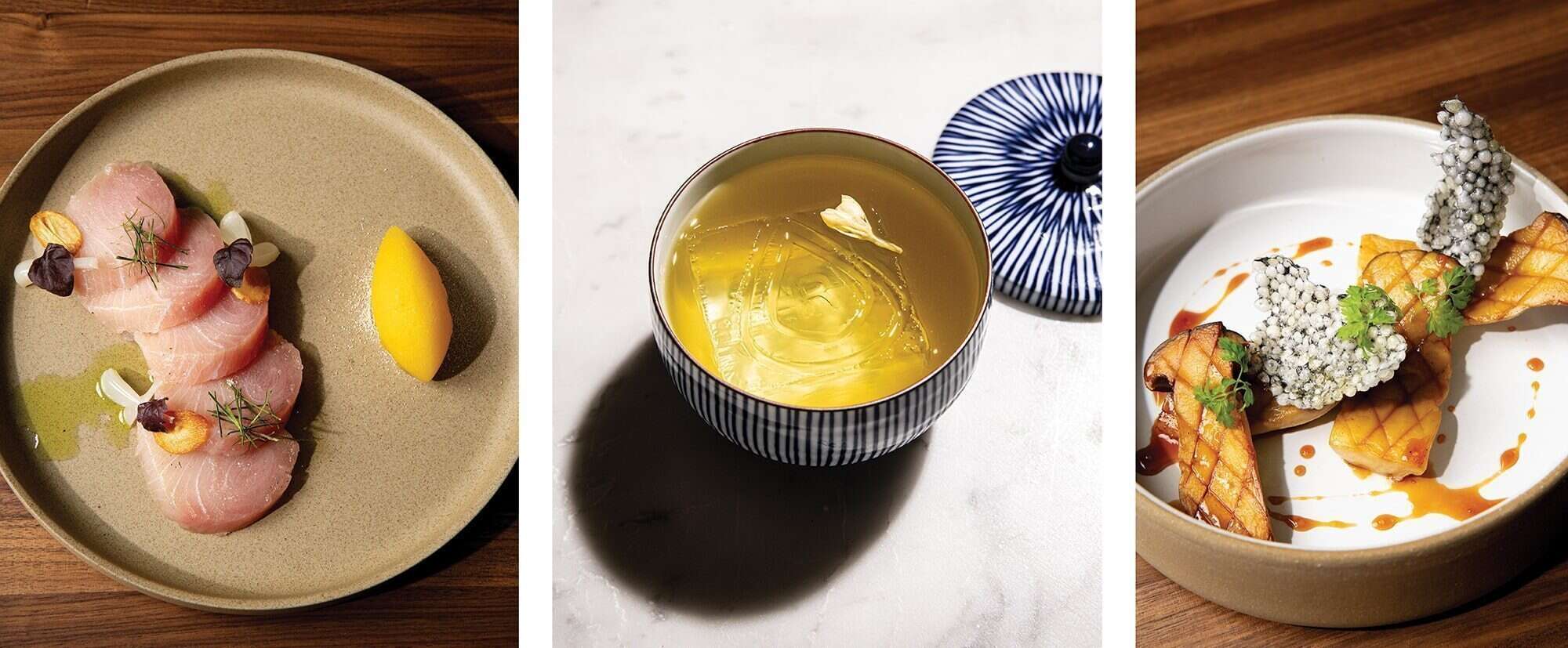
Even the simpler apps, like bánh tiêu — a hollowed-out loaf of bread served with whipped butter, local honey, fleur de sel and roasted sesame — are things you won’t find anywhere else. Ramie’s dessert menu is required viewing, too, thanks to Trinh’s background in French pastry. Her multi layered chè thái is a coconut pavlova adorned with durian pastry cream, fruit milk ice cream, jackfruit veil and shiso dust — another total original.
Unexpected course
The life of a chef-owner was never Trinh’s master plan. “I don’t think I ever imagined growing up and saying I’m either a chef or a restaurateur or anything,” she laughs, “by any means.” She describes once dreaming of a career as a singer, and later of one as an hotelier.
When she was 19, just weeks before she was slated to start her bachelor’s degree in business management and finance, her parents told her they had bought a Vietnamese restaurant — Pho T&N — and needed her to punt her college plans in order to help them restyle the restaurant as their own and open it as quickly as possible.
Within days, she found herself negotiating the first lease for the restaurant and figuring out how to commission a sign from a commercial sign maker — things she had never thought about. Once the shop was open, she ended up working the front of the house for six years while her parents cooked in the back.
Trinh has always been one to take challenges in stride. The Nguyen family moved to Washington state in 1998, after spending seven years in a refugee camp in Thailand, where her brother Thai was born. “My parents and my grandparents had multiple restaurants before the fall of Saigon,” she says, and although she didn’t always enjoy cooking herself, she’s always loved to eat and has been keenly interested in culinary processes, even back in Thailand.
“As a kid, when I was in the refugee camp, I would just sit and watch people cook and put things together. And I was always drawn into the dessert side of things.”

She eventually became a co-owner of Pho T&N, which is still in business in Poulsbo today, before opening the award-winning Ba Sa on Bainbridge Island with Thai in 2019. Ramie could be considered the next phase of their journey as chefs and restaurant owners, where no holds are barred when it comes to their combined culinary creativity.
“We didn’t open Ramie as a business,” Trinh says. “We opened it as a passion project. Thai and I really, really want to push the boundaries of Vietnamese food. I feel like it’s time. Every ethnic cuisine has gone through it, from pizza to pasta to sushi to hand rolls to ramen, (and) now to real rustic Vietnamese dishes, whether they’re eaten at home, or dishes that are just [beyond] what Americans know of the cuisine.”
Trinh eventually did go to college, earning her degree in finance and business management, and she spent years working in banking after graduating. It was her parents’ 2016 retirement that drew her back to the family business, along with Thai, to her own surprise.
Considering the acclaim Ramie has received in just a year — and the inspired dishes she and Thai have conjured up — it’s kind of impossible to imagine her doing anything else. Although it’s been a bit of an uphill climb to make this latest dream exist, Trinh figures it’s all in a day’s work.
“If it were easy,” she shrugs, “everyone would be doing it.”
Follow Us

Palace Kitchen Celebrates 30 Years
The Belltown staple still feeds the city after 10 p.m.
After the last tickets come off the rail, floor mats are hauled out to be hosed down, oven hoods are scrubbed, aprons come untied, and someone counts the drawer. It’s a familiar ritual in restaurant cities everywhere. When the shift ends, cooks and servers go looking for a drink and something to eat. For three…

Protein Without the Pressure
In her new cookbook, Seattle author and dietitian Rachael DeVaux keeps healthy eating grounded in real life.
Rachael DeVaux is not afraid of beef. That might sound obvious, but in a wellness culture still haunted by plain chicken breast and low-fat everything, her enthusiasm for grass-fed ground beef feels almost radical. The Seattle-based New York Times bestselling author, personal trainer, and founder of Rachael’s Good Eats has built a following of more than 3.5…

Restaurant Roundup: Nordic Cuisine and a Brazilian Brick-and-Mortar
Here’s what was served up recently in the Emerald City.
Monday nights are worth celebrating—you made it through the first day of the week, so why not treat yourself to a delicious meal? Unfortunately, but understandably, plenty of restaurants are closed. But at these spots, not only are the kitchens still serving, the quality doesn’t drop off post-weekend, providing a perfect opportunity for a surprise…

Whisky in the Wild
Good spirits.
Over the summer, Westland Distillery announced a new offering, inspired by Washington State. Made in Seattle and taking cues from the Northwest outdoor lifestyle, Watchspot Whiskey blends eight-year-old Westland American Single Malt with grain whiskey from America’s heartland, resulting in a pour that has notes of toasted grain, milk chocolate, biscuit, apricot, and cherry pie….