





Food & Drink
Read More ›
‘The Lunchbox’
Luke Kolpin brings a sense of experimentation and whimsy to his work at Cedar + Elm

Would you try salted caramel ice cream with hints of mushroom? How about pumpkin with a drizzle of seaweed oil? Chef Luke Kolpin, head chef at Cedar + Elm, located within The Lodge at St. Edward State Park in Kenmore, hopes you’ll give some unexpected flavor combos a try.
After nine years working at Noma – the famed Copenhagen restaurant repeatedly named the best in the world — and a stint on Top Chef, the 37-year-old Seattle native brings a spirit of experimentation to his new gig at a time when the Emmy-award winning TV series The Bear has raised interest in kitchen and restaurant culture.
Kolpin’s willingness to experiment began early in life, instilled by his mother, a nurse and talented home cook. Fed up with her son’s picky eating, she struck a deal with him: He had to try every dish once. If he didn’t like it, she’d never make it again. Turns out, he liked almost everything. By high school, his voracious appetite was so well-known that it earned him the nickname “Lunchbox.”


These days, Kolpin channels his adventurous palate into the menu at Cedar + Elm. Housed in a stately former seminary, the setting is somehow fitting for the chef, who has an almost monastic quality about him. He speaks about ingredients with reverence, despises waste, and strives to instill in all of his staff the idea that every task, no matter how small, deserves focused attention.
The ability to focus (or not) has been a defining theme in Kolpin’s life, at times serving as a source of intense anxiety, at other times — as in a kitchen, where dozens of things go on at any given time — serving as a superpower. Throughout childhood, he struggled due to learning disabilities that made focusing and reading difficult. Any time he had to speak in front of people, he’d seize up. “I can actually remember those specific moments still,” he says. At no point did he envision an ambitious career for himself.
His parents, who both worked at Harborview Medical Center, strove to navigate the education system for their son, but it wasn’t easy. The family lived in Queen Anne but, for a time, they sent Kolpin across town to Hamlin Robinson, a private school that specializes in helping students with learning challenges. Later, he attended Roosevelt High School, where he barely passed after failing a math class.
After graduation, Kolpin felt aimless until a close friend suggested he learn to cook since he loved to eat so much, so he enrolled in the culinary program at Seattle Central Community College. “From day one, I absolutely loved it,” he says. Though the academic requirements were tough, he made it through and landed a job at the former McCormick and Schmick’s on South Lake Union. Like many young chefs, he made moves quickly — spending a year at Canlis, then helping open a bistro in West Seattle. All the while, something like ambition began to brew within him. He’d buy cookbooks and emulate the dishes based on the pictures, since he still disliked reading. “Of course, I’d mess it up probably 10 times,” he says. “At that point, I was already used to everything of mine being wrong, with all my learning disabilities. So, it was fine, just trial and error.”
When Kolpin first saw a cookbook for Noma, the images enchanted him. But they felt oddly familiar, too. “I was like, those are Northwestern ingredients,” he recalls. Yet they were being prepared in ways he’d never seen. Itching to expand his horizons, he landed an internship at Noma. The catch: He told everyone in his life he was flying to Copenhagen for a job trial, not an unpaid, two-month stint with no guarantee of employment. “That was me lying to everybody on purpose,” he says. “I knew if I didn’t do that, I wouldn’t maybe apply myself as much. So (I told myself), you’re either not going to get a job, and feel like a catastrophic failure when you come back. Or you put this out there and make sure you don’t come back.”
So, on Jan. 1, 2012, 25-year-old Kolpin walked through the doors of Noma and into an alternate reality. There were chefs from all over the world, all at the top of their field, and the intensity was off the charts. Those problems with focus he’d fought all through childhood? Here, they were a gift. There was always something to prep, clean, or attend to.
On his second day, he got a harsh reality check when he was told there weren’t actually any job openings. He resolved to work as hard as humanly possible and hope for the best. To his immense relief, Kolpin was offered a job after all — one that would transform him as a chef and take him to Japan, Mexico, and Australia to open pop-ups.

Like many super elite restaurants, Noma’s reputation as a grueling workplace has come under heavy scrutiny. Former workers report 16-hour days and cutthroat chefs. But as Kolpin rose the ranks, he continued to clean toilets and sweep floors. “There wasn’t one thing that I was going to do that I wouldn’t ask anybody else to do,” he says. Over time, he says, the culture changed to be more empathetic, and he feels he was an integral part of that shift. Indeed, Noma’s creator, René Redzepi, has said he’s closing the restaurant for regular service at the end of 2024 in large part because it’s not possible to maintain the business model while also treating workers fairly.
Eventually, Kolpin was called home by a desire to be near his family. In 2022, he did a stint on the Bravo reality show Top Chef after his friend, fellow local chef Shota Nakajima, recommended him. He did it, he says, “to motivate himself” again. His old reading anxieties returned when one of the competitions required reading a dossier to create a dish in a short period of time. “That was probably the biggest panic I had,” he recalls, adding that he felt no bitterness when he lost. “It was a lot of fun.”
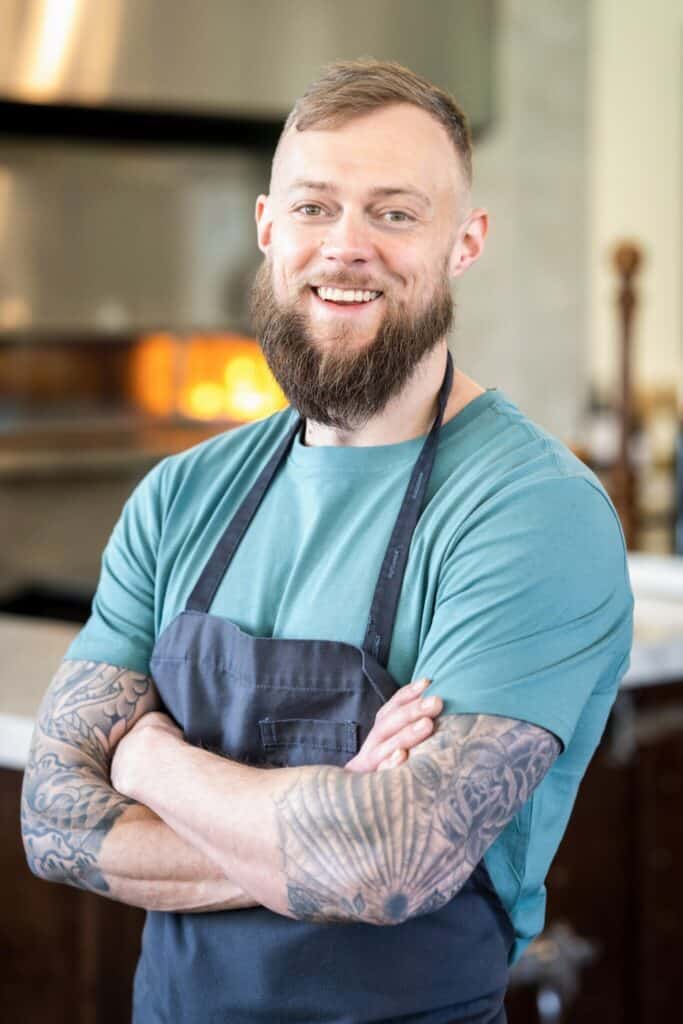
Last year he was offered a job at The Lodge, where he’s been able to build a menu that has the fingerprints of Noma all over it: He puts produce front-and-center, and seaweed makes an appearance in many dishes in untraditional ways, as do mushrooms.
Mentoring this team is of great concern to Kolpin, at least as much as the food itself. For one, he knows he can only put certain dishes on the menu if the staff has the skills to create them. But he also wants to foster staffers’ potential for their own sake. It’s as if he’s seeking to give people the education he often struggled to find. Like the seminary’s professors who once educated generations of aspiring priests within the hotel’s walls, Kolpin has his mentees’ futures in mind.
“I want everyone to know how to do everything,” he says. “Not only is that good for this place, but when they decide to leave, I want to encourage them to be able to go do that and give them the skill set that they need to be successful in their next job.”
If Kolpin could speak to his younger self, he’d reassure him: “You’re not that much different. You just think and look at things differently. And maybe in a better way.”
Follow Us

Restaurant Roundup: 3 Pearls and Restaurant Week Redux
Here’s what was served up recently in the Emerald City.
When something tastes good, you gotta go back for seconds—and that’s exactly what we’re doing for this fall’s Seattle Restaurant Week, Oct. 18-31. Building off a successful spring spread, this edition brings back curated menus at various price points ($20, $35, $50, and $65) at restaurants, bars, cafes, and pop-ups across the greater Seattle area….

House Special: A Taste of Ecuador at Bad Chancla
Chef José Garzón brings a coastal Ecuadorian classic to his 335-square-foot Capitol Hill kitchen, where he hopes to introduce more dishes from home.
There is not much room at Bad Chancla. The bright pink walk-up on East Olive Way seats a handful of people elbow to elbow, mostly outside, and the kitchen behind the counter is small enough that chef and co-owner José Garzón can talk to you while he cooks. Garzón grew up between Guayaquil and the…

Opening Night: GoodMart Makes Lunch Feel Like Luxury
Victor Steinbrueck, owner of Fremont’s acclaimed Local Tide, opens his second seafood-centric restaurant in the heart of Ballard.
On a Thursday afternoon I was able to walk right up to the counter at GoodMart on Ballard Avenue and order lunch, which surprised me. GoodMart is owned by Victor Steinbrueck, who opened Local Tide in Fremont during the height of the pandemic (August 2020) and built it into one of Seattle’s most acclaimed seafood…

Where to Warm Up With a Drink This Fall and Winter in Seattle
From swanky speakeasies to a cozy literary bar, these spots serve inventive cocktails and zero-proof options.
Seattle’s drearier days are slowly arriving, but it’s not all gray and gloom from here. Finding a cozy spot to warm up is part of the trick to enjoying the darker, colder months. The right place lets you bring a friend, a book, a journal, or simply yourself, and let time pass by. Whether you…