
The Sea Cowboy
Nick Mendoza wants his snacks to provoke thought as well as taste
By Stefanie Ellis January 1, 2024

This article originally appeared in the November/December 2023 issue of Seattle magazine.
When Nick Mendoza spent summers at his grandpa’s cattle ranch in southwest New Mexico, it never crossed his mind that he’d one day be known to friends as “Nick the Fish Guy.” If anything, the image of him on a horse with a lasso while wrangling cattle seemed more on brand. But today, he wields a metaphorical trident as CEO of Neptune Snacks, the Seattle company he founded in an effort to find sustainable solutions for excessive food waste in the fishing industry.
The sea-loving part of him first pursued a career in marine science. He tagged great white sharks in California, researched ways to improve the sustainability of oyster farms in Scotland, and explored the inner workings of a large shrimp farm in Central America. He soon discovered that his advocacy for the ocean could only go so far in his chosen field, though he never thought he’d launch a seafood snack company.
“In science, you don’t always get to tell stories,” says Mendoza, whose childhood in San Diego spurred a love of the ocean, but who notes that his entire family consists of mountain people. “When a project is done, it kind of goes on the shelf to get dusty. It became obvious that certain solutions are in the hands of industry and consumers, not scientists. I wanted to figure out how to change things from the consumer standpoint.”
Mendoza had long been dreaming of creating a company that would change the way people understand food systems, so he moved back to his family’s ranch with the intention of creating a farm-to-table enterprise. Given the abundant meat resources around him, beef jerky seemed like a good entry point, but while conducting land-based research, his thoughts continually drifted to the sea.
He soon found himself remembering how his friends always leaned on him when it came to his knowledge of fish (he was also a consultant for the Monterey Bay Aquarium’s renowned Seafood Watch program, which rates the environmental sustainability of fisheries and farms). “Nick the Fish Guy” was born.
“I’d get a text or call when my friends were standing in front of the frozen fish aisle at the grocery store, asking if what they were buying was sustainable or safe,” Mendoza recalls. “People want an answer like, ‘don’t eat farmed fish’ or ‘it’s OK to eat Alaska King Salmon,’ but it’s a complicated story. That was the epiphany moment for me.”
That moment of clarity helped him realize that while beef products had a notable presence in the U.S. snack food category, seafood was missing. During his years as a marine science and sustainable aquaculture researcher, he worked in eight different countries, where he sampled dozens of seafood snacks, and was always surprised to return to home to find that fish jerky had yet to gain a foothold.
After selling some cattle to purchase his first commercial dehydrator — followed by a lot of research and trial and error — Mendoza was able to mimic the taste, texture, and aroma of beef jerky using fresh fish that processors deemed imperfect in size or shape, thus relegating it to pet food, fertilizer, or the landfill.
He likens this type of waste to imperfect produce, where a misshapen apple tastes the same as a perfectly shaped one, yet more frequently ends up in the landfill instead of someone’s lunchbox. Figures from the USDA’s Economic Research Service estimate that food waste in the United States is around 30% to 40% of our total food supply, which means we’re discarding upward of 133 billion pounds of food each year.
“Seafood is the most traded food commodity in the world, yet there is so much waste that happens with perfectly good fish,” Mendoza adds. “Of the (nearly) 4.7 billion pounds of seafood bought, sold, and traded each year in the U.S., 50% of that is wasted. If a 4- to 6-ounce filet rips or has a different shape, it ends up in sack ends, where there is almost no market. Hundreds of thousands of pounds of fish are built into processor margins as accepted loss.”
By keeping waste from the landfill and creating new products from existing resources, companies like Neptune are contributing to what’s known as the circular economy.

Neptune Snacks launched in 2019, after being a part of into first cohort of the Maritime Blue Innovation Accelerator — a partnership between Washington Maritime Blue, the Port of Seattle, and the Washington State Department of Commerce that connects mentors and advisers from across the world with maritime businesses to help them develop ideas, expand production, and secure funding.
Each package of Sweet Citrus Ginger, Sea Salt and Juniper, Spicy Cajun and Cracked Pepper jerky uses wild Alaska pollack and U.S. West Coast rockfish from U.S. wild fisheries, with full traceability to the fish, fisher, and fishery from which they came — something Mendoza says is infinitely important, but most consumers don’t know much about.
“Source traceability is a tool for maintaining food safety, identifying and tackling illegal practices, verifying environmental sustainability, and ensuring that fraudulent and unethical seafood can’t be disguised in supply chains,” he explains.
Neptune fish jerky can be found at PCC, Bartell Drugs, QFC, the Space Needle, Sea-Tac International Airport, and in local distilleries and breweries. It is already making a splash across the country. Mendoza says a surprising number of convenience stores and conventional grocery stores have joined the list of retailers. In September, the company announced the launch of pescatarian snack sticks made of wild Alaska pollack, bringing seafood into the snack category in style.
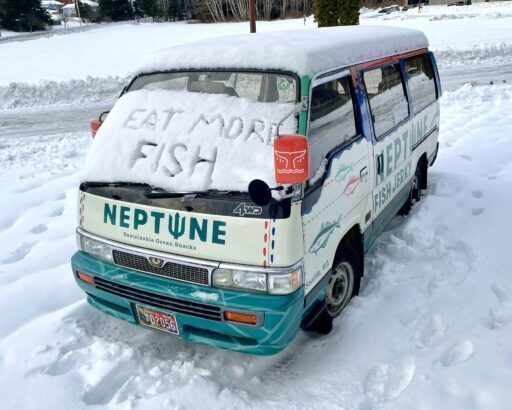
“Seafood is on people’s radar,” Mendoza notes. “It has always been recognized as a healthy protein choice, but in the last couple of years, I’ve seen interest and sophistication in seafood sustainability grow with (things like) tin fish becoming hip and trendy. But no matter how big we grow, it’s a drop in the bucket in terms of the scale of change that is needed, so what we really hope to scale is how society thinks about our food system.”
Mendoza ultimately hopes his seafood snacks spur thought as well as taste.
“We hope when someone sits down to order fish, they’re thinking about where it’s coming from and what the supply chain is behind it,” he says. “Consumers can vote with their dollar to create positive change. They just need to understand the problem and be offered solutions.”
Follow Us

Palace Kitchen Celebrates 30 Years
The Belltown staple still feeds the city after 10 p.m.
After the last tickets come off the rail, floor mats are hauled out to be hosed down, oven hoods are scrubbed, aprons come untied, and someone counts the drawer. It’s a familiar ritual in restaurant cities everywhere. When the shift ends, cooks and servers go looking for a drink and something to eat. For three…

Protein Without the Pressure
In her new cookbook, Seattle author and dietitian Rachael DeVaux keeps healthy eating grounded in real life.
Rachael DeVaux is not afraid of beef. That might sound obvious, but in a wellness culture still haunted by plain chicken breast and low-fat everything, her enthusiasm for grass-fed ground beef feels almost radical. The Seattle-based New York Times bestselling author, personal trainer, and founder of Rachael’s Good Eats has built a following of more than 3.5…

Restaurant Roundup: Nordic Cuisine and a Brazilian Brick-and-Mortar
Here’s what was served up recently in the Emerald City.
Monday nights are worth celebrating—you made it through the first day of the week, so why not treat yourself to a delicious meal? Unfortunately, but understandably, plenty of restaurants are closed. But at these spots, not only are the kitchens still serving, the quality doesn’t drop off post-weekend, providing a perfect opportunity for a surprise…

Whisky in the Wild
Good spirits.
Over the summer, Westland Distillery announced a new offering, inspired by Washington State. Made in Seattle and taking cues from the Northwest outdoor lifestyle, Watchspot Whiskey blends eight-year-old Westland American Single Malt with grain whiskey from America’s heartland, resulting in a pour that has notes of toasted grain, milk chocolate, biscuit, apricot, and cherry pie….