





Health + Wellness
Read More ›
Hacking Your Body For Better Health
In a bid for longevity, everyone—from experts to amateur athletes—is experimenting with ways to optimize their own biology.

This article originally appeared in the July/August 2026 issue of Seattle magazine.
When Frank Marinkovich, M.D., climbs Mount Kilimanjaro this fall, he’ll have a stronger head start than the typical hiker coming from sea level.
That’s because the internal medicine doctor has been spending time with a device called the Metabolic TrainerTM , which involves wearing a mask that cycles between releasing reduced-oxygen air and air with normal oxygen levels. Hypoxic training, as it’s known, can help acclimatize someone’s lungs to the thinner air at higher elevations. Those who aren’t planning high-altitude adventures report benefits that include increased mental clarity, improved insulin sensitivity, and better mitochondrial function.
The Metabolic TrainerTM is just one of more than a dozen gadgets at Bellevue’s Upgrade Labs, a biohacking facility that harnesses AI’s power to help people improve their health and well-being. It’s the brainchild of Dave Asprey, also the founder of Seattle-based Bulletproof Coffee, who plans to live to be at least 180.
“It’s working with your own genetics to have the most optimal function you can have.”—Claudia Arregoytia, M.D., N.D.
Indeed, the faces of biohacking tend to be tech guys who spend unfathomable sums in their quest to live forever—or at least a really long time. Well-known biohacker and entrepreneur Bryan Johnson is hoping to achieve immortality by 2039, and while Asprey has put $2 million toward extending his lifespan, Johnson spends $2 million every year on this pursuit. (It goes toward hundreds of supplements, hyperbaric oxygen therapy, and a team of medical professionals to monitor him, among many other things.)
Many of us are familiar with the term “biohacking” and have a vague sense that it’s about finding a cheat code to slowing the aging process. But what exactly is biohacking, and who is it for?
“It’s working with your own genetics to have the most optimal function you can have,” explains Claudia Arregoytia, M.D., N.D., a functional medicine physician who supervises naturopathic medical students at Bastyr University. Biohacking involves making incremental changes to optimize your body and mind, experimenting with what works best for you. And, no, you don’t have to be a millionaire to partake.
Those changes can be the kind of expensive, untested methods that make headlines—like plasma transfers, self-implanted devices, and DIY DNA modification—or they can be simple strategies like getting light first thing in the morning to regulate your circadian rhythms or walking barefoot in the grass. Biohacks once on the fringes, such as intermittent fasting and cold plunging, have gone mainstream as of late.
Debra and Kevin DeLashmutt, an active couple living on Bainbridge Island, hadn’t heard the term “biohacking” until a handful of years ago, but they’d always been interested in clean food, taking supplements, and trying to live as well as possible. They’d found some health equipment they really liked, but the cost made it prohibitive to own. When they learned about the opportunity to franchise Upgrade Labs, it was a perfect fit—they could get access to the gadgets they wished they had while also helping others. “The fun part of it is we get to bring all of this technology that’s being used by elite athletes, celebrities, and billionaires to the everyday people,” Debra says.
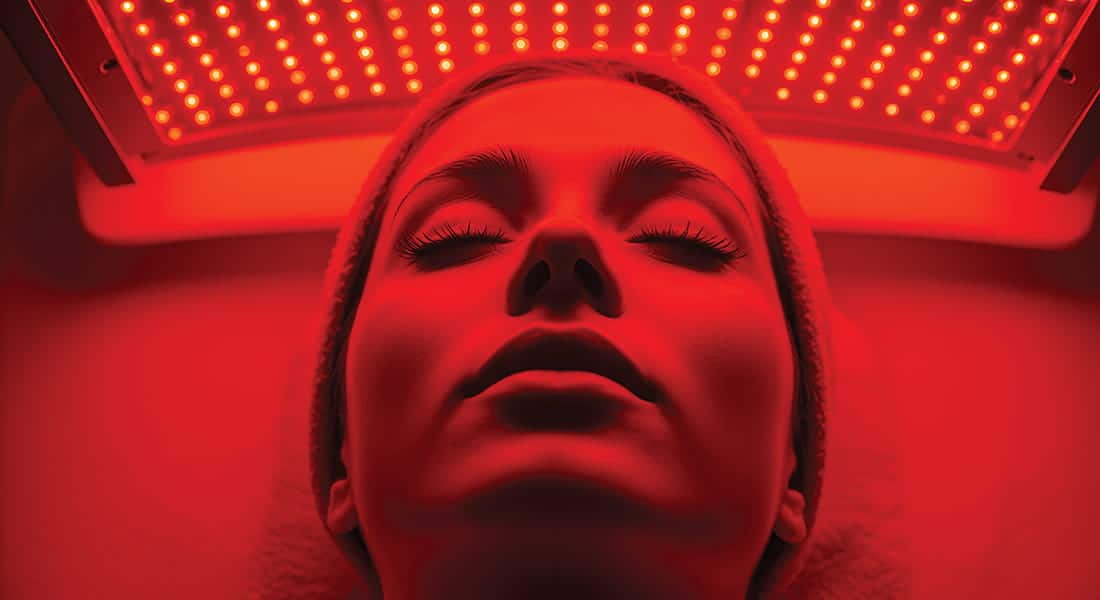
The Bellevue facility includes a variety of machines that target recovery, performance, and cognition. The most popular is a red-light bed that uses red, near-infrared, and green light to stimulate circulation, induce deep relaxation, and promote muscle recovery, among other benefits. While red light is often used to improve the skin’s appearance, the DeLashmutts say this bed is the only one of its kind in the area that has the frequencies, light, and harmonics to penetrate energy to the cellular level.
There’s also a stationary bike that consolidates a 40-minute workout into 9 minutes, a robotic back massager to relieve stiffness along the spine, and a neurofeedback device that trains your brain to enter into a state of calm.
Since owning Upgrade Labs, Debra says she’s gotten stronger and leaner, lost some visceral fat, and noticed improvement in her tremors. Kevin is able to manage his tinnitus so that he no longer has a constant ringing in his ears.
“My mom is 93, and she was just out playing pickleball with her great-grandchildren. I want to be 93 and have the ability to run around a pickleball court with a 7-year-old.”—Lisa Dupar, Owner, Pomegranate Bistro and Lisa Dupar Catering
Part of Biohacking’s rise can be attributed to wearable technology, which has given us access to previously difficult-to-come-by data. “A lot of people don’t realize how sedentary they are until they see it,” Dr. Arregoytia says. Though she’s cautious about robotic and AI-based treatments, she thinks tech has some upsides, such as helping people see their heart rate variability (HRV), which measures the amount of time between heartbeats. This can offer insights into one’s health—a drop in HRV could signal poor sleep, dehydration, illness, or stress. People can now monitor in real time how factors like alcohol affect their HRV, and with that info, many are motivated to make lifestyle changes.
While biohacking is becoming more popular nationally, thanks to increased attention via public figures, there are plenty of Puget Sounders who’ve been at this for years. Lisa Dupar, who owns Pomegranate Bistro and Lisa Dupar Catering, jokes that if she weren’t a chef, she’d be a homeopathic doctor. “I have always been obsessed with holistic healing techniques; how can we naturally heal from something without drugs or some medical procedure,” she says.
Dupar knows her job may seem contradictory to achieving optimal health—after all, she wrote a cookbook called Fried Chicken & Champagne—but she’s always invested a lot of time in understanding the sources of her ingredients. Some of her favorite biohacks are transcendental meditation and tapping, a practice she’s been doing for more than 20 years that involves tapping on specific acupressure points in combination with mindfulness techniques. It’s said to rewire the brain’s neural pathways.
Ultimately, Dupar hopes to keep her energy up as long as possible. “My mom is 93, and she was just out playing pickleball with her great-grandchildren,” she says. “I want to be 93 and have the ability to run around a pickleball court with a 7-year-old.”
Energy is also the goal for Dr. Marinkovich—who leads Eastside Family Health Center and serves as the medical director at Optimum Peak Wellness—especially as he prepares for Mount Kilimanjaro. It’s only in the past couple of years that he’s started to learn more about biohacking, and he believes there’s a place in medicine for a variety of perspectives. “It’s important not to become so narrow that we believe only Western medicine is good or only Eastern medicine is good, or only biohacking is good or only medications are good, or all medications are evil,” he says.
It can take a long time for studies and FDA approval to come through on things that may be beneficial, but there are also risks to trying unproven treatments—plus, something that works for the person next door could have the opposite effect on you. Dr. Marinkovich advocates a balanced approach, and both he and Dr. Arregoytia recommend undergoing testing first to uncover any underlying health conditions or predispositions that may impact your results. This will also help you streamline your efforts and understand what to focus on as you move forward, such as increasing cardio stamina, improving nutrition, or adding strength and resistance training to your regimen.
“I love biohacking because you’re empowering people to take ownership of their own health. We need to keep reading, we need to keep studying, and we need to surround ourselves with experts,” Dr. Marinkovich says. “My goal for myself, and all my patients, is to be the best steward of my body and my brain that I can be and to use all the information while having a solid foundation of science, biochemistry, and physiology.”
Follow Us

K9s For Warriors Helps a Whidbey Island Veteran Get Back Out Into the World
With his service dog Atlas beside him, Navy veteran Justin Hughes is finding his workdays—and everyday outings—easier to navigate.
When Justin Hughes gets frustrated while on his computer at work, a nose sometimes appears between the armrest and the back of his chair. It belongs to Atlas, his service dog, who has been resting on a bed behind him. Hughes runs simulators for the military, and irritation can build before he recognizes what’s happening….

Seattle Sauna Festival Returns to Ballard for Another Round
Mobile saunas from around the Northwest will gather at the National Nordic Museum November 7-8.
In Seattle, November is usually something to face in a raincoat. At the National Nordic Museum, you can meet it in a bathing suit. The Seattle Sauna Festival returns to Ballard November 7-8 for its second year, bringing mobile saunas from around the Northwest onto the museum grounds. Visitors can try several, cool off in…

Seattle Is Changing the Conversation Around Death
Death is one of life’s few certainties, yet it remains remarkably difficult to talk about. Across Seattle, a growing network of practitioners, advocates, and entrepreneurs is trying to change that. From grief walks to death doulas, Seattle is building a new language around loss, and one woman wants to bring more of that conversation into…
