





Outdoors
Read More ›
Freediving to an Otherworldly Place
Taking the plunge on a 7,000-year-old practice in the cold waters of a Northwest lake.

This article originally appeared in the September/October 2026 issue of Seattle magazine.
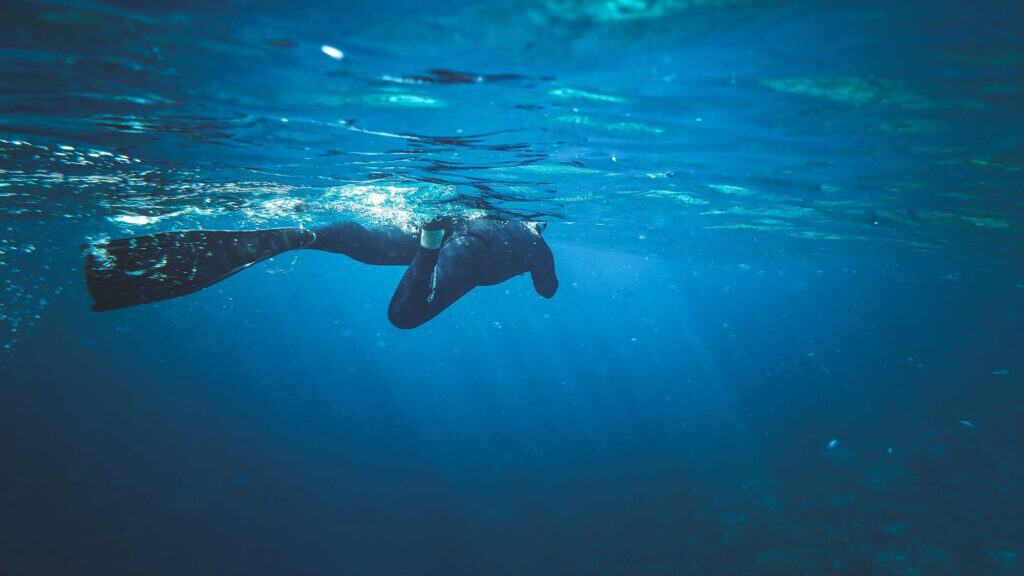
On a crisp, clear day, this spring, I stood at the edge of Lake Washington, ready to slip into the water and do something I’d never done before. Wrapped in thick neoprene, with goofy tight-fitting goggles on my face, and long, powerful fins on my feet, I felt as prepared as I’d ever be. Along with five other students, I slowly swam out to where the water was deeper. We were all there for the same reason: to learn how to freedive.
Freediving is the act of diving underwater on a single breath, without oxygen tanks or other breathing apparatus. People have been freediving as a way of fishing and harvesting for thousands of years. For many, it’s the purest form of obtaining one’s own food. As a recreational activity, freediving has been going on since the early 20th century. At its core, the activity is a way to shed our landlubber muscles and enter an underwater arena that few have the opportunity to experience.
Ryan Strong is one of those people who fell under the spell of freediving. “It gave me the opportunity to enter a world that feels otherworldly,” he says, “to move through the water on a single breath, and to experience what it feels like to adapt to the underwater environment in a way that is both humbling and inspiring.” The way freediving made him feel led Strong to start Renssant Freedive with the goal of teaching others how to dive safely and develop a deeper connection to the natural world.
Starting my freediving journey, I noticed the immediate juxtaposition of something so elementally simple feeling both difficult and exhausting. There I was, in a freezing cold lake, with weights strapped to a belt around my waist (to help create neutral buoyancy), learning how to equalize the pressure in my ears (using a special nose-pinching technique known as the Frenzel). It felt like there were a million pieces of new information spinning in my head. Not only does freediving require you to hold your breath for long periods, but you must also learn how to use your body efficiently, kick your fins in synchrony, position your body just so—and ultimately let go in order to dive farther.
The dichotomy of pushing the body to its limits while simultaneously giving up control is part of the intrigue for Strong. “What makes freediving unique is that success is often achieved not by pushing harder, but by learning to let go and relax,” he says. He teaches his students that by letting go of the fear, panic, and insecurity that can initially come with freediving—and trusting their bodies—they are far more capable than they think.
Most people think of freediving as something people do in tropical climates, like Hawaii or the Caribbean. When Strong started freediving, there were no instructors in the Seattle area, and he decided that teaching people under the Freediving Instructors International lens was an opportunity to help others safely get into the sport. Despite the simplicity of freediving, there are inherent risks, and Strong relies heavily on safety above all.
During my FII Level 1 Freediver course, we started with several hours of classroom learning before entering the water. We not only learned breath-holding techniques, but also about what can go wrong underwater, and how to mitigate the risks. It was clear from the start that freediving wasn’t about just putting on a bathing suit and trying to dive as deep as possible on a single breath of air.
Strong taught us that while freediving can be very safe, it can also be fatal. “When divers follow established safety protocols, serious incidents are relatively nonexistent,” he explains, “but the consequences of poor decisions or diving alone can be catastrophic.” For that reason, he relies heavily on his training, in addition to his small team of instructors, Benjamin McElroy and Viktoryia Zhuleva, to make sure his students focus on processes and procedures while freediving, rather than simply winging it.
You must also learn how to use your body efficiently, kick your fins in synchrony, position your body just so—and ultimately let go in order to dive farther.
After two days of rigorous training and mind-expanding learning, only two of our group of six students passed the exam to become FII Level 1 certified. Exiting Lake Washington on our last day, I was exhausted, a little disheartened, and slightly defeated. I hadn’t mastered the equalization technique, which meant I couldn’t dive as deeply as I would have liked, and my kicking technique was poor. After debriefing with Strong on the shore, I told him that I wasn’t sure freediving was for me.
A few days later, upon reflection and some much-needed rest, I emailed Strong: “Initially, I thought maybe freediving wasn’t for me, but after a little bit of time to reflect, I don’t think my journey is over!”
The thing about freediving is that there is nothing quite like it. The quietness of being underwater, seeing animals and sea plants, feeling weightless, and pushing deeper into the abyss is what keeps freedivers seeking more. “It’s a practice that combines adventure, personal growth, connection, and a profound appreciation for the underwater world,” Strong says. He hopes more people will come to see for themselves why freediving is so special, even if it involves heavy wetsuits, cold water, and a lot of practice.
Follow Us

Finding Fortitude Through Triathlon
More than 2,000 athletes will take on IRONMAN 70.3 Washington Tri-Cities Sept. 20, testing their endurance—and finding benefits that go far beyond physical fitness.
In 2005, Jennifer Comfort was a new mom who wanted some exercise. She joined a gym, where she met a fellow Jen who had just done a triathlon. Comfort had no idea what that meant—it’s a sporting event with a swim, bike, and run component—but she signed up for one anyway. “I doggy-paddled the swim,…

Helsinki is Like Seattle—Only More Hockey-Obsessed
As the Kraken head to Finland in November for their first regular-season games outside North America, Seattle fans will find ferries, coffee, craft beer and a familiar devotion to life by the water.
We were maybe 15 minutes into our inaugural Helsinki stroll when my kid asked the question my jet-lagged brain had mulled over but filed under “later”: “Where are all the cars?” We were walking down Esplanadi on a bright June evening near the summer solstice, and the street noise was mostly gulls and the whine…

Who Let the Dogs In? The Mariners’ Bark at the Park Is Seattle at Its Best
Baseball is better with a few hundred dogs in the stands.
Every so often, a city reveals its personality in the smallest and most delightful of ways. In Seattle, that might just be a baseball game … with dogs! The Seattle Mariners host “Bark at the Park” several times each season at T-Mobile Park, and if you haven’t been, you’re missing out on a high dose…

Why I Built a Pickleball Club With My Daughter
My father showed me how to turn my love of sports into something lasting. Pickle at the Palms carries that lesson forward.
Looking back, I wouldn’t say my family teaming up to launch Pickle at the Palms—a new 20-court indoor pickleball club—was inevitable, but it may have been predictable. Sports have shaped my life for more than 50 years. I fell in love with rowing as a 17-year-old college freshman and went on to compete on two…