





Outdoors
Read More ›
The Great Outdoors Goes High-Tech
The all-electric Pebble Flow can hitch itself, power a house, and make camping feel a little like space travel. And Seattle is one of its biggest markets.

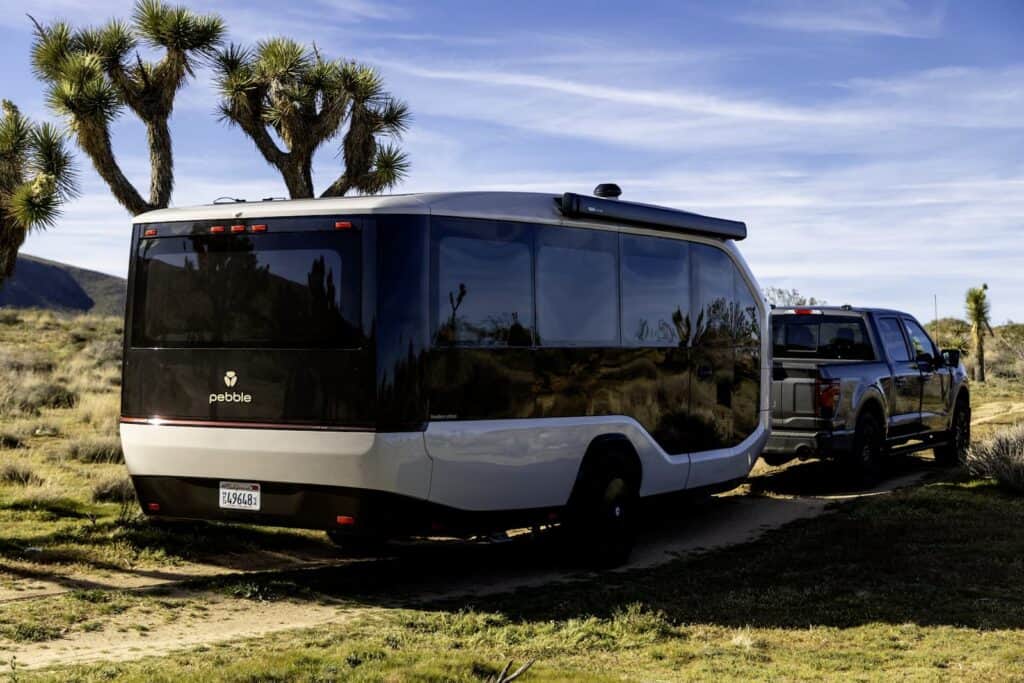
When Ted Theocheung pulls into a campground, people can’t stop staring at his rear end.
Theocheung, a tech entrepreneur, is an avid outdoorsman—by land and by sea—who lives near the University of Oregon’s campus in Eugene. About a year ago, he was one of the first Americans to take delivery of a Pebble Flow RV trailer, an all-electric travel trailer that resembles an elongated iMac, with fun colors to match.
When Pebble’s head of design, Page Beermann, set out to design the Pebble Flow, he faced something of a quandary. “Tech and cozy is not something I have a lot of experience marrying,” says the former BMW designer. Beermann and his team settled on the following governing concept: “What if NASA were designing a product for Joshua Tree? It’s our moon buggy.”
“It feels like you live in a spaceship, and you come out and you’re like, ‘Where am I?’ ” says Missy Hartley, a Pebble Flow owner who resides in Arizona and organizes yoga retreats in Costa Rica. Everywhere Theocheung goes, he’s asked about his moon buggy/spaceship of a trailer. “If you’re an introvert, this isn’t the trailer for you,” he says.
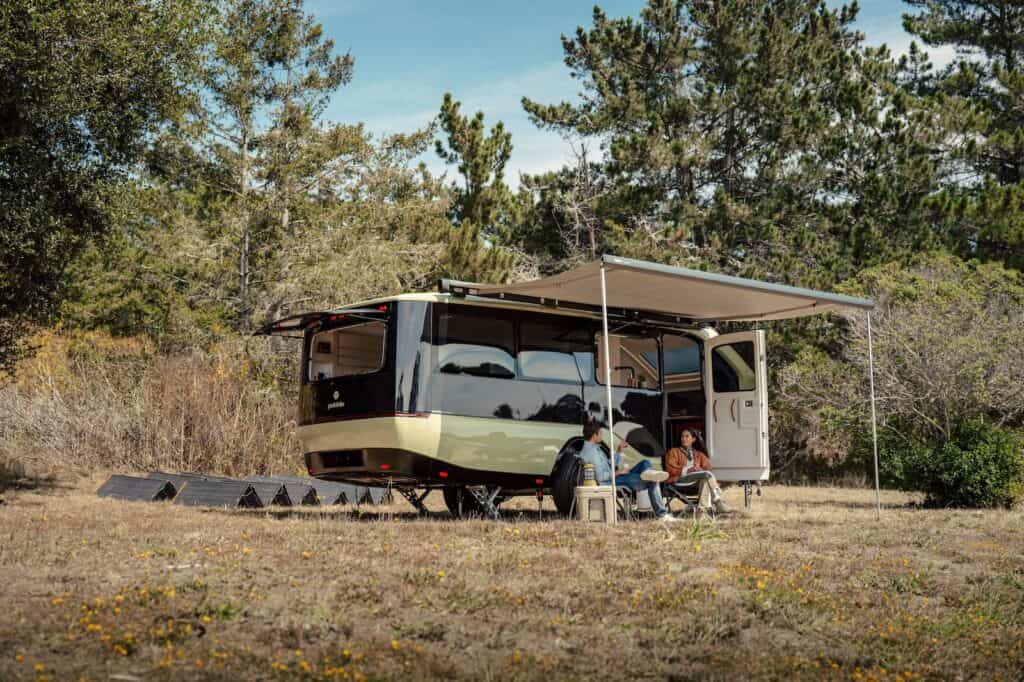
The Pebble Flow is the brainchild of another tech entrepreneur, Bingrui Yang. In a story that’s not exactly uncommon, Yang took his first travel-trailer camping trip during the coronavirus pandemic, renting a vintage Airstream for the excursion. He loved the freedom to roam that the Airstream afforded him and his family, but “that freedom was just so hard,” the Pebble CEO says at the unveiling of the 2027 Pebble Flow at the Costanoa campground off Highway 1 on the north-central California coast. “Every second was just so stressful.”
A former Apple engineer who went on to develop autonomous vehicle hardware systems for Zoox and Cruise, Yang found himself uniquely positioned to harness “all this technology” and solve what he considered to be a serious recreational problem. What he and his team at Pebble—which is based in Fremont, California, and includes several Apple and Tesla alumni—came up with was, as Yang put it, “the world’s first all-electric, hassle-free, self-propelling trailer.”
“It’s Apple design meets Tesla tech,” Yang says.
With its own motor and camera, the Pebble Flow attaches itself to the hitch ball of a truck or car through the touch of an orange button on the trailer’s iPad, which controls everything from lighting to heat. Yang describes the self-hitching function as akin to “a spaceship docking on a space station.” The Pebble sales associate who was demonstrating the self-hitching function at the Costanoa launch event used a more earthbound analogy, describing the feature as “the marriage saver.”
Given its relative affluence and abundance of outdoor activities, Seattle is a top-five market for the Pebble Flow, which offers models ranging from $159,000 to $189,000 but is planning to bring a more modestly priced version to market. The Pebble Flow is powered by a 45-kilowatt-hour battery that can be recharged via plug-in stations or rooftop and external solar units that are among the trailer’s options.
As Yang pointed out, when parked at home, the Pebble Flow can serve as a detached office, accessory dwelling unit or guest room. In the event of a power outage, its battery can also serve as a long-lasting backup power source for an entire home—or, as happened at Costanoa, the power source for a mobile chef’s kitchen.
At Costanoa, the Pebble team arranged to have a lavish, protein- and vegetable-heavy dinner served by Chef Ryan Davis, a constant presence in the televised “foodiverse.” Knowing he would be cooking outdoors, Davis and his crew naturally brought along generators—which Yang politely told them to put away once they arrived. Instead, the various cooking stations and strings of overhead lights were powered exclusively by a Pebble. “It’s like a microgrid on wheels,” Yang says.
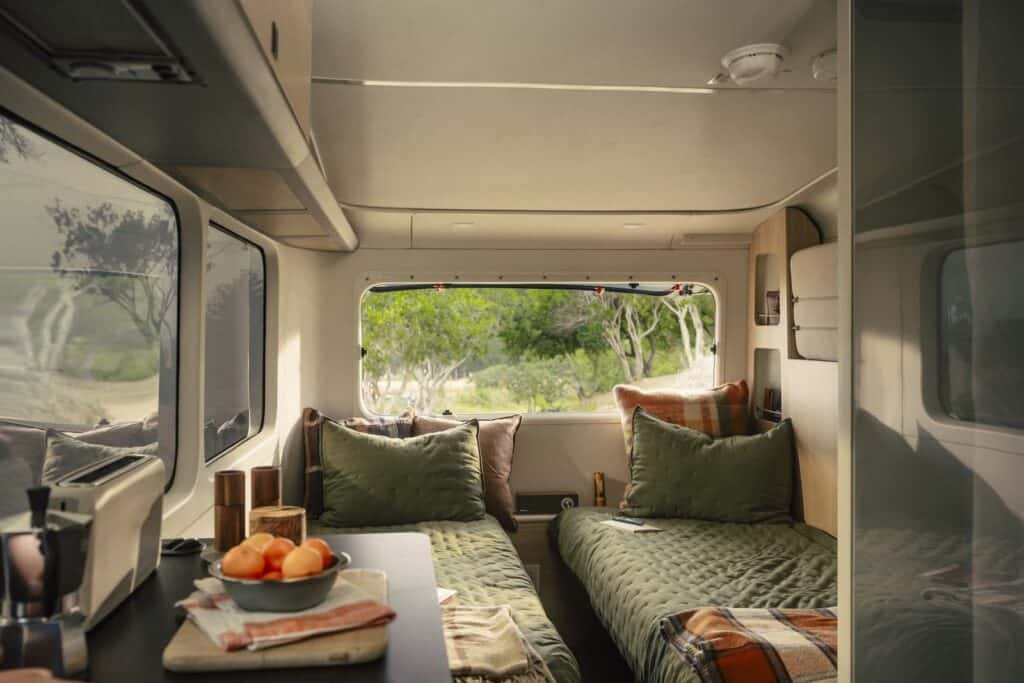
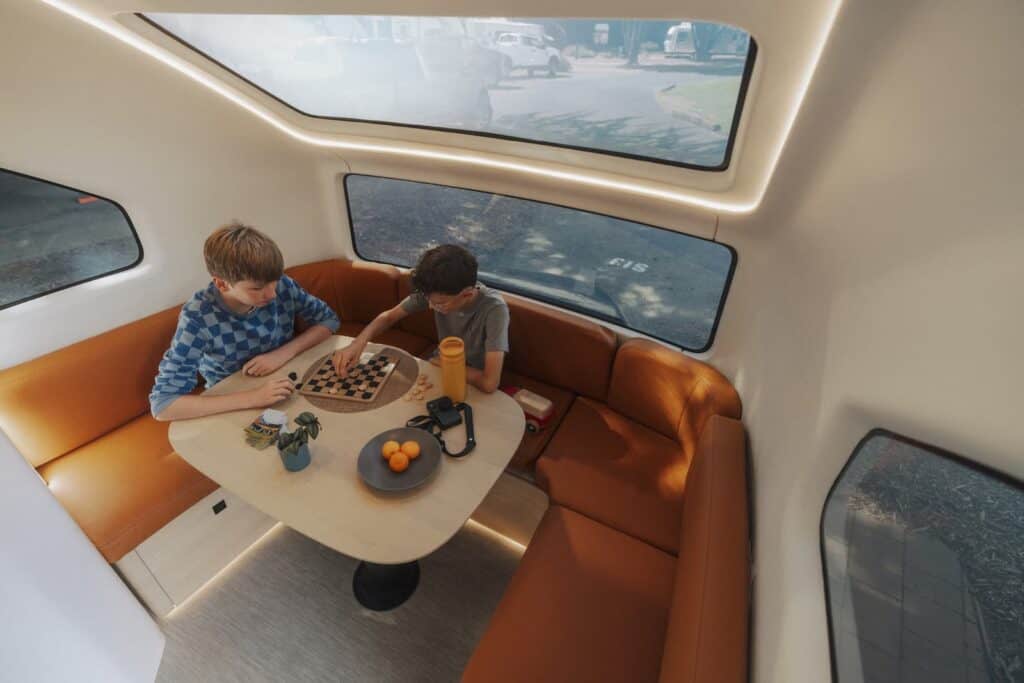 Inside, the Pebble Flow is clean and sleek, its windows able to switch from clear to opaque through a touch of the iPad. The appliances—a refrigerator and a combo microwave/convection oven—are 110 volts rather than the 12-volt standard for travel trailers. There’s a dining section with a booth on one end of all models that can be transformed into a bed for two once the table is dropped to a lower level and the back cushions are repositioned to serve as part of the sleeping area.
On the other end of the trailer, there are two configurations. Originally, the Pebble Flow was designed with an office table that folded out into a queen-sized Murphy bed. That configuration is still available in the 2027 model, which also does away with the workspace in favor of two twin beds that can be combined into a king-sized bed. And for maximum privacy among inhabitants on either side, there’s a detent that allows the bathroom door to act as a fixed partition.
In the middle are the kitchen, which features a detachable stovetop that can be moved outdoors for al fresco cooking, and a bright bathroom with a well-separated shower. It should be said that this trailer, like most travel trailers, is not especially wide. If you are a big or tall person, like I am, it can be quite snug. And if you happen to be doing some lateral resistance-band stretching near the bathroom at the precise moment that your wife opens its door, as I was, you’re liable to get slammed in the side of the head, as I did. The lesson there is to do those stretches outdoors—under the ample awning if it’s raining cats and dogs.
Pebble’s chief technology officer, Stefan Solyom, is an Apple and Tesla alum of Hungarian descent who sounds like a Bond villain if that villain were actually nice. “The behavior of the Pebble is defined by software, and software shifts,” he says, noting that, as with an iPhone, software and operating-system upgrades are pushed out to every existent Pebble free of charge.
Solyom and I climbed into the cab of an F-150—me at the wheel, he with the Pebble’s iPad in his hands. We cruised down Highway 1, darting in and out of fog banks, with Solyom demonstrating the Pebble’s new Boost Mode, which more closely syncs the trailer’s movements to those of its tow vehicle, improving either gas mileage or EV range. “With normal trailers, the EV range is 100 miles,” Solyom tells me. “With Pebble, it’s 200 miles.”
Before we set off on our jaunt down Highway 1, we had to exit Costanoa. There, as we approached the open road, a truck towing an old Airstream was heading in. “The past meets the future,” I said, as Solyom nodded, smiled, and repeated the phrase.
Follow Us

Outdoor Store: Snow Peak Brings Japanese Design to Fremont
The outdoor lifestyle brand’s Seattle shop pairs beautifully made camping gear and apparel with a calm, minimalist space.
Pacific Northwesterners know that summer is all about spending time in nature, so Snow Peak’s first Seattle store, which opened this spring, couldn’t have landed at a better moment. Known for its camping equipment and outerwear, the Japanese outdoor lifestyle brand features pieces with simple silhouettes and superior craftsmanship. The retailer has settled into its…


Off the Grid
In winter, Alpine Lakes High Camp near Stevens Pass trades cell service for peace and quiet.
Editor’s note: Since publication, it was brought to our attention that flooding has closed Highway 2 long term, limiting access to this location. Please check current conditions before planning a visit. This is the quietest place I’ve been in a long time, I think, as I stand alone in the snow. Just off Highway 2,…

An Inside Outside Plan
Five ways to camp this summer
Summer is the best time to go camping in the Pacific Northwest. The endless blue skies, sunny days, and perfect temperatures, combined with an amazing variety of places to discover, make it easy to get out the door and explore. Figuring out the ultimate setup for sleeping, cooking, storing gear, and traveling while camping can…