
Ahead of the Cut
How a tech-minded home cook turned years of tinkering into a chef’s knife powered by 40,000 vibrations per second.
By Jenise Silva December 3, 2025

Scott Heimendinger traces his love for knives back to college, when his dad taught him how to cook over the phone. By his junior year he had saved for his first real knife, a JA Henckels Santoku. Compared with the $9 IKEA knife he had been using, “it felt like a laser… things that used to smush now cut with satisfying ease. It was my first ‘new car smell’ for knives, and it’s a feeling I want everyone to have, all the time.”
Before Heimendinger unveiled his ultrasonic knife, he was learning how to make tools work better than anyone expected. Growing up, he liked to take things apart, figure out how they moved, and put them back together in ways that made sense to him. That curiosity led him through a career in tech, developing business intelligence software at Microsoft and IBM, and later into the kitchens of Modernist Cuisine, the Seattle-based culinary lab founded by Nathan Myhrvold.
Myhrvold, a former Microsoft executive and award-winning photographer, ran a place that combined scientific rigor with a dedication to craft. Heimendinger recalls that Myhrvold often explained there are two ways to make something. One is to do market research and ask people what they want. The other is to make something you want and hope there are other people out there who feel the same. Heimendinger notes that “most of the greatest ideas come to life in that second way, but so do most failures.”
Heimendinger first shared his kitchen experiments through a blog called Seattle Food Geek in 2009. It was a simple idea: show readers how to get better results at home. The blog became a testing ground, a place where he could explain complicated techniques in plain language and invite anyone to try along.
By 2013, he co-founded his first company, Sansaire, which brought sous vide cooking into home kitchens. The company ran successfully for several years before closing, but the experience left Heimendinger energized and ready for new challenges. “That experience gave me a taste of entrepreneurship, and I knew I’d be back for more,” Heimendinger says. He wanted to create tools that helped people feel capable at home, making cooking more approachable and satisfying.
The idea for his latest venture struck on an ordinary night in front of YouTube. Heimendinger was watching engineering videos when the algorithm served him clips of industrial ultrasonic food-cutting machines. Massive and intimidating, they could slice sticky foods like cheesecake and mozzarella without squishing them or letting anything cling to the blade. “I was hooked,” Heimendinger recalls. He began to imagine whether the same technology could be shrunk down to fit inside a chef’s knife, and whether it could outperform even the best steel alone.
Building a working, portable ultrasonic knife proved far more challenging than he expected. A sketch in his notebook suggested a six-month development timeline. In reality, the project took nearly six years. Ultrasonics is a tricky area of physics, and a chef’s knife is a complicated shape. The blade is long, thin, and asymmetric, and the ultrasonic elements cannot be placed in ideal positions because of the handle. “I spent years trying new combinations of shapes and settings until I got it to work the way I wanted,” Heimendinger says. Thousands of computer simulations helped, but the real breakthroughs came on his workbench, surrounded by prototypes, half-finished ideas, and tools.
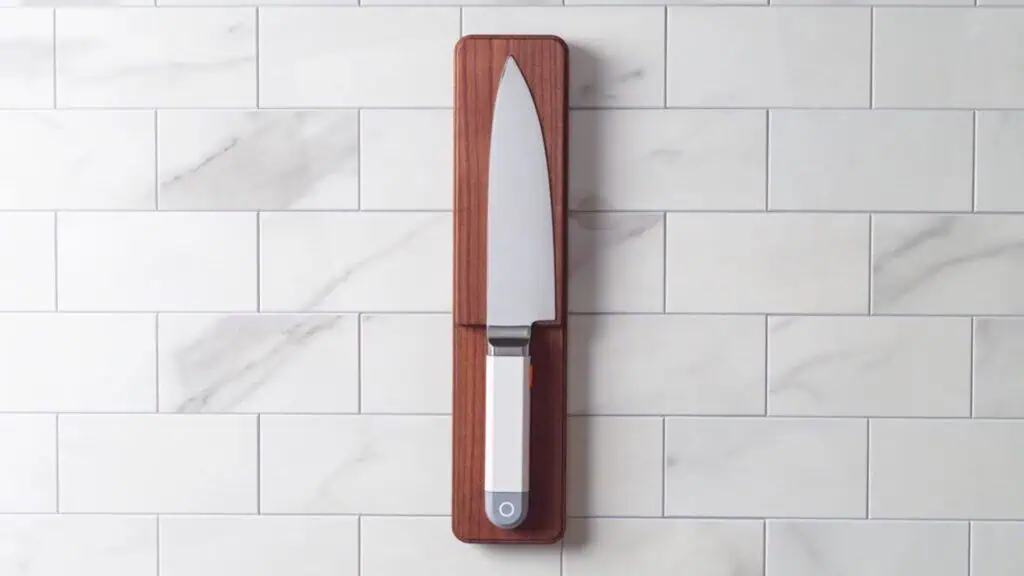
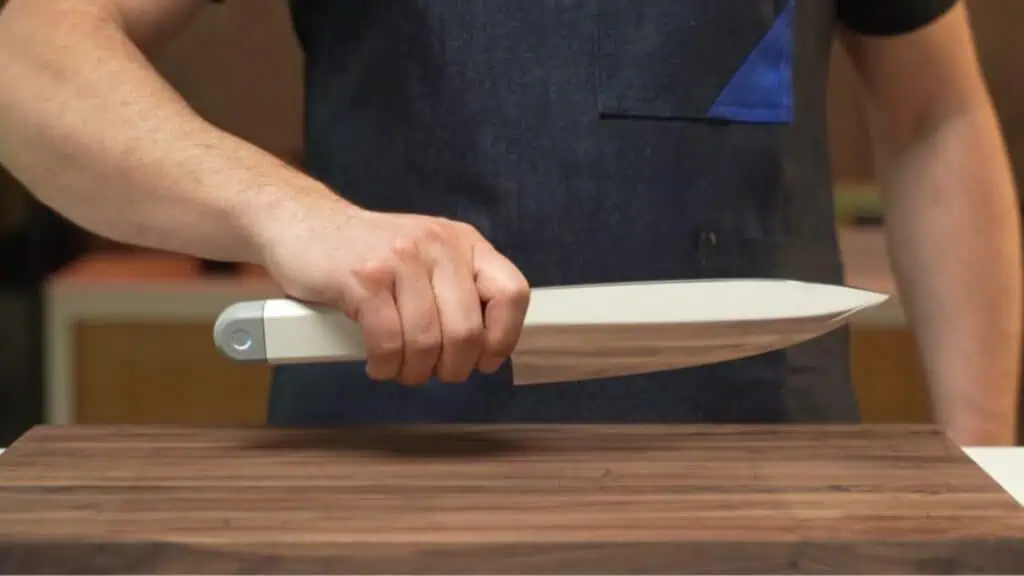
He built the knife he wanted to use himself, not the knife a focus group might request. “If I asked a focus group of home cooks what they look for in a chef’s knife, they might say they want a knife that’s sharp, that makes cutting easier, and that has great food release. But none of them would say, ‘I want an ultrasonic knife.’ So I’m building the knife that I want, and I hope like hell there are other people out there like me. So far, it looks like there are.”
The knife, called the C-200, is simple in use but advanced in engineering. Press a button, and the blade vibrates more than 40,000 times per second, reducing friction and cutting effort by up to 50%. Even when the ultrasonic function is off, the blade—made from high-quality Japanese AUS-10 steel—performs like a traditional chef’s knife. It sells for $399, with shipping expected in March of next year.
Seattle Ultrasonics runs as a small, focused team. Heimendinger works alongside Caitlin Sanders, also formerly of Modernist Cuisine, who helps with marketing and special projects. He draws on a broader network of engineers, industrial designers, and factory partners in Malaysia to turn the knife from concept to reality. In 2023, he raised $2.1 million from 28 angel investors, stressing that he uses a “founder-friendly and investor friendly” model developed by his friend, board member and investor, Rand Fishkin.
Heimendinger is an inspiration to many in the tech and culinary fields for the way he follows his curiosity and pursues his passions. He admires Will Guidara and Brian Canlis for their approach to hospitality, and Ray and Charles Eames for their design philosophy. He wants his knife to do more than cut; it should make people feel capable and confident. And who doesn’t want that?
Follow Us

Palace Kitchen Celebrates 30 Years
The Belltown staple still feeds the city after 10 p.m.
After the last tickets come off the rail, floor mats are hauled out to be hosed down, oven hoods are scrubbed, aprons come untied, and someone counts the drawer. It’s a familiar ritual in restaurant cities everywhere. When the shift ends, cooks and servers go looking for a drink and something to eat. For three…

Protein Without the Pressure
In her new cookbook, Seattle author and dietitian Rachael DeVaux keeps healthy eating grounded in real life.
Rachael DeVaux is not afraid of beef. That might sound obvious, but in a wellness culture still haunted by plain chicken breast and low-fat everything, her enthusiasm for grass-fed ground beef feels almost radical. The Seattle-based New York Times bestselling author, personal trainer, and founder of Rachael’s Good Eats has built a following of more than 3.5…

Restaurant Roundup: Nordic Cuisine and a Brazilian Brick-and-Mortar
Here’s what was served up recently in the Emerald City.
Monday nights are worth celebrating—you made it through the first day of the week, so why not treat yourself to a delicious meal? Unfortunately, but understandably, plenty of restaurants are closed. But at these spots, not only are the kitchens still serving, the quality doesn’t drop off post-weekend, providing a perfect opportunity for a surprise…

Whisky in the Wild
Good spirits.
Over the summer, Westland Distillery announced a new offering, inspired by Washington State. Made in Seattle and taking cues from the Northwest outdoor lifestyle, Watchspot Whiskey blends eight-year-old Westland American Single Malt with grain whiskey from America’s heartland, resulting in a pour that has notes of toasted grain, milk chocolate, biscuit, apricot, and cherry pie….