





News
Read More ›
To Skate Like A Girl
The Professional Women’s Hockey League expands to Seattle with the Torrent, a talent-filled team poised to sweep the ice.

This article originally appeared in the January/February 2026 issue of Seattle magazine.
When Danielle Serdachny was growing up, she dreamed of playing professional hockey.
This wasn’t unusual, given that she’s from Alberta, Canada, where hockey is as much a passion as a sport. Her dad teaches skating and hockey skills, and he’d even worked for the National Hockey League’s Edmonton Oilers at one point. Her older sister played hockey. So did her two younger siblings.
Danielle’s ambition was a little different—it was outsized. “I dreamed of playing in the NHL,” she says, “which obviously was probably not realistic.”
Up through ninth grade, Serdachny played in boys’ leagues, and while there was a path for women to play hockey in college, the professional options weren’t as straightforward. There was a league in Canada and opportunities in Europe, but there wasn’t one central destination for the best women’s hockey players in North America.
Three years ago, in June 2023, that changed with the introduction of the Professional Women’s Hockey League. Debuting with six teams (three each in the United States and Canada), the league added two expansion teams this season, one in Seattle and one in Vancouver, B.C. Serdachny is one of 23 women on the active roster for the Seattle Torrent.
“I’m very excited,” she says, “but also very grateful for all the work that has been done and people that continue to pave the way for women’s hockey.”
This is a story about women not just fulfilling their dreams, but making them possible. It’s a story about Serdachny—now in her second year in the PWHL, she has also played for the Canadian women’s national team—and it’s about Hilary Knight and Cayla Barnes, two U.S. Olympians who are also on the Torrent’s roster.

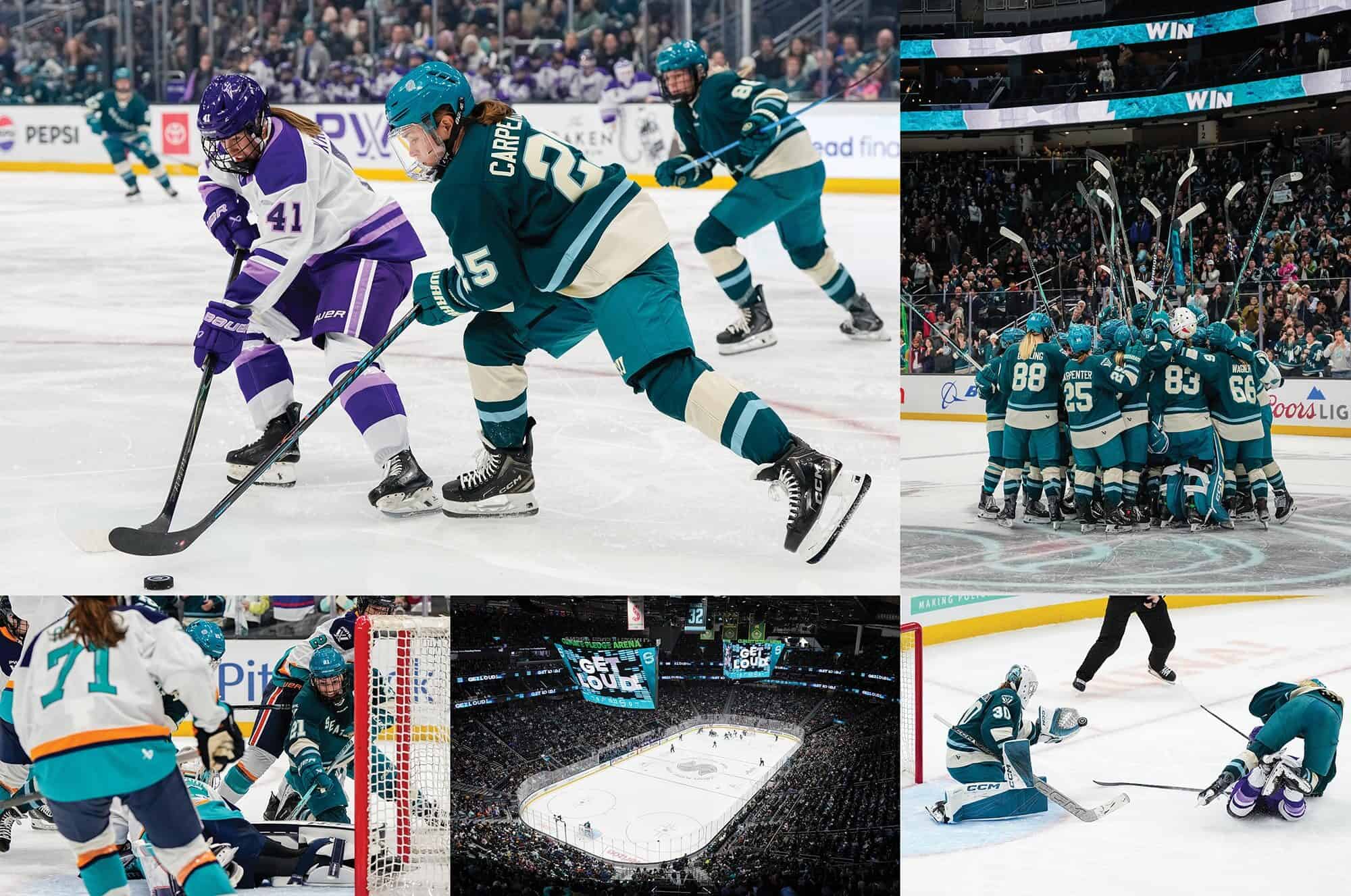
The setting of this story matters. Seattle has become a city that not only creates the space and opportunity for women to play professional sports but also provides the necessary support. Look at the Storm, a team that entered the WNBA in 2000. Or the Seattle Reign, the women’s soccer franchise that debuted in 2013. Now we have the Torrent, who will play 15 of their 30 regular-season games at Climate Pledge Arena, skating fast and fierce on the same ice the NHL’s Kraken use—and giving the next generation of girls something to dream about.
“That’s my favorite part,” says Jessie Eldridge, a Torrent forward. “Playing the game is something I very much enjoy, but being able to see how playing that game can impact the people around you, it’s never something I thought I could accomplish.”
Eldridge is from Ontario, Canada. Like Serdachny, she learned the game from her family. Eldridge played collegiately at Colgate University, and for the past two years, she was a member of the New York Sirens, one of the PWHL’s six founding teams.
It is a remarkable thing, this league. Something that took years of planning and some guidance from Billie Jean King, the women’s tennis pioneer. She is part of the league’s advisory board and a key figure in facilitating the financial investment from prominent philanthropists Mark and Kimbra Walter, which brought the PWHL to life.
It happened just in time for Meghan Turner.
She is the Torrent’s general manager, which means she’s the one who hired Steve O’Rourke as head coach and oversaw the selection of the players.
Before Turner was an executive, she was a player who grew up in New Hampshire and went on to compete for Quinnipiac University in Connecticut. After finishing her college career in 2017, she went to work at one of the country’s top accounting firms and called it quits on her hockey career. Things were fine for the first year, but Turner soon found herself missing her time in the rink. “I severely underestimated how much of my personal identity was wrapped up in the game,” she says. “Not just the game, but the camaraderie and the team environment.”
“Playing the game is something I very much enjoy, but being able to see how playing that game can impact the people around you, it’s never something I thought I could accomplish.”—Jessie Eldridge, Torrent Forward
Turner decided to try out for one of the pro teams, the Worcester Blades, which was feasible only because the practices were at 10 p.m. She kept her more-than-full-time job and played hockey at night, but it was a lot to juggle. In the spring of 2023, she decided to focus on her off-rink career and start consulting, when a close friend and college teammate called to talk about a front-office job with one of the teams in the new league.
“What’s that saying?” Turner jokes, “‘We plan, God laughs.’ As soon as I felt like I had planned out my career, it was turned on its head.”
In 2024, Turner became the assistant general manager with the Boston Fleet, a job that combined her professional experience and ambitions with her passion for the sport.
She held that position for two years, and in May 2025, she was hired to be the architect for Seattle’s new team, which kicked off its season in November. “I always hoped that this would happen for women’s hockey,” she says. “I always thought to myself, ‘Maybe I’ll be involved in it one day.’”
Now Turner and the team she assembled are making it possible not just for this generation, but all the women who will come after them—in Seattle and beyond.
Follow Us

Finding Fortitude Through Triathlon
More than 2,000 athletes will take on IRONMAN 70.3 Washington Tri-Cities Sept. 20, testing their endurance—and finding benefits that go far beyond physical fitness.
In 2005, Jennifer Comfort was a new mom who wanted some exercise. She joined a gym, where she met a fellow Jen who had just done a triathlon. Comfort had no idea what that meant—it’s a sporting event with a swim, bike, and run component—but she signed up for one anyway. “I doggy-paddled the swim,…

Helsinki is Like Seattle—Only More Hockey-Obsessed
As the Kraken head to Finland in November for their first regular-season games outside North America, Seattle fans will find ferries, coffee, craft beer and a familiar devotion to life by the water.
We were maybe 15 minutes into our inaugural Helsinki stroll when my kid asked the question my jet-lagged brain had mulled over but filed under “later”: “Where are all the cars?” We were walking down Esplanadi on a bright June evening near the summer solstice, and the street noise was mostly gulls and the whine…

Who Let the Dogs In? The Mariners’ Bark at the Park Is Seattle at Its Best
Baseball is better with a few hundred dogs in the stands.
Every so often, a city reveals its personality in the smallest and most delightful of ways. In Seattle, that might just be a baseball game … with dogs! The Seattle Mariners host “Bark at the Park” several times each season at T-Mobile Park, and if you haven’t been, you’re missing out on a high dose…

Why I Built a Pickleball Club With My Daughter
My father showed me how to turn my love of sports into something lasting. Pickle at the Palms carries that lesson forward.
Looking back, I wouldn’t say my family teaming up to launch Pickle at the Palms—a new 20-court indoor pickleball club—was inevitable, but it may have been predictable. Sports have shaped my life for more than 50 years. I fell in love with rowing as a 17-year-old college freshman and went on to compete on two…