





Architecture + Design
Read More ›
Craft Value: The Founder of Henrybuilt Reflects on What He’s Learned in 25 Years of Business

This article originally appeared in the March/April 2026 issue of Seattle magazine.
In 2001, after 15 years of working in publishing—where I was a founding team member of two venture-funded technology companies—I decided to start a different kind of company: one that made physical products.
This company, Henrybuilt, would combine product innovation and craft under one roof and sell directly to the end user—the homeowner—so that we could get direct feedback from our client and improve our product more quickly. Before I launched the company, I had remodeled three houses, which helped me to understand many of the nuances of designing spaces for living.
When it came to Henrybuilt, I was determined to bootstrap it without outside investment. This model would allow us to stay 100% focused on our product and our clients, while creating enough value that we would be driven to pursue a self sustaining business from day one.
We narrowed our focus to the kitchen, the place of most impact in most homes. Kitchens in the U.S. were, and still are for the most part, produced in an antiquated way, no matter how beautiful they might be. We wanted to change that.
Working in parallel to a category known in the industry as “millwork” or “cabinetry,” we adopted a whole-system, whole-outcome design approach (first used by a handful of European companies), and expanded it to an interconnected family of products and tools that work together to create a performance kitchen. The goal was to make cooking, cleaning, serving, socializing, and other everyday activities that center around the kitchen feel more satisfying.
I grew up on a farm in North Carolina. From the ages of 11 to 18, I worked for my grandfather each summer. His name was Henry, and he passed on to me a love of hard physical work and the joy of building. Henrybuilt is named after him. The moniker has helped carry his spirit and his joy of making into our work—and our brand. His name is also part of a unique URL, an intentional decision that has helped us grow since our launch day. Through the years, I’ve learned that soul and technical optimization are two circles that are powerful when they overlap. Focusing on combining two things that are often seen as in competition with each other is a great starting point for creating good outcomes at every level of a company, combining technology with handcraft, artfulness with running things by the numbers, and ownership interests with the interests of employees and clients.
My grandfather passed away in 1983. Around the same time, my family lost the farm where I grew up. I was just beginning college, but I decided to take a break and pursue other things. I learned to weld. I worked in oil fields, on bridges, and in a few fabrication shops, doing physical work, making things, and rock climbing between jobs. It was an incredible exposure to the skill, toughness, and resilience of people who cut, bend, and melt metal to build the infrastructure of our cushioned modern life.
It is hands on, and “brain on,” a combination that fuels ingenuity and innovation. —Scott Hudson, owner & founder, Henrybuilt
When starting Henrybuilt, I read a lot of management consultant and educator Peter Drucker’s work, and much of it was really valuable. But one phrase that he coined, “knowledge work,” is dangerously misleading; it distorts what we value and how we view people.
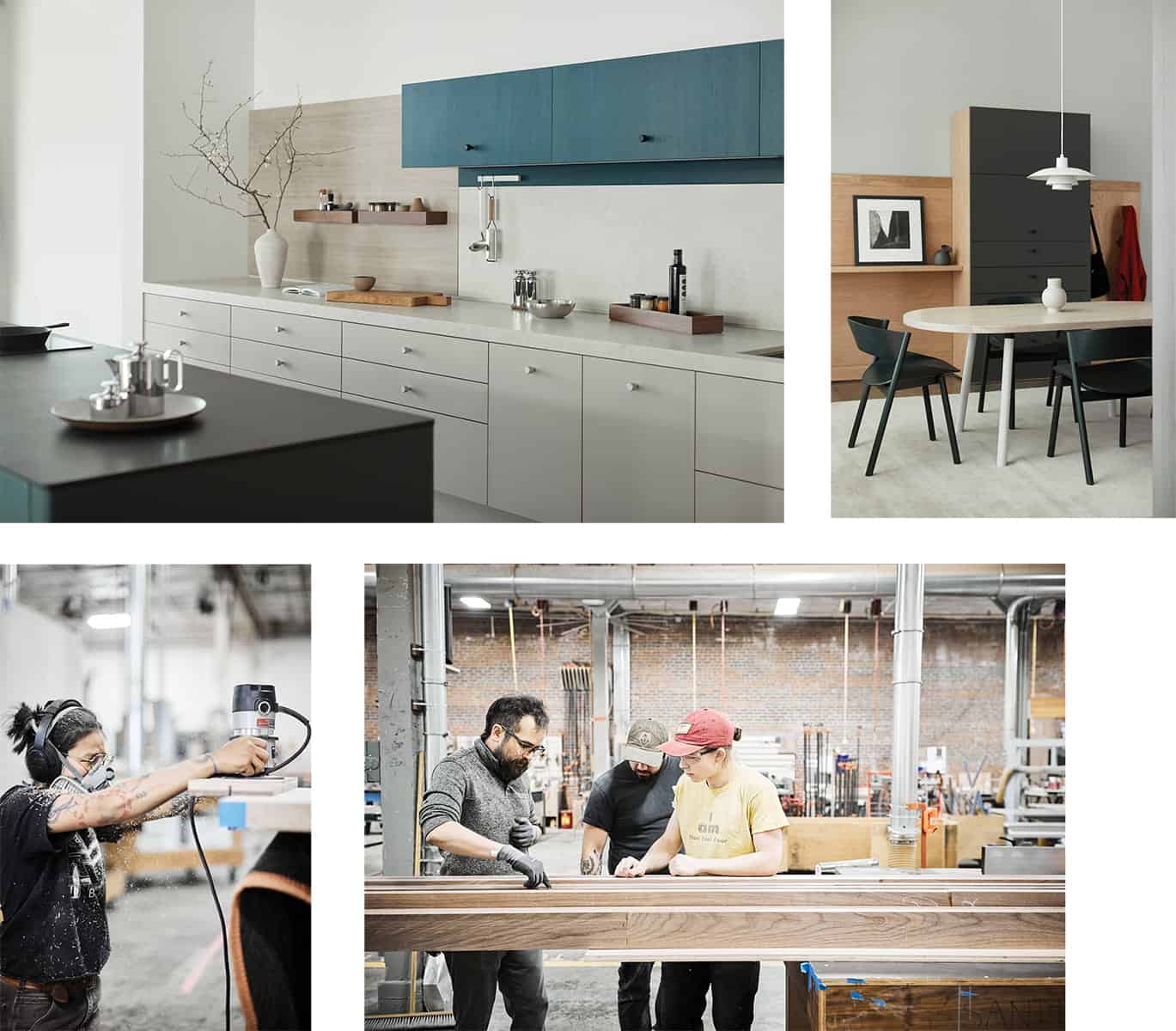
One of the most transformative phases of growing Henrybuilt was when we began adopting the principles of the Toyota Production System in 2012. It is both a social and a technical system developed by Toyota engineers in the 1950s and ’60s. It focuses product production teams on improving their processes together through several factors, including attention to flow, waste decrease and elimination, and customer experience improvement. Done well, it’s both optimizing and humanizing. It is hands on, and “brain on,” a combination that fuels ingenuity and innovation.
Software and automation are vitally important to most businesses. There’s no question that they bring value. We have a software team at Henrybuilt, and we have built the core applications that we use to manage workflow and to design our projects. However, economic theories that over-emphasize high technology and present acts of constructing as lower-level work distance us from the healthy daily routine of making things—including food. Which is why the kitchen is so important. For many of us, it’s the only place we still escape the screen and experience the joy of creating something with our hands.
Scott Hudson is the owner and founder of Seattle-headquartered Henrybuilt, which has 130 employees across offices in New York, Los Angeles, and San Francisco. The company counts clients in eight countries and has won more than 60 international design awards for its products.
Follow Us

Can Alaska Kelp Help Washington Crops Beat the Heat?
A Ketchikan company is working with WSU researchers to see whether its kelp-based biostimulant can help grapes and berries withstand environmental stress.
From the floatplane, reddish-brown kelp traces the edges of the small islands between Ketchikan and Prince of Wales Island like brushstrokes on the surface of the water. Up close, on a rare 70-degree July day in Alaska, the kelp is glossy and beautiful, though the wind coming off the water makes it nearly impossible to…

PlantCon Is Coming for Seattle’s Windowsills
The nation’s largest gathering for houseplant lovers makes its Pacific Northwest debut this August with 200 booths, hands-on workshops, and a DJ.
My house is full of plants, enough that I’ve lost count. Houseplants have the same suspicious math as tattoos: One is rarely the final number. I propagate cuttings in jars of water, regularly rearrange corners of the house in pursuit of better light, and like to imagine the entire collection is improving the air. That…

Noir Lux Lights Up Fourth Avenue
The Seattle candle brand’s new two-level pop-up brings workshops and community gatherings downtown through September.
It’s often said that good things come in threes, and for Colina Bruce, founder of the lifestyle and home fragrance brand Noir Lux, that’s certainly proving true. With a flagship shop in Belltown and an outpost in Ballard, Bruce is rounding out a Noir Lux trio with the opening of the Noir Lux Collective on…

Better Together: This Take on Co-Housing Emphasizes Quality and Community
The Seattle project presents an out-of-the-box model, where investors are also residents, and the design focuses on longevity and tenant retention—not profit.
Growing up in rural Detroit, Chad Dale spent many after-school and weekend hours playing with neighborhood kids in an open lot near his house. It’s an experience he always hoped his children would have someday, but by the time he became a father in Seattle, land was at a premium: either already developed or prohibitively…