





Dance
Read More ›
Pacific Northwest Ballet Opens Its Season with Heart
Serenade pairs Balanchine’s romantic sweep with a revealing new work by Jessica Lang and a jubilant finale from Alexei Ratmansky.

Finding stillness can be challenging. To pause without scrolling or anticipating the next thing on a to-do list, especially at the change of the seasons. It is well-timed, then, that Pacific Northwest Ballet’s 2026-27 season-opening program Serenade is rich in sensory experiences: light, color, movement, stillness—and the value of the calm spaces in between.
The first ballet of the three-part rep is Serenade, choreographer George Balanchine’s first American-made production. It premiered on a rainy outdoor stage in 1935, and while costume designs and bits of the choreography have evolved over the decades, Serenade’s focus on shapes, synchronized movements, and naked emotion remains a hallmark of this signature slice of American classical ballet.
The curtain rises on Serenade’s 17 member cast standing stock-still, right palms raised to the sky in salute—or opposition to—some unknown entity. Much of the choreography is what one would expect to see in a classical ballet, but the real gems of this work lie in the unexpected movements and long pauses that lead up to a final scene: a plotless yet incredibly emotional romantic drama. It is fantastic fodder for the imagination.
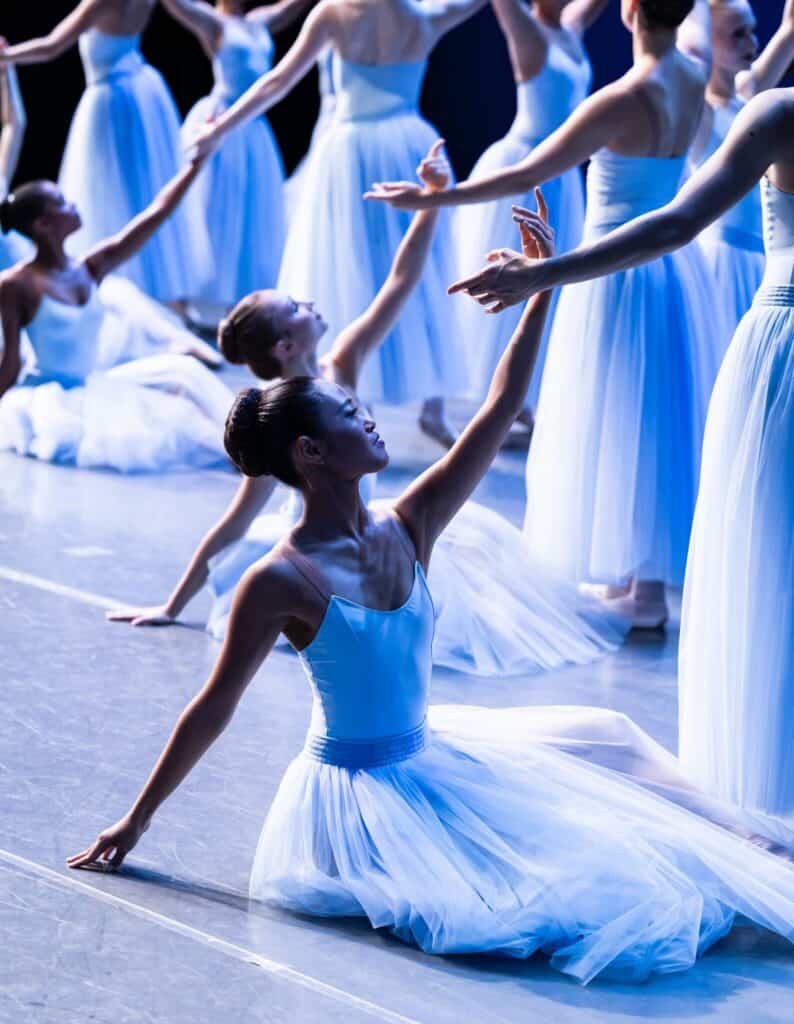
PNB’s opening night cast did solid justice to Balanchine’s reverence for shapes and contrasts. The sudden turning out of feet into first position as the 17 dancers gazed at their feet for four long seconds elicited a satisfying gasp from the audience. Principal dancer Leta Biasucci’s sudden (choreographed) fall to the floor, her glorious dark hair cascading out of her perfectly coiffed bun, shook away any malaise a viewer might have been feeling on that chilly Friday evening.
The sudden stops and starts in Serenade’s choreography are well matched to Tchaikovsky’s haunting, yearning score, Serenade in C for string orchestra, Op. 48. Sections of this ballet require rigorous synchronized movements, and Friday night’s ensemble sometimes fell short of perfect unison, which detracted from a few of Serenade’s more heart-stopping moments. My heart, however, is still recovering from the final sections where principal dancers Leta Biasucci, Angelica Generosa, Christopher D’Ariano, and soloists Leah Terada and Dammiel Cruz-Garrido lifted and swooned over each other with such convincing heartache it took some effort to not run onstage myself and comfort them.
The second work of the evening, Pages, is yet another unique and intelligent contemporary work from PNB resident choreographer Jessica Lang. Inspired by a room full of books, and, as Lang describes it, “the contrast between silence and inner noise,” the ballet begins with one dancer (on opening night, soloist Leah Terada) standing and swaying slowly atop a large white box. Set to a mix of looped spoken word recordings and music from Pulitzer Prize-winning composer David Lang, Pages follows ten dancers through a series of duets, solos, and collective movements that illustrate the complexity of the creative process. The large white box, a chair hanging crookedly from the ceiling, and lighting design from Brandon Stirling Baker, all add texture to the piece rather than clutter.
Where Balanchine’s Serenade relied on uniformity within a group to paint a picture, Lang’s Pages is focused on individuals. It is a gentle trip through the mind of an artist, a series of moments in a fleeting process that usually goes uncaptured, let alone presented as the work of art itself. Pages is deeply personal yet not self-indulgent. Each section belongs entirely to the dancer performing it. Lang is clearly finely tuned to the unique talents of company dancers: Leah Terada, Sarah-Gabrielle Ryan, Dylan Wald and Yuki Takahashi are at the top of their game in this work. I’d pay to see it 20 more times.
The last work of the rep comes from Russian-born choreographer Alexei Ratmansky, a Bolshoi-trained dancer with current professional roles at New York City Ballet and the Dutch National Ballet. Ratmansky’s works are typically complicated, requiring emotional depth and choreographic maturity that’s often not available to all dancers performing his pieces. However, Friday night’s cast comprising Angelica Generosa, Melisa Guilliams, Amanda Morgan, Sarah-Gabrielle Ryan, Yuki Takahashi, Jonathan Batista, Christopher D’Ariano, Luther De Meyer, Dylan Wald, and new corps de ballet member Jory Luthy absolutely killed it. Dead.
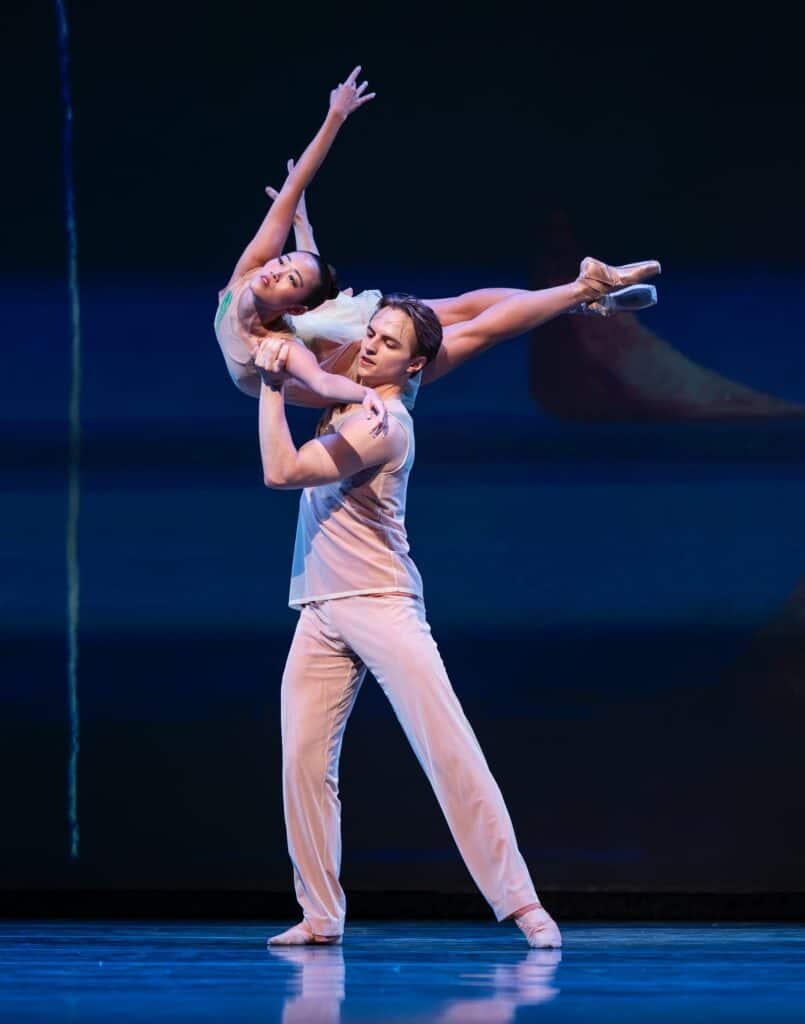
Set to a 19th-century score by composer Modest Mussorgsky, Pictures at an Exhibition features ten dancers performing in various configurations under projections of Kandinsky’s Color Study, Squares with Concentric Circles. The result is breathtaking, a seven-course meal of different moods and flavors. I found myself savoring each bite even if the costumes (sheer, nightie-esque tunics that give off weird sexy slumber party vibes) made me grimace.
Pictures at an Exhibition is a party piece, a high-energy exploration of how grownups play and let loose in the world. The opening night audience went wild for it. A surprise solo performance from Jory Luthy was particularly notable, his strong stage presence matching a physical control that we don’t often see in younger dancers. The day after the show, I’m still seeing Kandinsky’s bright circles on the edges of my thoughts. It’s a lovely way to move through a sometimes chaotic world.
Serenade runs through October 4 at McCaw Hall. Tickets and more information can be found here.
Follow Us

Studio Sessions: Heidi Grace Acuña
Drawing on her Filipino heritage, interdisciplinary artist Heidi Grace Acuña brings sculpture and fashion together with a spirited approach to ancestral traditions.
Heidi Grace Acuña has made me fond of crocodiles. At her exhibition at ARTS at King Street Station, I could study the little ones alongside their larger companions, peer into mouths lined with uneven gold teeth, and circle their clay bodies with all the curiosity and delight that fear would ordinarily keep in check. The…

CID Night Market Returns This Saturday With a New Food Walk
More than 100 vendors will take part in the free festival, with food specials starting at $6.
My daughter and I were recently watching the Tokyo episode of Eugene Levy’s The Reluctant Traveler, and we couldn’t get over how pretty the lanterns looked along the busy streets. It made me want to be out in a city at night, somewhere with good food and plenty of people. Now in its 19th edition,…

Rearview Mirror: Crocodile Guardians, Late-Summer Potato Salad, and a Halloween Costume Hunt
Things I did, saw, ate, learned, or read in the past week (or so).
COOKING WITH ASTER PANTRY A few leaves turn, my inbox fills with fall festival pitches and cozy brunch menus, and suddenly I want to stay home with a glass of wine and cook. I love this nesting season, though I’m not ready to give up summer produce. Earlier this year, I wrote about Seattle chefs…

WALKDONTRUN Returns This Saturday, Turning Downtown Seattle Into a Sprawling Art Show
In its second year, the free festival brings 200-plus artists to a 20-block route September 19, with a secret garden and a former 7-Eleven stocked with art.
Most walks through downtown Seattle involve trying to get somewhere. On September 19, the crosswalk itself might be the reason to stop. Heap Troupe will turn a four-way crossing into a performance, one of dozens of encounters planned for this year’s WALKDONTRUN. The free, all-ages art walk stretches across more than 20 blocks. From 11…