





Performing Arts
Read More ›
Becoming Bruce Lee
Seattle Children’s Theatre’s 'Young Dragon' traces how five formative years in Seattle shaped a global icon and reminds young audiences that excellence is built, not born.
 By Sarah Stackhouse February 26, 2026

The dragon first appears as a flicker.
Bruce Lee is not yet the untouchable icon of posters and slow-motion flying kicks. He’s a teenager with a temper, wrestling with a little hot dragon inside him—the fire that flares before he knows what to do with it. It’s a feeling many kids (and adults) in the audience will recognize immediately.
That’s one of the many triumphs of Young Dragon: A Bruce Lee Story, the world premiere written by Seattle playwright Keiko Green, who has also written for Hulu’s Interior Chinatown, and directed by Jess McLeod. Commissioned by Seattle Children’s Theatre and the John F. Kennedy Center for the Performing Arts, the production focuses not on Lee’s Hollywood stardom but on the five years he spent in Seattle from 1959 to 1964—studying philosophy at the University of Washington, teaching dance classes, performing at the 1962 World’s Fair, opening two kung-fu schools, falling in love with his wife Linda Emery, and figuring out who he was.
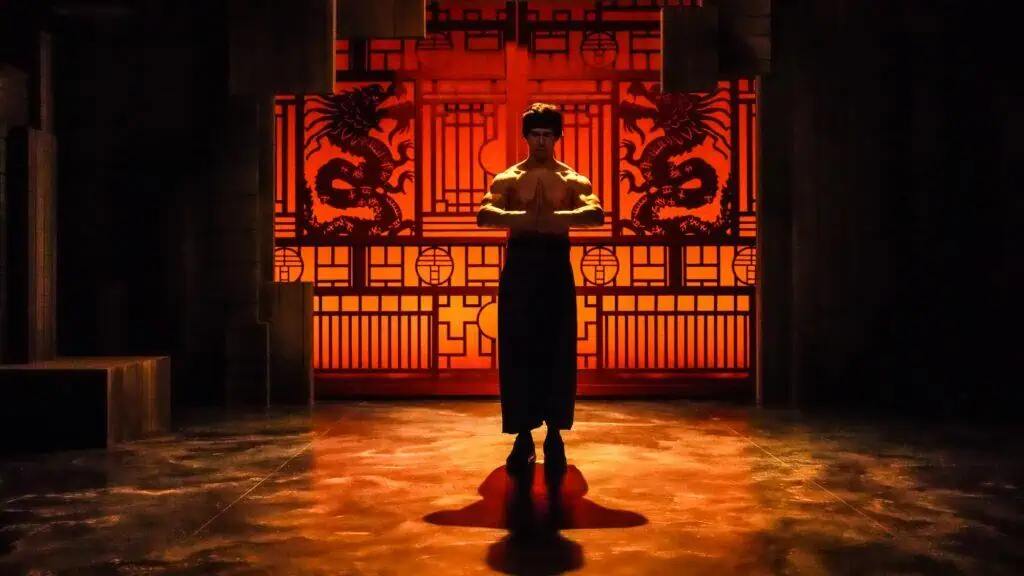
The focus on Bruce’s Seattle years came directly from the commission. When the project began, Green was directed to Be Water, My Friend, a book by Bruce Lee’s daughter, Shannon Lee, as source material. “Her book is more like philosophy than it is biography,” Green says. “So the big question was, how do you make a philosophy story meaningful and fun for kids?” In early conversations, Green asked Shannon what she hoped young audiences would take away. Shannon told her she didn’t want the play to feel like a documentary. “I want it to feel like you have a voice,” she told her. She also emphasized her father’s curiosity and complexity, and that kids should walk away understanding they don’t have to put themselves in a single box.
The play opens with Bruce’s debilitating back injury—an experience that would come years after his time in Seattle and force him to rethink both his body and his philosophy. Michelangelo Hyeon, who plays Bruce, could relate. He took on the role shortly after suffering his own severe back injury.
“It means the world to me,” Hyeon says of playing Bruce. “It’s probably the greatest honor of my entire life to get to honor the legacy of one of the greatest people who ever lived.”
In preparation, he trained at the Inosanto Academy of Martial Arts under Dan Inosanto, one of Bruce Lee’s former students. Green says the goal was never to present Bruce as untouchable. “By telling the part of the story where he is flawed and still figuring it out,” she says, “we get to show that everyone is capable of their own version of excellence.”
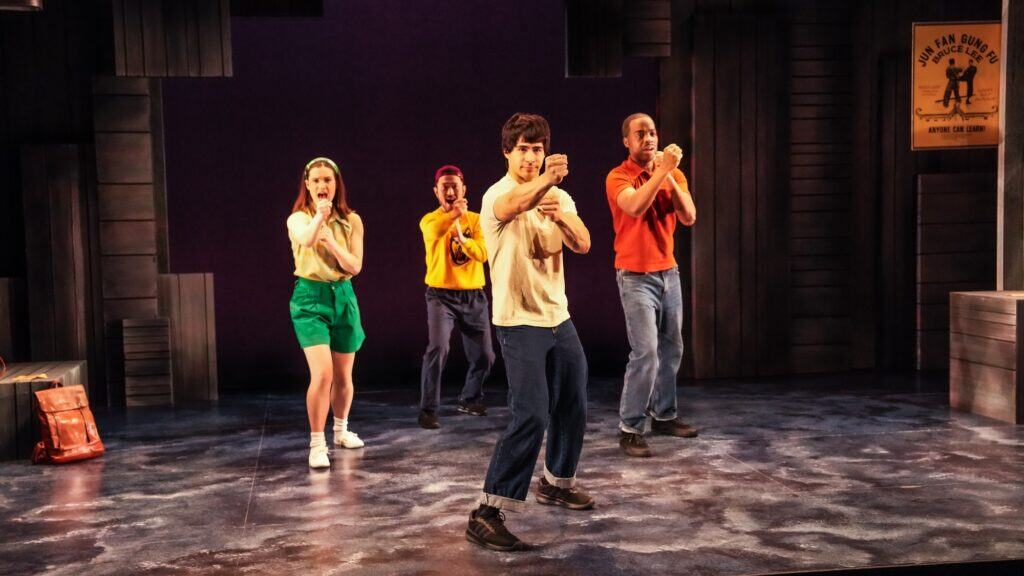
Bruce struggles in the U.S. as a Chinese immigrant navigating racism and confusion about his identity. When he returns to Hong Kong for a visit, he feels out of place there, too. The play does not smooth those tensions or resolve them neatly. It lets them sit. For kids in the audience—especially those who have ever felt caught between cultures or identities—that struggle will be familiar.
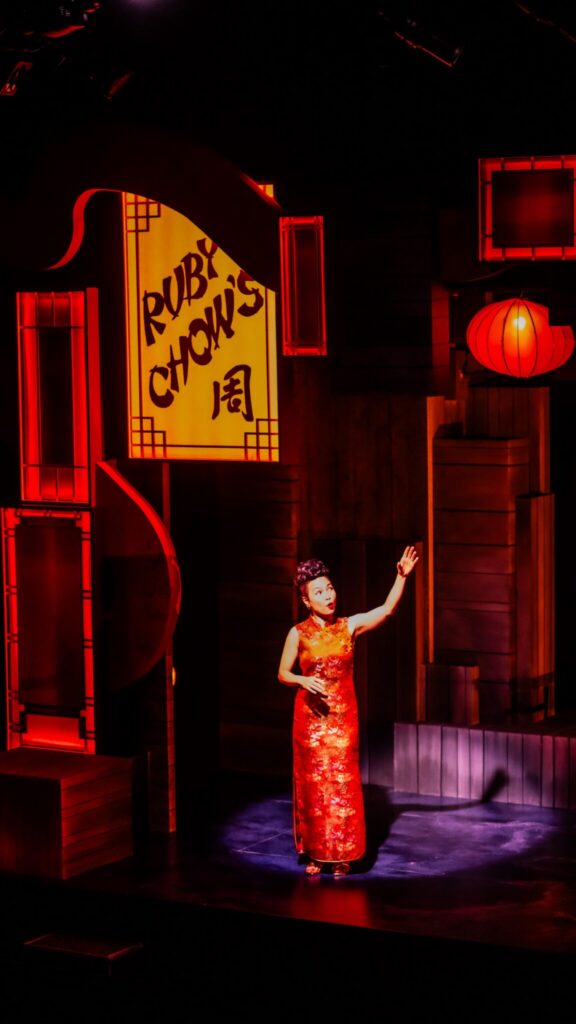
One of its most compelling characters is Ruby Chow, the formidable Seattle restaurateur who gave Bruce a room and a job when he first arrived at 19. Played with authority and depth by Khanh Doan, Ruby is both savvy and strategic. She’s a Chinese American woman who knows how to charm powerful white patrons while also pushing back against racism and advocating for her community. She has a clear affection for Bruce and identifies with his determination. She acts as a mentor, giving him opportunity while also teaching him how to move within the system without being swallowed by it.
The tension over who gets to teach kung fu is also central. Bruce’s embrace of students of all races and genders defies tradition. Having studied Wing Chun in Hong Kong, he begins developing Jeet Kune Do in the U.S.—a hybrid form influenced by boxing and other disciplines. He believed Chinese culture had a lot to offer the Western world and refused to restrict access.
Water becomes the play’s governing metaphor. A twirly, ribbon-like banner arcs above the stage like a cresting wave or the curve of a dragon’s back, shifting from red to blue as Bruce wrestles with his temper and learns control. He studies his reflection, absorbing the lesson he would later immortalize: “Be like water.” Fluid, adaptive, soft and strong at once. In the final scene, an icy blue dragon meets him. It does not attack. It moves with him. They circle and mirror each other. The hot, unruly fire from earlier in the play cools into something steadier. What once threatened to spill over now moves with intention.
Seattle’s reputation for grit feels baked into the show. Anyone who lives here has fielded questions about the gray, rainy skies. And for someone young and driven, it can be a hard place to find footing, so it makes sense that this isn’t a story of instant genius but of practice, self-discipline, failure, and resilience. Green leans into the local details—Seafair jokes, UW references, and nods to Dick’s Drive-In that land with a hometown audience.
Sitting in the theater, you feel it. The story belongs here.
The show was originally slated to transfer to the Kennedy Center after its Seattle run, but Seattle Children’s Theatre opted not to continue the production there following recent leadership changes at the Kennedy Center under the Trump administration that prompted national backlash and artist withdrawals. While the decision means a broader audience will not see the play, it shows the theatre’s commitment to standing by its values and its artistic community.
Just last week, the U.S. Postal Service released a Bruce Lee Forever stamp. At the same time, Seattle is coming off a Super Bowl win that drew more than 120 million viewers worldwide, with halftime messaging about love, unity, and the embrace of immigrants and diverse cultures, and a Seahawks victory parade that brought an estimated one million fans into our streets to celebrate. The past few weeks in Seattle have been defined by civic pride and neighbors showing up for one another. Bruce Lee’s story—an immigrant who made Seattle part of his foundation while challenging cultural boundaries—is especially relevant right now.
By the final bow, Bruce Lee has not yet become the Bruce Lee many of us think of. He is still in motion. The global fame comes later. The work happened in Seattle.
Young Dragon: A Bruce Lee Story runs through March 29 at Seattle Children’s Theatre. Tickets are available here.
Follow Us

WALKDONTRUN Returns This Saturday, Turning Downtown Seattle Into a Sprawling Art Show
In its second year, the free festival brings 200-plus artists to a 20-block route September 19, with a secret garden and a former 7-Eleven stocked with art.
Most walks through downtown Seattle involve trying to get somewhere. On September 19, the crosswalk itself might be the reason to stop. Heap Troupe will turn a four-way crossing into a performance, one of dozens of encounters planned for this year’s WALKDONTRUN. The free, all-ages art walk stretches across more than 20 blocks. From 11…

At Two Dot Schoolhouse, Ruth Marie Tomlinson Builds an Artistic Community
For nearly 20 years, the Seattle artist and her husband have welcomed artists, writers, and musicians to a historic Montana schoolhouse. Now they’re searching for its next stewards.
At her solo exhibition last year at The Vestibule, Seattle artist Ruth Marie Tomlinson presented a new series of work inspired by her close readings of British nature writer J.A. Baker’s The Peregrine and Icelandic author Sjón’s The Blue Fox. As if on sheets torn from a sketchbook, her pages included excerpts and outtakes of…

Rearview Mirror: Seahawks Off the Field, Seattle on the Board, and Smoked Oysters
Things I did, saw, ate, learned, or read in the past week (or so).
HOOKED ON KNOCKS Admittedly, I am late to this one. The Seahawks’ first season of Hard Knocks, the HBO series that follows NFL teams through training camp, premiered in August, but until last week, I had never heard of it. To be honest, my football knowledge starts with knowing what a touchdown is and doesn’t…

Studio Sessions: Colleen Louise Barry
Multi-hyphenate artist Colleen Louise Barry on discipline, the arts ecosystem in Seattle, and saving abandoned trampoline from the side of the road.
It’s hard not to smile around artist and writer Colleen Louise Barry. Bubbly and bright, she radiates optimism and cheer that would put most stereotypical Seattleites on edge. I think she is an absolute delight. Originally from Albany, Barry received her MFA from the University of Massachusetts, Amherst, before moving to Seattle in 2016. Once here,…