





Arts
Read More ›
SAM Opens Its First Solo Exhibition By a Pakistani-American Artist
With Geometry of Light, Anila Quayyum Agha presents a dazzling Pacific Northwest debut
 By Rachel Gallaher-Zenz August 28, 2025

Anila Quayyum Agha is an artist who invites you to step closer to her work. To lean in, observe patterns, follow a stitch of thread or a beam of light. Her pieces are large—especially the laser-cut steel light sculptures featured in Seattle Asian Art Museum’s new show, Anila Quayyum Agha: Geometry of Light—but they hold minute details like tiny messages waiting to be uncovered by the most astute observer. Opened on Aug. 26, and running through April 19, 2026, this is Seattle Art Museum’s first solo exhibition by a Pakistani-American artist—and Agha’s first show in the Pacific Northwest.
“[Anila] is widely celebrated for her installations, which explore the themes of cultural identity, gender, and the intersection of art, architecture, and spirituality,” says curator José Carlos Diaz, SAM’s Susan Brotman deputy director for art. “She draws from Islamic art and South Asian architecture, particularly the geometrical patterns and motifs [found in] sacred spaces such as mosques and tombs, as well as ornamental palaces.”
From the exhibition’s entry space, Agha’s attention to detail is present—if you look hard enough. A yellow scrim hung on the windows facing Volunteer Park is transparent enough to reveal the lush landscape outside, and its pattern also holds a sneaky double “A,” seeming to signify the artist claiming the work, and putting pieces of herself and her life experiences deeply within it.
“She decided to be an artist from an early age,” says Diaz. “She entered into the National College of Arts in Lahore, [Pakistan] in 1982, and she did so in secret. Only one of her sisters knew that she had enrolled in college; she wanted to study arts, and the area of art that she was focusing on was textiles.” Sewing and embroidery were crafts she learned from her mother at sewing circles in their mosque. “It was a feminine space that allowed Anila to be amongst other women,” Diaz explains.

This influence is present in the framed, wall-hung pieces of Geometry of Light, which feature intricate beadwork and steel thread on mylar paper that almost seems to glow in the museum lights. They are simultaneously delicate and tough; one glance and the patterns flow like embroidery on a gown, but lean in closer and they appear rougher, almost like stitches on an injured body. “In an essay, one scholar talks about the needle being her weapon of choice as an artist, instead of a brush and palette,” Diaz says. “The needle is made of steel, and she associates that with being a champion of feminism, being a woman, a female artist, in a male-dominated world.”
Those familiar with Agha’s work are likely to think first of her large-scale, full-room installations, which feature laser-cut steel forms (often suspended from the ceiling) outfitted with a single lightbulb that, when illuminated, casts brilliant shadows around the room and ensconces the viewer in the work, seemingly making them an element of the piece. At the Seattle Asian Art Museum, there are two such installations: one is the familiar suspended cube, which glows blue at the center of the gallery, its scrolling, leaf-like shadows cast against walls painted a pinkish-red color. The LED light is harsh, almost hard to look at, and the patterns are best observed in their softened, silhouetted forms on the ceiling and other surfaces in the room.

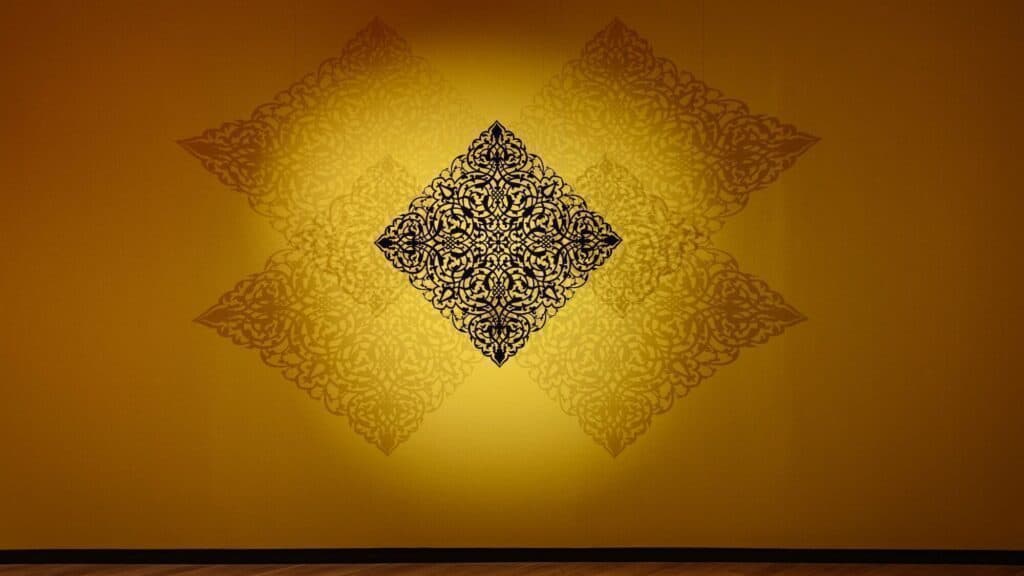
Long interested in architecture, Agha draws from buildings and sites she saw growing up in Pakistan. (The artist is currently based in Indianapolis.) “She would visit different archeological sites, the historical tombs and mausoleums around Lahore,” says Diaz. “And that’s when she started to gravitate towards the geometrical shapes that you see in a lot of work today.” A second installation centers a white steel form stylized like a child’s simple drawing of a house: four walls and a pitched roof. It’s universally recognizable, a symbol with varying meanings depending on one’s experience with the concept of home. Here, the laser cuts are larger, making a pattern of large flowers, according to Diaz, inspired by a stand her mother once had to hold the family’s Koran.
In our fast-paced world, Agha’s work invites us to slow down, take a beat, and contemplate. It also taps on the idea that, much like the shadow shapes cast throughout the gallery, who we are, and how we act—whether through word, thought, or action—has the potential to radiate into the world, touching everything, and everyone around it.
Anila Quayyum Agha: Geometry of Light runs through April 19, 2026. Tickets here.
Follow Us

SENSORIUM Takes on Our Screen Addiction
Dance, drag, and immersive art collide in an eight-week exploration of our phone-obsessed lives, with a few surprises along the way.
What do drag queens, smartphone addiction, art installations, and an old luggage shop have in common? According to longtime Seattle choreographer Alana O’Farrell Rogers, a lot. “There’s no dead time anymore,” says Rogers, explaining how the proliferation of smartphones fills the empty spaces that once served as time for rest or connection. Where we snuggled…

Salt-N-Pepa on Breaking Barriers and Staying Power
Ahead of their performance at Seattle’s Museum of Pop Culture gala, the hip-hop pioneers talk about creative ownership, connecting with new generations, and the songs that still resonate.
The Museum of Pop Culture (MOPOP) will host its annual ICONS of Pop Culture Gala in Seattle on October 22, honoring five artists and institutions whose work has helped shape entertainment and culture. This year’s honorees are martial arts and film legend Bruce Lee, fashion designer Jeremy Scott, the video game franchise Halo, hip-hop pioneers…

Studio Sessions: Christopher Paul Jordan
Drawing on childhood memories, neighborhood history, and salvaged materials, Christopher Paul Jordan’s latest show at Cornish’s Behnke Family Gallery explores how the past stays with us.
Start in the middle. It’s good advice for telling a story, and a way into Christopher Paul Jordan’s paintings. By the time you encounter them, their materials have already been something else, and who knows what they might move on to become. The Tacoma interdisciplinary artist works with salvaged objects, including screens, picture frames, canvas,…

Rearview Mirror: Wedding Bells, A Furniture Launch, and the Symphony’s New Look
Things I did, saw, ate, learned, or read in the past week (or so).
WEDDING BELLS I’ve been a bit absent from this column lately, but I think I have a pretty good excuse: I got married! It’s already been three weeks since my September 19 wedding, but I’m still reflecting on the magic of the day. My fiancé, well husband now (I can’t get used to saying it!),…