





Visual Arts
Read More ›
Studio Sessions: Gabi Nirino
Working with textiles to explore ideas connected to nature, community, and womanhood, Buenos Aires-born Gabi Nirino never stops experimenting with her medium.
 By Rachel Gallaher-Zenz August 27, 2026

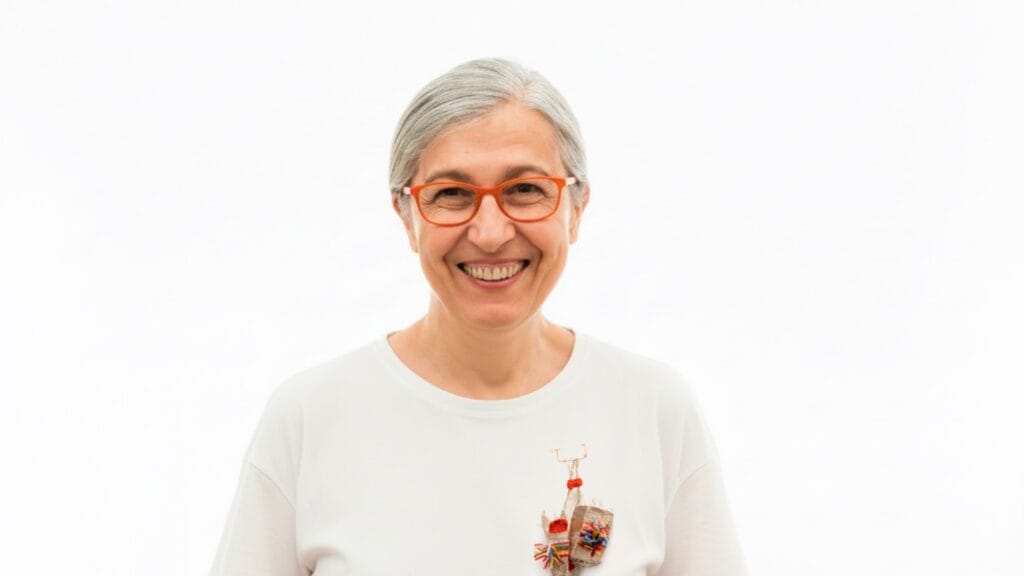
Gabi Nirino carries bag of materials with her almost everywhere she goes. Cloth, thread, yarn, textile scraps, collected fibers—the pieces inside are a network of inspiration waiting for her hands. “You can work with textiles anywhere—on the floor, on a plane—which is why I always carry a project in my bag,” Nirino says. “It’s like carrying my knitting around, just as I used to do when heading to my literature classes.” Originally from Buenos Aires, the creative (who prefers the word “maker” to “artist”) landed in Seattle in 2020. Here, she connected with nature, an easy thing to do when surrounded by forests, water, and mountains.
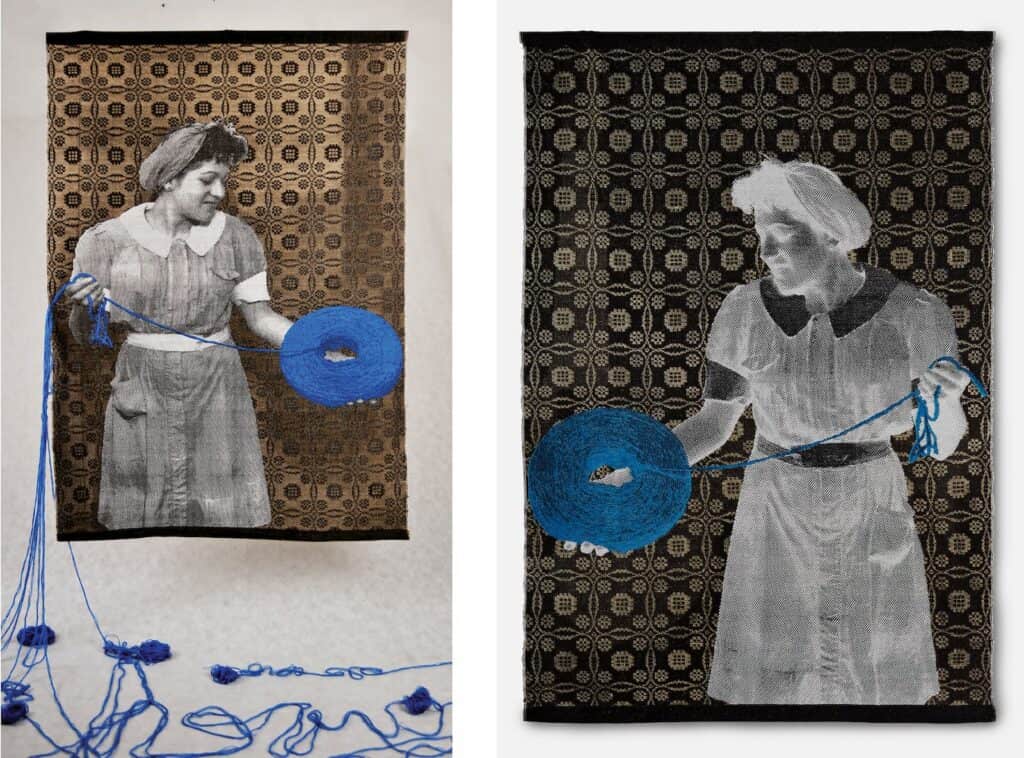
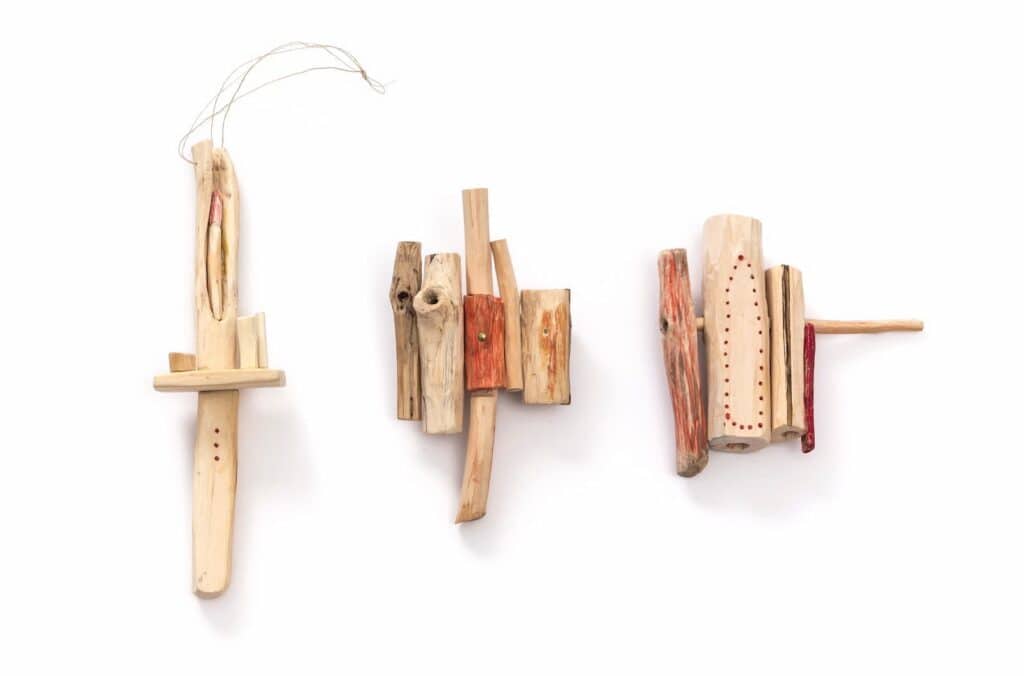
Nirino’s work ranges from tapestries woven with images based on photographs from the National Historical Archive of Argentine to multi-media installations that incorporate found materials such as branches and foraged leaves. Sometimes, the process proves more interesting than the product. “Experimenting with something I found (a plant, for example), or a new material I discover sometimes is more interesting than finishing an actual piece,” she admits. “All the garage became my studio after the very strange experiments my husband found in the refrigerator!”
Currently, Nirino has work in a group show at the Vestibule in Ballard (through September 19). Titled Threaded by Language, it features pieces by diasporic artists, including Claire Renaut and Shin Yu Pai, that explore a loss of language and culture. On September 5, Nirino will host an informal weaving demonstration during gallery hours. Additionally, she will have an installation of four weavings in Unwavering Hope, Columbia City Gallery‘s 18th annual juried exhibit, running now through October 4.
Name
Gabriela Nirino or Gabi Nirino
Hometown
Originally Buenos Aires, living in Seattle since 2020
Discipline
Textiles
Favorite Spot in Seattle
My house. It is the first time I am living in a house with trees, not in an apartment.
Describe your work in three words.
Materiality. Organic. Becoming.

When did you know you wanted to be an artist?
I don’t think of myself on those terms. I identified more with the word “maker.” Doing with my hands was always something that creates for me an internal safe space and give me a lot of happiness, allows me to be me. I used to draw a lot, on all surfaces available (newspaper margins, white pages in the books, the top of my desk at school), since I was a little child. My mother allowed me to do it on one of the walls of the house. When I was 8, my godmother gave me the best present ever: 10 big illustration boards, a box of professional tempera and a book about famous artists.
Where do you find inspiration?
Books are very important. The other thing that I used to do like a maniac, since I learned how, was reading. That was my other safe place when I was growing up. I used to read at lunch, when walking in the street, at family reunions, at school when I was supposed to do other things, and late at night under the blanket. Books were and are my friends. So, I found a lot of inspiration in words. I would mention photography too. Certain types of images are so evocative and intriguing. In the last years, I was more and more driven by the material itself. Experimenting with something I found (a plant, for example) or a new material I discover sometimes is more interesting than finishing an actual piece.
What draws you to your particular medium?
Textiles are so approachable. The material itself is always inviting, and I’ve been fascinated by it since I was very young. My grandmother, whom I never met, used to make hats and do embroidery. At my parents’ house, there were boxes filled with lace, fabrics, unusual buttons, feathers, and other things that belonged to her. For me, it was a joy to climb up to the wardrobe, pull down the boxes, take everything out, and put it all back in order. It was fascinating—like opening a box of magical things.
What I love most about textile work is that it is portable. I’m always doing something, and textiles—inherently linked to a nomadic lifestyle—are the kind of pieces you can historically carry with you. It suits me perfectly.
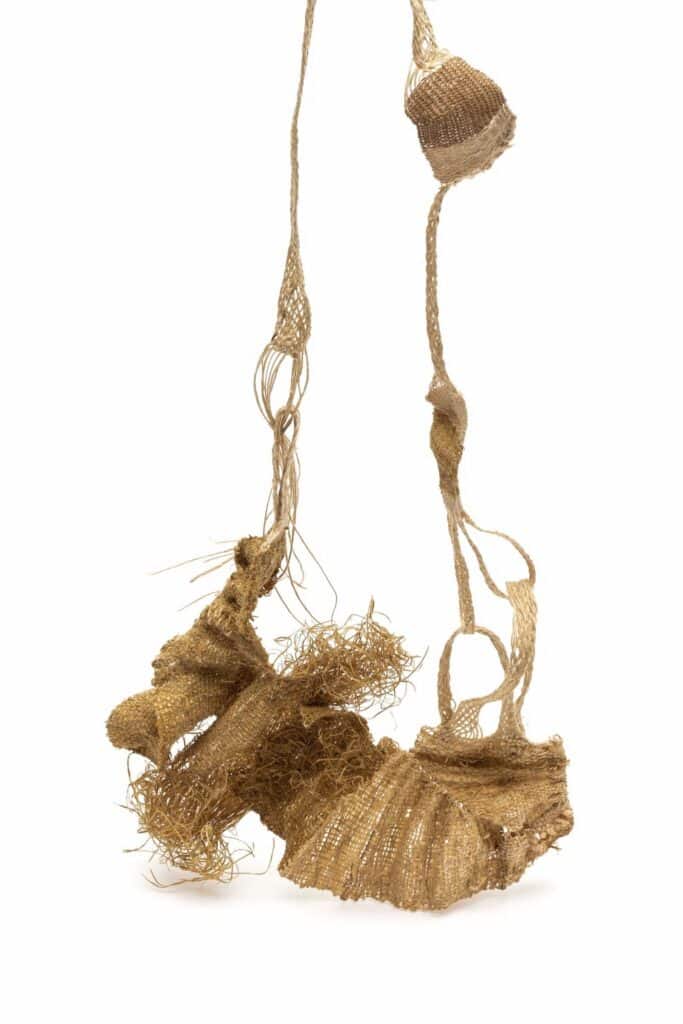
I love threads, especially unusual ones. Seeing them sends me into a state of ecstasy. Only someone who truly loves textiles can understand that feeling—or perhaps anyone who has ever been captivated by something. It’s a fascination with their qualities, but also with the fact that you can find and reclaim them almost anywhere. You can extract fibers even from plants, and that’s precisely what I do. They’re everywhere. They surround you. I see fibers everywhere.
Share one piece of advice you wish you knew when you were first starting out.
More like a piece of advice, I wish I will have more confidence. But that came with time, in my case. I will say: keep doing what makes you happy, the way you can.
What do you still hope to accomplish?
Go deeper into the textile work, focus more on quality of the technique. Develop more the writing that I do sometimes with the pieces. Work with wood. I was doing wood workshops at the Pratt Arts Center thanks to the Mary Molineaux grant and I hope I can integrate that with textiles. I used to work with metals too, but it is not my preferred medium. Maybe do some painting, like in my twenties.
If you weren’t making art, what would you be doing?
I worked as a professor for many years. I love to teach. Doing art/craft was always there, but only after retirement I can dedicate [time to it] completely. If I was born again, I would dedicate more time to create since the beginning. It was not an option to make a living at that time. Only as a fantasy, I would dance as an alternative. Finally, one path I considered at certain point to pursue was being a lawyer.
Who do you admire and why?
I admire anyone who is enthusiastic and generous with what they do. People willing to include and supports others. The world needs a lot of community.
Follow Us

SENSORIUM Takes on Our Screen Addiction
Dance, drag, and immersive art collide in an eight-week exploration of our phone-obsessed lives, with a few surprises along the way.
What do drag queens, smartphone addiction, art installations, and an old luggage shop have in common? According to longtime Seattle choreographer Alana O’Farrell Rogers, a lot. “There’s no dead time anymore,” says Rogers, explaining how the proliferation of smartphones fills the empty spaces that once served as time for rest or connection. Where we snuggled…

Salt-N-Pepa on Breaking Barriers and Staying Power
Ahead of their performance at Seattle’s Museum of Pop Culture gala, the hip-hop pioneers talk about creative ownership, connecting with new generations, and the songs that still resonate.
The Museum of Pop Culture (MOPOP) will host its annual ICONS of Pop Culture Gala in Seattle on October 22, honoring five artists and institutions whose work has helped shape entertainment and culture. This year’s honorees are martial arts and film legend Bruce Lee, fashion designer Jeremy Scott, the video game franchise Halo, hip-hop pioneers…

Studio Sessions: Christopher Paul Jordan
Drawing on childhood memories, neighborhood history, and salvaged materials, Christopher Paul Jordan’s latest show at Cornish’s Behnke Family Gallery explores how the past stays with us.
Start in the middle. It’s good advice for telling a story, and a way into Christopher Paul Jordan’s paintings. By the time you encounter them, their materials have already been something else, and who knows what they might move on to become. The Tacoma interdisciplinary artist works with salvaged objects, including screens, picture frames, canvas,…

Rearview Mirror: Wedding Bells, A Furniture Launch, and the Symphony’s New Look
Things I did, saw, ate, learned, or read in the past week (or so).
WEDDING BELLS I’ve been a bit absent from this column lately, but I think I have a pretty good excuse: I got married! It’s already been three weeks since my September 19 wedding, but I’m still reflecting on the magic of the day. My fiancé, well husband now (I can’t get used to saying it!),…