





Arts
Read More ›
WALKDONTRUN Offers a Different Way to See Downtown
The one-day art festival brings new life to familiar corners of the city.

How often do you linger in the central business district of downtown on the weekend? If you’re like me, not terribly often. Certain blocks can feel a little forlorn once the weekday workers empty out—or perhaps not forlorn so much as waiting for their purpose. On Saturday, September 19, plenty of new purpose flourished (and twirled, and bloomed) along downtown plazas and courtyards that normally sit silent until Monday morning. There was a festival air, plenty of smiling faces, and a sense of rediscovery.
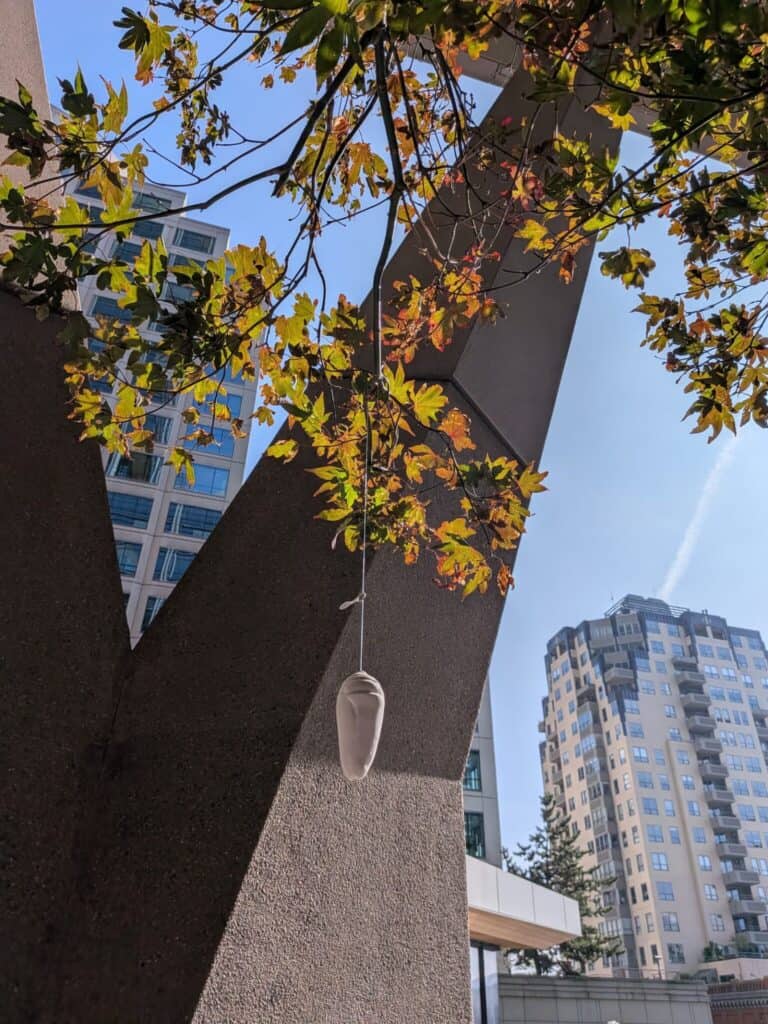
I first felt it when the sun came out at the 2+U courtyard on Second Avenue in the middle of the day. As the light hit the branches of a Japanese maple just starting to turn red for the season, I noticed white and almost blue-black shell-like objects hanging from the tree’s branches. All around me, people were stopping to look. Against the background of honking cars and the ordinary business of the city, these strange little objects offered a reason to pause.
They were ceramic cocoons made by artist Sharon Gottula, part of her installation The Count, and one of the surprises that made WALKDONTRUN feel like an invitation to reconsider downtown. The free, all-ages “art marathon” stretched from Westlake Park to Occidental Square, filling more than 20 blocks with installations, music, dance, and collaborative opportunities to help make something (a sidewalk mural, a denim tapestry, a dance party). More than 200 artists participated. But what stayed with me wasn’t the scale so much as the shifts in attention: a tree becoming an exhibition space, plaza steps becoming a dance stage, a courtyard becoming a secret garden.
Seattle arts producer Kira Burge helped launch WALKDONTRUN last year, inspired by artist Klara Glosova’s NEPO 5K, a participatory art adventure through the Chinatown International District and Beacon Hill. This year, Burge worked with music producer Steven Severin and a curatorial team of artists and other advisors to create an event meant in part to encourage community as we continue to heal from pandemic isolation. That impulse felt tangible in the clusters of people looking, listening, and making things alongside one another.
“As artists, we usually work alone in our studios, solving problems nobody really asked us to solve,” Gottula says. She tells me joining hundreds of other artists to create an immersive public experience is “incredibly exciting.”
Her own contribution rewards close attention. Modeled on monarch chrysalises, the pit-fired cocoons hung in small groupings along the route, each one numbered. Their beauty carried a darker meaning, however: Gottula describes the numbers as “a ledger of disappearance,” asking viewers to consider extinction and our own place in interconnected ecologies.
Nearby in the courtyard, vinyl images showed Jesse Higman’s painting project from last year, part of his Collaborative Landscape project, in which groups co-create evanescent art with cups of mica flakes in water that swirl together against a large black canvas stretcher. The result is a fantastic expression of the power of community and the possibility inherent in restrictions, with an underlying critique of the idea of the artist as a lone genius.
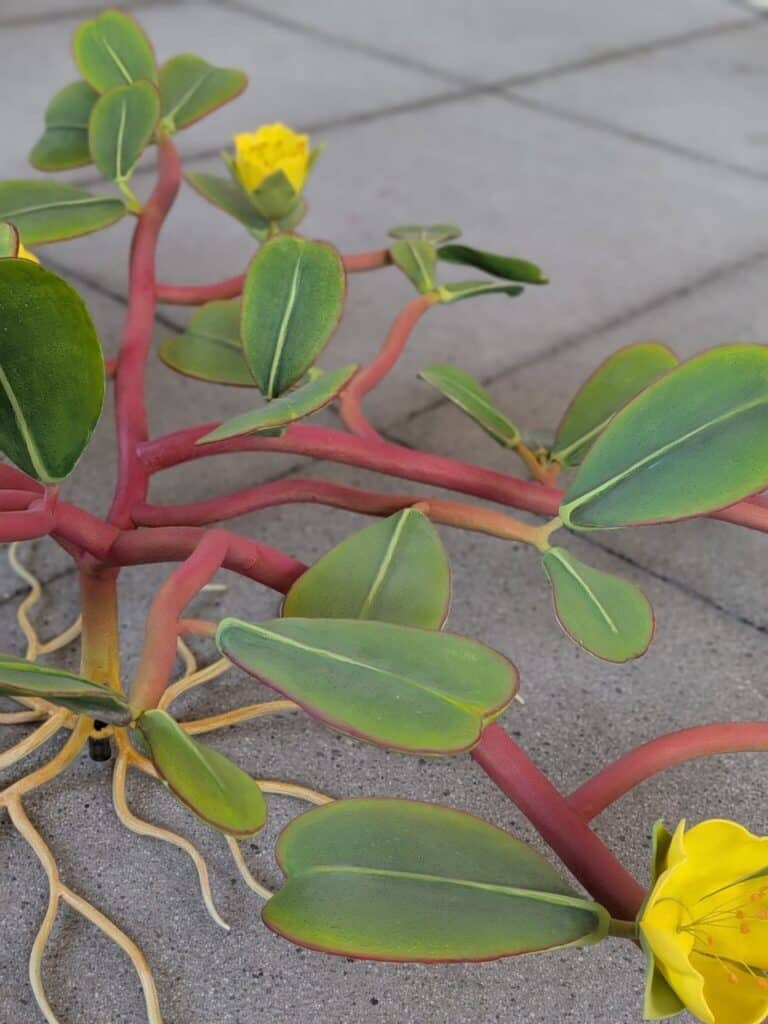
Meanwhile, Renee Adams’ plant sculptures seemed to be sprouting from the concrete. One looked as tender as new spring growth, an unlikely little emergence in a hard urban surface. The works belonged to her Uncultivated series, inspired by resilient plants often dismissed as weeds. “Like us, they set roots, claim territory and struggle for resources,” Adams writes in her artist statement.
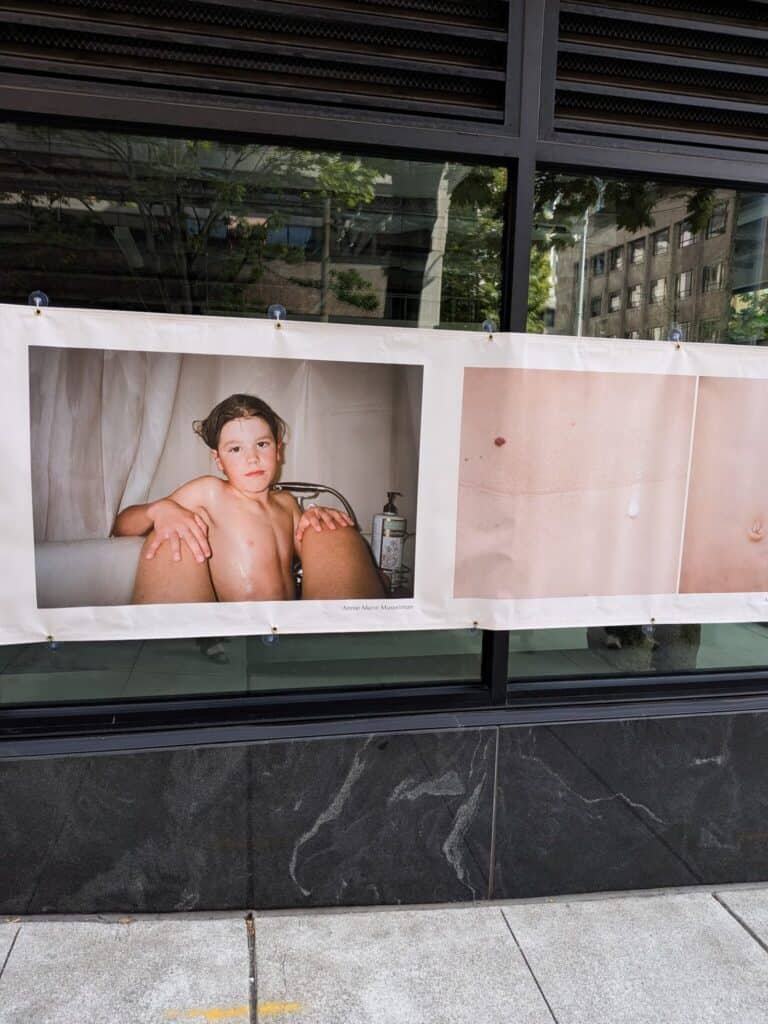
That sense of vulnerable but persistent life continued in Tender Care, an exhibition by the Mothership Photography collective displayed in the windows near the Madison Street plaza. There were children sprawling or clutching stuffed animals, wet skin glistening in a bath, a drop of milk descending against pale flesh. After the flowers pushing up from the pavement, these intimate images felt connected: the tenderness of unruly bodies growing, almost defiant in their vulnerability.
At Madison Street Plaza, dancers from Kinesis Project filled the space for Bridge Matter/The Reach, accompanied by live wind instruments. The piece was a collaboration with geologist Dr. Missy Eppes (more collabs with geologists, please), meant to draw parallels between human attempts to bridge cracks and the Earth’s own processes. The vividly colored, diaphanous outfits of the dancers were a special treat, as were the moments they embraced, in a manner far less dramatic than tectonic plates.
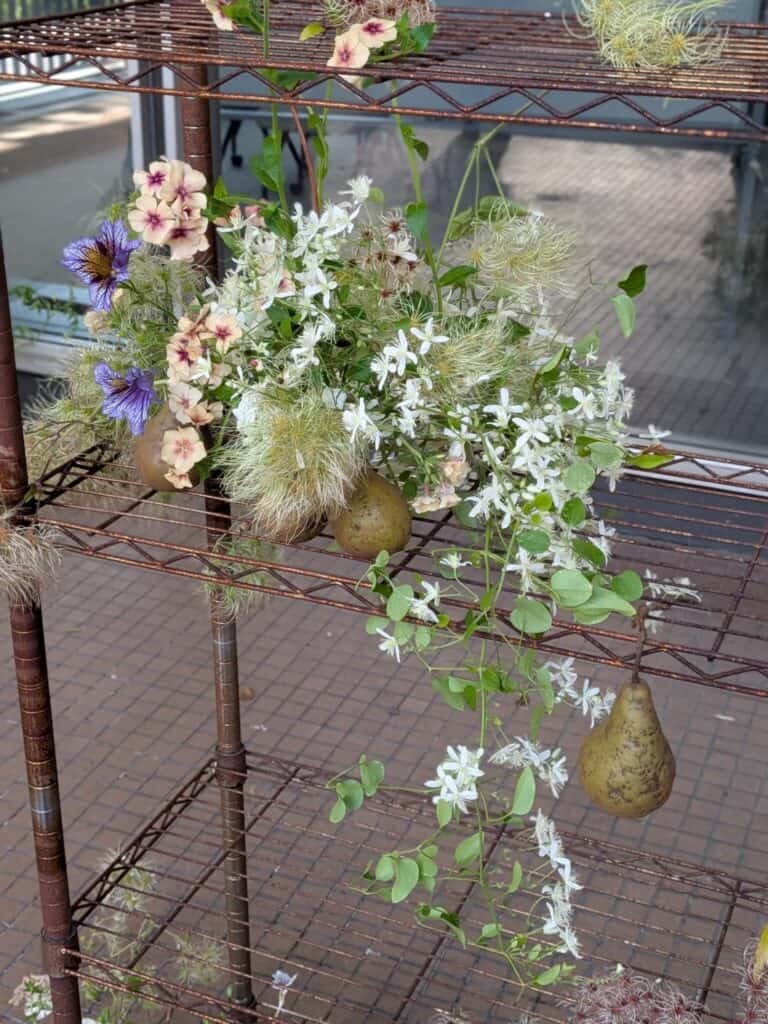
At Norton Plaza, music by Deitrich Jones II provided a particularly lovely backdrop for a tucked-away garden created by Francesca Lohmann and Isvald Klingels’ floral installations—trailing, elegant arrangements of flowers and fruit that looked like table centerpieces for an urban buffet. On Cherry Street, meanwhile, Undercurrent’s dancers moved so slowly that the scene took on the slightly uncanny feeling of a zombie apocalypse.
Admittedly, there were moments when I wished for the quiet of a gallery. A chorus of honks and occasionally sobbing children is not always the ideal accompaniment to looking at art, and finding water and a bathroom along parts of the route proved tricky. But the interruptions belonged to the experience, and the inconveniences were worth it as spaces came alive in new ways. The word “activation” can be overused in arts marketing, but here it was in practically its Platonic ideal.
When I finally stopped for juice and soup at the minor vegetable miracle that is Cocoa Banana, I overheard another customer say, “I walk by here every day and never noticed this place.” Before leaving, he added, “Thank you, I’ll be back. I work three blocks from here, and I never know where to go for lunch.”
It was a modest, soup-based discovery, but it gestured at something I’d felt throughout the afternoon. WALKDONTRUN is an invitation to look longer at downtown, to turn toward places we might otherwise pass by in a hurry. The sense of surprise and re-engagement is something people crave, and it draws folks who might not be as inclined to go into a gallery—perhaps because the ever-shifting, choose-your-own-adventure nature of the experience feels enticing to those put off by white walls. I’ll think of the saxophonists, the secret gardens, and the geologist-inspired dancers next time I pass through Second Avenue, and I hope they come back soon.
Follow Us

What’s on Screen at Diwa Filipino Film Festival
Family histories, migrant stories, political struggles, ghosts, romance, and an unexpected dose of comedy shape this year’s lineup.
Before Adrian Alarilla had an international film lineup to consider, there was a loft at Seattle Center to fill. Organizers of the Pagdiriwang Philippine Festival—part of the Festál series—wanted to expand their arts programming and make better use of the Armory’s upstairs space. A friend suggested adding movies and recommended Alarilla to lead the effort….

Pacific Northwest Ballet Opens Its Season with Heart
Serenade pairs Balanchine’s romantic sweep with a revealing new work by Jessica Lang and a jubilant finale from Alexei Ratmansky.
Finding stillness can be challenging. To pause without scrolling or anticipating the next thing on a to-do list, especially at the change of the seasons. It is well-timed, then, that Pacific Northwest Ballet’s 2026-27 season-opening program Serenade is rich in sensory experiences: light, color, movement, stillness—and the value of the calm spaces in between. The…

Studio Sessions: Heidi Grace Acuña
Drawing on her Filipino heritage, interdisciplinary artist Heidi Grace Acuña brings sculpture and fashion together with a spirited approach to ancestral traditions.
Heidi Grace Acuña has made me fond of crocodiles. At her exhibition at ARTS at King Street Station, I could study the little ones alongside their larger companions, peer into mouths lined with uneven gold teeth, and circle their clay bodies with all the curiosity and delight that fear would ordinarily keep in check. The…

CID Night Market Returns This Saturday With a New Food Walk
More than 100 vendors will take part in the free festival, with food specials starting at $6.
My daughter and I were recently watching the Tokyo episode of Eugene Levy’s The Reluctant Traveler, and we couldn’t get over how pretty the lanterns looked along the busy streets. It made me want to be out in a city at night, somewhere with good food and plenty of people. Now in its 19th edition,…