





Features
Read More ›
Rachel Marsh Knows a Good Joke Takes Work
The Bothell-raised actor talks about trusting her comic instincts and making a beloved character her own in the new rom-com The Love Hypothesis.

Rachel Marsh, who grew up in Bothell, has been building an eclectic résumé with roles in Prime Video’s Fallout and Hulu’s Adults. Now she’s stepping into the romantic-comedy spotlight with The Love Hypothesis, which began streaming on Prime Video Sept. 23. Based on Ali Hazelwood’s bestselling 2021 novel, the film stars Lili Reinhart as Olive Smith, a Stanford Ph.D. candidate who impulsively kisses intimidating professor Adam Carlsen (Tom Bateman) to convince her best friend that she’s moved on from her crush. The favor leads to a fake-dating arrangement that soon becomes more complicated, with Marsh playing Anh Pham, Olive’s best friend, whose own romantic situation helps set the story in motion.
Marsh spoke with Seattle magazine about growing up in the Seattle area, her approach to comedy, and bringing elements of her Filipino culture to the role.
Tell us a bit about your upbringing in Bothell and some of your favorite parts about growing up in the PNW.
I love Washington. I was born in Portland, and then my family moved to the Mountlake Terrace area. I grew up in Bothell, and I love that area so much. I loved being away from the city a little bit. I loved my childhood in a small town. It was beautiful. I grew up in a neighborhood with a lot of trees, in this really cute little apartment complex next to our church. Our community was there, my school was there, my apartment friends were there. It was just a very sweet way to grow up. I went to Cedar Park High School in Bothell, and then I went out of state for college, but my family is still there. I visit all the time.
Any favorite Seattle-area restaurants?
My favorite place to eat in Seattle is probably Homer. I really like Local Tide for lunch. I love Hama Hama and Taylor Shellfish, especially the locations out at the farms. They’re so fun.
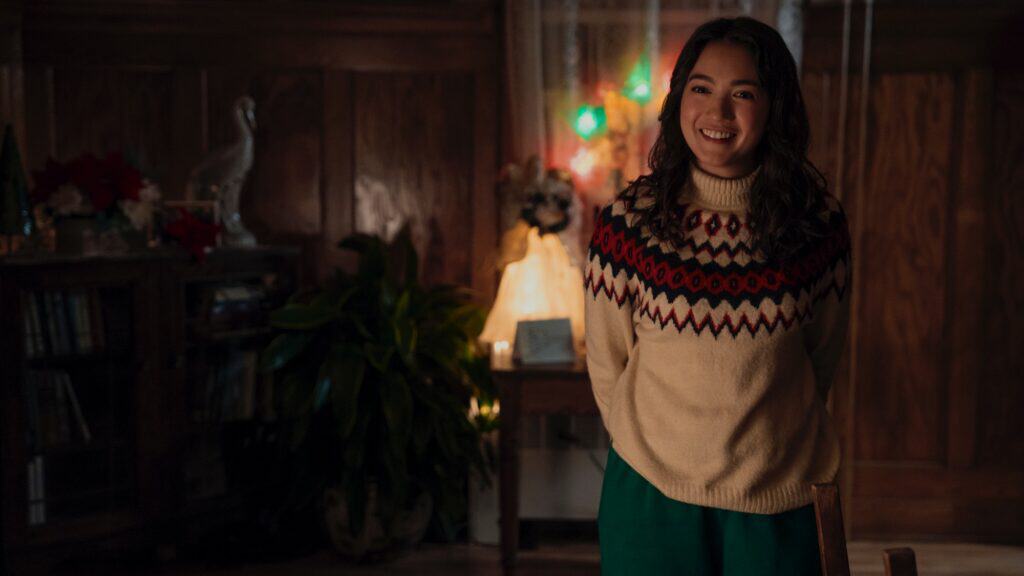
From your time learning improv with Upright Citizens Brigade Theatre in L.A., how much does a logical approach inform your own comedy and acting, versus taking wild swings and following your instincts?
UCB was a big part of my acting training, along with acting schools in L.A. So much of acting is failure—trying to put yourself outside of yourself—and you can really only learn that onstage by failing.
That’s become a big part of my process on camera, especially because I do a lot of comedy. What makes something funny on paper is different from what makes it funny on camera. Onstage, you learn that something is working when people laugh. On camera, you’re looking for your scene partner, the director, the DP—anyone behind the camera—to laugh.

In that sense, comedy is very scientific. There’s a formula and patterns that work. I think the part you can play around with is your personal taste. In comedy, the more specific, the better.
So when I get a script, I’ll think, “This is obviously a joke. The writers wrote it for a reason—why did they think this was funny?” That’s the formula. Then I can personalize it: Why do I find it funny? Can I change the timing or improvise a little? Can I find my way into the joke in a way that makes me laugh? That’s where art meets science.
For The Love Hypothesis, at what point did you feel like you found your own version of Anh?
For Anh, she is not super serious all the time. She does have her moments, but she is playful, and she’s the one who’s kind of light and gets Olive out of her head. It was really fun to play with the language of what that might look like from a best friend, and getting in the mindset of, “Who’s my best friend? How do I talk to my best friend? How do I make my best friend laugh? How do I make her feel loved?” It was taking a lot of my own life experiences and imagining someone that I love and someone that I’m very close to, and just substituting that with Lili. It was very easy because Lili and I did get along really well.
The jokes are hard because sometimes in the book there would be things that you would have to honor—language or jokes or things that fans really wanted to see—and sometimes it doesn’t translate to screen one-to-one. We had to change the joke a little bit, and luckily all of the things that we’ve changed from the book to the movie, the fans have really loved. At the time, it felt like a little bit of a gamble, but now that it’s been received well, I feel like it was kind of worth the risk.
Anh is Vietnamese in the book, but the character was given a Filipino background for the film. How did it feel to have the character tailored to you?
It was interesting because that conversation is really nuanced. I think a lot of people reading that book were excited for a Vietnamese actor to play this role. Her name is Anh Pham. When I was cast, it was really special that people were like, “OK, let’s see a Filipino version of Anh.” There wasn’t going to be a version where I tried to play Vietnamese. I didn’t want that. I don’t think anyone on the film wanted that.
But because her culture is important when she comes home for Christmas, we wanted real representation of what my family would be like. Claire [Scanlon, the film’s director] was like, “What do you guys even do on Christmas? What’s a big tradition?” And I was like, “My family gambles.” So we were able to put cards in there. I think a lot of people can relate to families having fun in a different way that’s not necessarily part of their culture. It is part of Hawaiian culture—we’re all gamblers—but not necessarily Filipino culture. We were very precious about that aspect of it.
I think a lot of people will be looking to see, “Is this authentically cast as Rachel Marsh? What does that mean?” We had a lot of conversations about changing my last name, too, but because it’s in the book and it’s so beloved, it felt like it was something that belonged to people already.
The party scene (which looks like it was a lot of fun to shoot) features a Rube Goldberg machine. Were those sequences all practical, or was there some camera magic involved?
It was all practical. We had to hold and reset everything a ton of times. That was probably one of the longest scenes to shoot, just because of how many people were there. We had to reset the Rube Goldberg machine so many times. Sometimes we’d get the acting and camera right, but then the machine wouldn’t go off. That’s just part of filmmaking—you really want something to work, but sometimes you have to spend that extra time and care on it. I think it paid off in the end. It was funny because that was a night shoot, so it was like 2 a.m. and we were all just like, “Oh my God.”
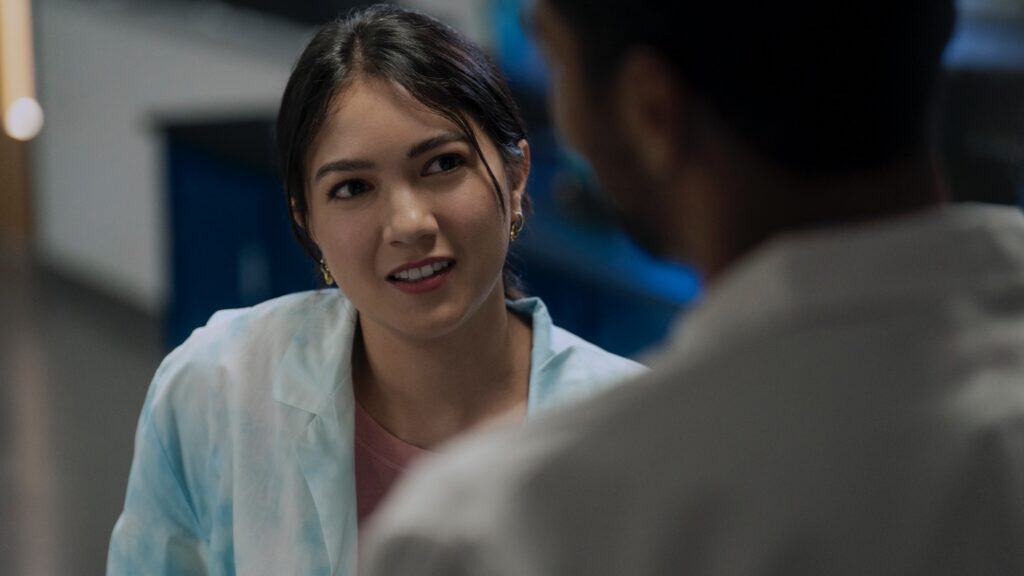
One of the things the movie does well is explore friendship, but also the experience of having someone see something in you before you see it in yourself. When you were starting out in your career—or even now—is there someone who did that for you?
I had an acting teacher, John Shorb at Cedar Park High School, who was the first person who made me realize I could be funny. I did a one-act, and hearing people laugh at me was a feeling I’d never had before. Looking back now, I realize that was the moment I knew I wanted to explore acting. I obviously didn’t have anyone in my life who did that, and I didn’t even know acting was a job.
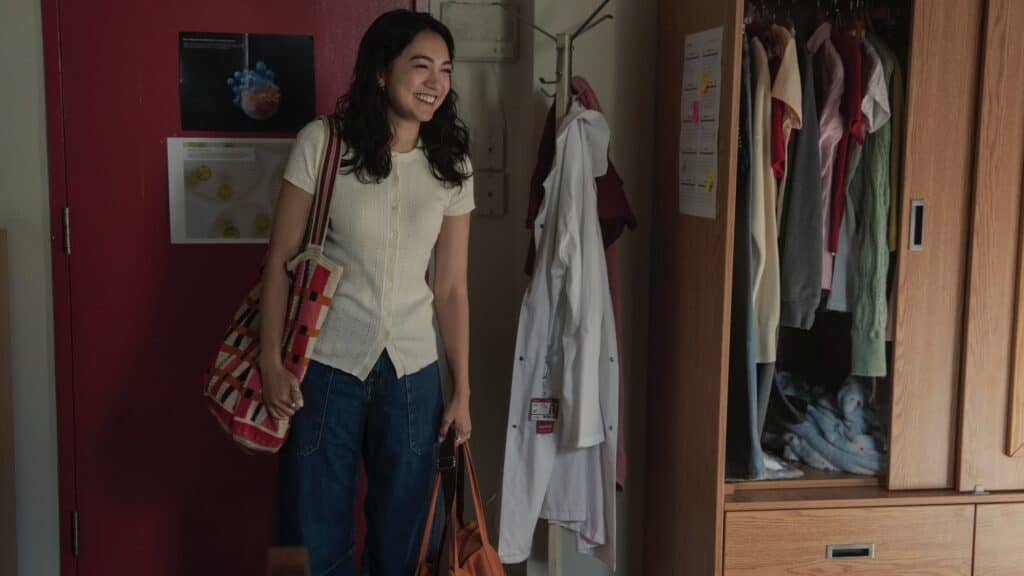
It’s cool to have that perspective now. I also think there were a lot of teachers at UCB who really saw something in me and encouraged me to audition for a house team. And honestly, my acting teachers, Desean Terry and Graham Shiels, were mentors to me. Having someone believe in you sounds so cheesy, but it really does make a difference.
I have to ask about your hilarious turn as a K-pop singer in Hulu’s Adults. I need “Hiccups (Body Go Crazy)” on streaming. How did you ultimately land on the version we hear on screen?
We had so many versions of that song. All credit to Rob Rossell, our creators Ben Kronengold and Rebecca, and Charlie O’Connor, our songwriter and composer—they did it, not me. At the table read, none of the music was done, so I had to rawdog a little singing, which was really difficult. That version didn’t end up making the final cut, but it was fun because we kept thinking, “This is way too good.” The brief was essentially to make a bad song, and somehow they made a genuinely good one.
In the studio, we tried so many different versions, producer tags and silly little ideas. It was really collaborative, and I got a taste of what goes into making a song. A big part of it was getting into the mindset of someone who earnestly thinks they’re trying to make a banger. We tried everything, and then Charlie worked his magic in the editing process.
Do you actually sing?
Well, I’m Filipino, so I obviously sing. Is it good? No. I’m not a singer. I love to sing, but I’m not good at it. There’s no other world in which I would sing seriously, so I’m grateful that I get to sing as a joke—something that will live forever.

Is there another book or franchise you’d love to be part of?
My dream is to do something inspired by Martha Stewart. She was my icon growing up, and I’m a little bit of a homemaker in the same way—I love to cook and craft. I’d love to adapt something like Country Living or The Martha Stewart Living books into a public television-style series. I love public television, and my dream would be to create an Asian Martha Stewart.
Follow Us

Studio Sessions: Kelly Bjork
Fresh off the opening of a solo gallery show, Kelly Bjork talks working in pencil, the turning point in their career, and staying authentic in their art.
A longtime fixture in the local art scene, Kelly Bjork creates works that are intimate, relatable, and that hum with emotion. Working with pencil and paint, Bjork’s illustrations—often vibrantly colored and patterned—give viewers a glance into scenes of domesticity, highlighting simple moments between humans (or between a human and a place) that make up daily…

What’s on Screen at Diwa Filipino Film Festival
Family histories, migrant stories, political struggles, ghosts, romance, and an unexpected dose of comedy shape this year’s lineup.
Before Adrian Alarilla had an international film lineup to consider, there was a loft at Seattle Center to fill. Organizers of the Pagdiriwang Philippine Festival—part of the Festál series—wanted to expand their arts programming and make better use of the Armory’s upstairs space. A friend suggested adding movies and recommended Alarilla to lead the effort….

WALKDONTRUN Offers a Different Way to See Downtown
The one-day art festival brings new life to familiar corners of the city.
How often do you linger in the central business district of downtown on the weekend? If you’re like me, not terribly often. Certain blocks can feel a little forlorn once the weekday workers empty out—or perhaps not forlorn so much as waiting for their purpose. On Saturday, September 19, plenty of new purpose flourished (and…

Pacific Northwest Ballet Opens Its Season with Heart
Serenade pairs Balanchine’s romantic sweep with a revealing new work by Jessica Lang and a jubilant finale from Alexei Ratmansky.
Finding stillness can be challenging. To pause without scrolling or anticipating the next thing on a to-do list, especially at the change of the seasons. It is well-timed, then, that Pacific Northwest Ballet’s 2026-27 season-opening program Serenade is rich in sensory experiences: light, color, movement, stillness—and the value of the calm spaces in between. The…