





Arts
Read More ›
Book Excerpt: A Fun Ride
Biking Uphill in the Rain explores Seattle’s robust bicycling culture

This article originally appeared in the September/October 2023 issue of Seattle magazine.
Despite Seattle’s infamous hills and seemingly constant drizzle, the city is known across the United States for its strong bicycling culture. Bicycling magazine, in fact, has named Seattle the best bike city in the country. A new book by Tom Fucoloro, the founder of the popular Seattle Bike Blog, takes a deep dive into the evolution of the city’s bicycle scene and what challenges lie ahead for Puget Sound bike advocates. Biking Uphill in the Rain: The Story of Seattle from behind the Handlebars, was released last month by the University of Washington Press. Here is an excerpt as it appears in the book.
The Boeing bust gave Seattle a head start on the national recession of the 1970s, triggered by the 1973 oil crisis. As Seattle would see again in the 2008 recession, people seeking ways to save money in difficult economic times found that and much more in the humble bicycle. The seeds of Seattle’s 1970s bicycle movement had been planted in the previous decades. Bicycle sales grew throughout the 1950s and 1960s as lighter bikes with multiple gears and easy-to-use gear shifters and derailleurs became more widely available at the consumer level. By 1968, a new kind of bike-riding movement was forming, empowering advocates to push for bike-friendly changes to the city.
The moment that propelled bicycling into the civic spotlight was the brainchild of a woman who didn’t even ride a bike. It rained all day November 16, 1967, which is to say that it was a very typical Seattle evening when Mia Mann walked into the regular meeting of the Seattle Board of Park Commissioners with a simple idea that would change her city forever. Mann was active on city and nonprofit boards, especially in support of city beautification and arts efforts.
The act of kicking cars off the street for a few hours demonstrated the benefits of public spaces without cars.
Mia decided to push an idea being tried out in her hometown of Minneapolis: a car-free streets event. She wrote a Seattle City Council resolution to create such an event, but her idea met resistance from those in charge. First, the Parks Department tried to ignore her, but she would have none of that. Then the Parks superintendent said they couldn’t do it because it would interfere with vehicle traffic and because the Parks Department didn’t have jurisdiction to close streets. Eventually, Mia got a powerful City Council member named Myrtle Edwards involved. Edwards was responsible for major parks efforts, including the city’s acquisition of a closing gas plant at the north end of Lake Union that would one day become Gas Works Park. Edwards ran with Mia’s open streets idea, gathering council support and convening multiple city departments to make it happen. Her support was more than enough to win approval from the Parks board that rainy evening. They agreed to hold one trial event in the spring just to see how it would go.
The plan was simple: put up signs closing a two-mile stretch of Lake Washington Boulevard to cars starting at Seward Park in South Seattle and heading north. They then invited people to bike freely on the boulevard and on the forested roads through Seward Park without fear of cars. The whole thing cost the city less than five hundred dollars, and Mia Mann, Harry Coe of the League of American Wheelmen (now known as the League of American Bicyclists), and coaches from Rainier Beach Cottage School volunteered to carry out much of the organizing and promotion. “People have to get hold of their lives and get out in the open,” Mia told the Seattle Post-Intelligencer before the first Bicycle Sunday event. “The automobile just isn’t doing this for us. I haven’t ridden a bike in years, but I’ll be out there.”
Nobody, it seems from news reports, expected the number of people who showed up April 28, 1968. An estimated five thousand people brought their bikes to Lake Washington during the seven hours the road was closed to cars. City leaders clamored to show their support for the popular event and call for more. Soon the city was hosting Bicycle Sundays several times a month in locations across the city. More than half a century later, the Parks Department still hosts Bicycle Sunday on the same stretch of Lake Washington Boulevard.
But Bicycle Sunday did more than just create a fun space for a few hours. The simple act of kicking cars off a street for a few hours demonstrated to people the benefits of public spaces without cars. Cars require an enormous amount of space, and by the late 1960s nearly all street space had long been the domain of car travel and storage. In the city’s deeply entrenched car culture, getting out on a bike on a car-free street could be a radical experience.
The start of Bicycle Sunday in 1968 was something of a coming-out party for Seattle’s growing bicycle revival. Politicians saw that many people were deeply interested in biking; people with bikes realized they should use their numbers to get organized and start asking for better conditions for biking; and people who didn’t bike saw the crowds and thought it looked like fun. Within weeks of the first event, Harry Coe was rallying political support for a citywide bike route network. Signed bike routes were a small step, but they could be done quickly and represented perhaps the first time since the turn of the twentieth century that the city’s Department of Engineering was tasked with thinking about how someone on a bike might get around town.
Coe was a runner for Team USA during the 1908 London Olympics and had biked all over Seattle as a child. “You could ride downtown without much competition from automobiles,” he told the Seattle Times in 1968. Coe also wrote a letter to the Seattle Post-Intelligencer around the same time saying that the first Bicycle Sunday reminded him of those early days. “It was a day which will be long remembered as one of Seattle’s finest for a lot of people who too seldom get together at one place to enjoy something which they all have in common, namely, love of bicycle riding,” he wrote. He was eighty-three in 1968 when the city started putting up his long-sought bike-route signs. The sheer number of bicyclists who participated in the first Bicycle Sunday gave the plan the popular push it needed to win approval. Signs started going up within months of the first event, and fifty miles of signed bike routes were installed across the city in the first year. Some of these green signs are still in place, bearing a pictogram of a bicycle and reading simply “Bike Route.”
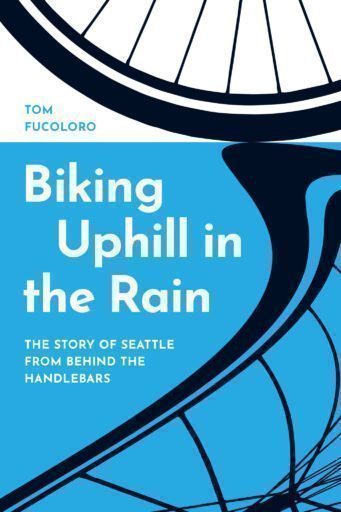
© University of Washington Press. Excerpted with permission from Biking Uphill in the Rain: The Story of Seattle from behind the Handlebars by Tom Fucoloro.
Follow Us

SENSORIUM Takes on Our Screen Addiction
Dance, drag, and immersive art collide in an eight-week exploration of our phone-obsessed lives, with a few surprises along the way.
What do drag queens, smartphone addiction, art installations, and an old luggage shop have in common? According to longtime Seattle choreographer Alana O’Farrell Rogers, a lot. “There’s no dead time anymore,” says Rogers, explaining how the proliferation of smartphones fills the empty spaces that once served as time for rest or connection. Where we snuggled…

Salt-N-Pepa on Breaking Barriers and Staying Power
Ahead of their performance at Seattle’s Museum of Pop Culture gala, the hip-hop pioneers talk about creative ownership, connecting with new generations, and the songs that still resonate.
The Museum of Pop Culture (MOPOP) will host its annual ICONS of Pop Culture Gala in Seattle on October 22, honoring five artists and institutions whose work has helped shape entertainment and culture. This year’s honorees are martial arts and film legend Bruce Lee, fashion designer Jeremy Scott, the video game franchise Halo, hip-hop pioneers…

Studio Sessions: Christopher Paul Jordan
Drawing on childhood memories, neighborhood history, and salvaged materials, Christopher Paul Jordan’s latest show at Cornish’s Behnke Family Gallery explores how the past stays with us.
Start in the middle. It’s good advice for telling a story, and a way into Christopher Paul Jordan’s paintings. By the time you encounter them, their materials have already been something else, and who knows what they might move on to become. The Tacoma interdisciplinary artist works with salvaged objects, including screens, picture frames, canvas,…

Rearview Mirror: Wedding Bells, A Furniture Launch, and the Symphony’s New Look
Things I did, saw, ate, learned, or read in the past week (or so).
WEDDING BELLS I’ve been a bit absent from this column lately, but I think I have a pretty good excuse: I got married! It’s already been three weeks since my September 19 wedding, but I’m still reflecting on the magic of the day. My fiancé, well husband now (I can’t get used to saying it!),…