
Born to (Run) Ski
Pro runner and University of Washington alum Anna Gibson took up ski mountaineering only eight months ago. In February, she represented Team USA in the endurance sport’s Olympic debut.
By Chelsea Lin March 31, 2026

This article originally appeared in the March/April 2026 issue of Seattle magazine.
Anna Gibson is always beaming. Not a phony only-for-the-socials kind of smile, but an open-mouthed grin of exaltation that seems to radiate from her very core.
Maybe it’s the lack of oxygen above 6,000 feet near Jackson Hole, Wyoming, where Gibson trains in the Tetons. Maybe it’s because she just really, really loves running.
But we’re not here to talk about running. We’re here to talk about how Gibson—a University of Washington alum and former Husky track star turned professional runner—responded when a friend, Cameron Smith, asked her to join him last summer to compete in an Olympic-qualifying race in a sport she’d never tried professionally.
Ski mountaineering, affectionately shortened to skimo, combines an intense uphill sprint in the vein of Nordic (cross-country) skiing, followed by a downhill blitz to the finish line. It’s a sport of endurance and extremes. Of course, Gibson agreed, if not immediately, then definitely enthusiastically.
In many ways, Gibson has been training for skimo her entire life: She’s been on skis since she could stand and running since she knew how to walk. Her parents competed in Jackson Hole’s Randonnee Rally, North America’s first ski mountaineering event, when she was a kid.
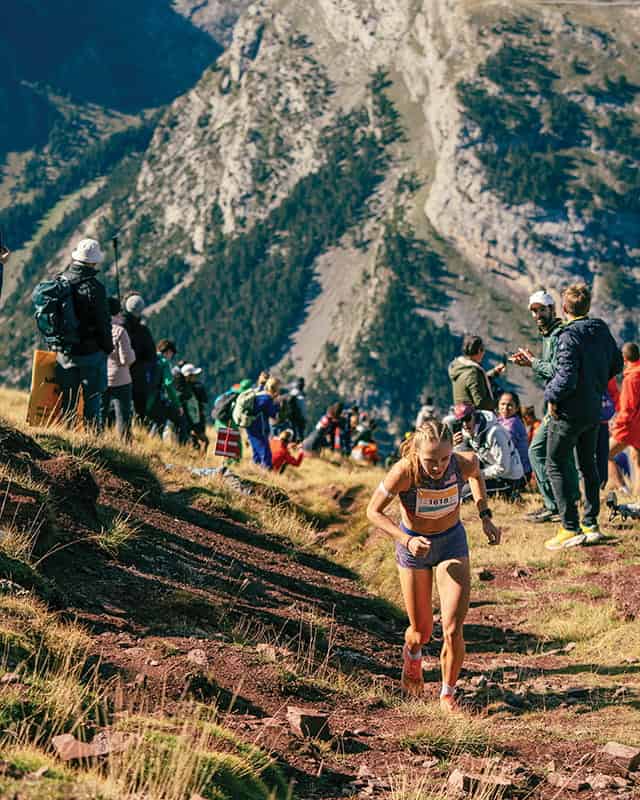
But her first real race was the World Cup last December, just six months after she started training with USA Skimo. Gibson and Smith placed first, qualifying them for the sport’s Olympic debut last month in Italy.
“That environment is really inspiring for me. I want all the people around me to be sparking creativity and inspiring me to push myself, too.”—Anna Gibson
“It’s funny because people hear that story and they’re like, ‘That is insane!’ But anyone who has known me for a lot of my life understands this makes complete and total sense,” she says. “I’ve basically been doing this sport since I could walk—I just hadn’t raced.”
Gibson says she’s experienced a lifelong “gravitational pull to Wyoming, where the average person is a pretty insane athlete.” She loved the four years she spent at the UW after transferring from Brown University in Rhode Island. In Seattle, she broke NCAA records as part of the Track & Field team and broadened her appreciation of the outdoors, first with a degree in environmental science and terrestrial resource management in 2021, then with a Master of Jurisprudence in environmental law in 2023.
Ultimately, the tetons called her home, though she continues to visit Seattle regularly as part of her sponsor partnership with Brooks Running. “I’m really happy running in the mountains,” she says. “I was raised in a town full of mountain athletes who are skiing, mountain biking, trail running—doing all these things up in the high peaks all the time. People here are constantly pushing themselves and falling in love with new sports and signing up for challenging adventures. That environment is really inspiring for me. I want all the people around me to be sparking creativity and inspiring me to push myself, too.”
It’s easy to see how Gibson is a product of her environment, but Olympic teammate Smith says there’s more to it than that: Her dedication and positivity are infectious and inspiring, particularly to younger athletes who see how she’s able to maintain focus while still having fun. A quarter of the way through the World Cup relay, Smith says they were behind the teams they needed to beat for the Olympic qualifications, and Gibson had just finished an all-out effort on her leg to tag him in. “She shouted, ‘You got this!’” Smith recalls. “She was just out there having fun on the course and knew we would pull it off. That’s such a great example to me that she never lets the pressure get to her—she’s the same upbeat person no matter the situation.”
This issue went to press around the time of the Olympic Games’ opening ceremony in early February—too soon to see how Gibson fared in the women’s sprint on February 19 or with Smith in themixed relay on February 21. Generally, skimo races can take hours through the world’s most daunting ski terrain. The Olympic course in Bormio, a mountain hamlet in the Italian Alps between the games’ host cities of Milano and Cortina, was designed to take minutes, though with a vertical gain of more than 40 stories. Regardless of the outcome, Gibson says she has no plans to hang up her skis. “I don’t know what skimo will look like in my life after this year,” she predicts, “but I know it’s here to stay.”
Chelsea Lin is a writer at the University of Washington.
Follow Us

From Ph.D. to Paralympics
She found adaptive sports while pursuing her doctorate. Now the UW alum and world-class Para Nordic skier is racing in Italy.
Nicole Zaino should have been working on her Ph.D. qualifying exam. It was 2019, her second year as a graduate student in the University of Washington Department of Mechanical Engineering, and though Zaino was excelling academically and enjoying her coursework, something was missing. “I was feeling burnt out and a little too stressed,” she says….

To Skate Like A Girl
The Professional Women’s Hockey League expands to Seattle with the Torrent, a talent-filled team poised to sweep the ice.
When Danielle Serdachny was growing up, she dreamed of playing professional hockey. This wasn’t unusual, given that she’s from Alberta, Canada, where hockey is as much a passion as a sport. Her dad teaches skating and hockey skills, and he’d even worked for the National Hockey League’s Edmonton Oilers at one point. Her older sister…

Please Stop Talking About Malcolm Butler
This Seahawks run deserves to be enjoyed on its own terms, not filtered through old Super Bowl trauma.
I refuse to learn what Malcolm Butler has been up to. This has taken a conscious effort on my part. Within 12 hours of the Seahawks winning their way to the Super Bowl this past Sunday, I saw the first story on the Patriots player who broke Seattle’s heart 11 years ago. I did not…

We’re in a Pickle
Kings of the court.
Unlike some trends, the popularity of pickleball has only increased with time. Here in Washington, the birthplace of the game, we’ve seen a recent wave of new facilities dedicated to the state’s official sport. Last October, Sideout Tsunami Pickleball Center opened in Mt. Baker with 26 state-of-the-art courts that offer instant video replays sent straight…