





Outdoors
Read More ›
Meet West Seattle’s “Freelance Beaver Detective”
A group of urban beavers helped Pamela Adams through a tough time. Now she’s returning the favor.

This article originally appeared in the July/August 2026 issue of Seattle magazine.
Pamela Adams was living in Port Townsend when her marriage fell apart. Little did she know at the time that she would soon find love again while doggedly pursuing the Five Families—not the ones of Mafia lore, but a four-legged sort living along the Longfellow Creek Watershed.
Prior to moving to Washington, Adams resided in Redmond, Oregon, on a large parcel of land adjacent to the Deschutes River, where she encountered a bobcat, a badger, and then a beaver. “I met the bobcat and watched her nurse and turned into my 12-year-old self,” says Adams. Now 62, she remembers studying geese in high school in California and was in the Youth Conservation Corps.
After splitting from her spouse, Adams washed up on the shores of Alki Beach, looking to rebuild her life. She maintained a keen interest in wildlife—and beavers in particular. While working on a beaver-related project on the Elwha River, she forged a friendship with a King County ecologist named Jen Vanderhoof, who introduced her to the beavers of Longfellow Creek near Adams’ apartment in West Seattle.
“She was already interested in finding beavers that she could observe more long-term as opposed to popping in on sites here and there,” Vanderhoof says of Adams. “She really wanted to spend time and get to understand the beavers of a particular creek.”
That was 2021. Fast forward five years and, as Vanderhoof puts it, Adams is “the go-to person for the beavers down there.” Her “Beavers of Longfellow Creek” Facebook page caught the attention of Airbnb, for which she now conducts “beaver tours” as part of the vacation-rental company’s experiential arm. It was through her work that Adams met a West Seattle filmmaker named Kay D. Ray—but not because the latter had signed up to learn more about beavers.
Ray was walking along Longfellow Creek with her sister one day when they lost the trail and stumbled upon Adams, who happened to be conducting field research on that particular stretch of the 4.4-mile creek. Ray asked her what she was doing there, and after learning about the resident beaver families and Adams’ sleuthing in their territory, Ray was immediately interested in making a documentary about her.
The resulting hour-long film, The Freelance Beaver Detective, has been screening at festivals, individual theaters, and public libraries for nearly a year.
“She’s really just helping people learn to live with these magnificent creatures,” says Ray, who sometimes asks Adams about various beaver activities she sees near the creek. “I walked down to the Bone Bridge [a fish-skeleton-shaped structure by environmental artist Lorna Jordan], when there was a big dam there. There was this big beaver taking mud and putting it on this pile. I texted Pamela and she says, ‘It’s scent-mound building.’” This common activity happens when beavers build scent mounds from mud and vegetation, then apply castoreum from their castor sacs. The scent communicates information about who lives there and serves as a territorial marker to other beavers.
“I think there’s value in that—observation is science. I want to make these Longfellow beavers famous and help everybody. I think there needs to be a crazy beaver person at every watershed.— Pamela Adams
Adams is mostly self-taught, although she did complete the Beaver Corps program—a professional training course that teaches nonlethal beaver management—put on by the Beaver Institute in Massachusetts. In spite of her lack of formal education—“I’m not an -ologist,” she quips—nowadays the scientists are learning from her about the Longfellow Creek beavers, not the other way around.
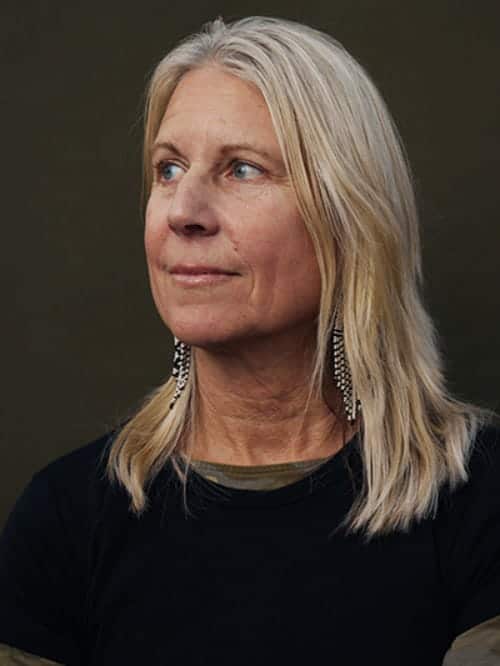
“She was a great resource and a mentor to me,” says Madison Newton, a project manager for Beavers Northwest, which works with landowners to mitigate cumbersome situations involving beavers on their property. “She does a really great job communicating with residents near Longfellow Creek.”
“Some people who know a lot about something withhold information,” adds Betsy Dennis, who sought Adams’ counsel for a beaver issue on her Key Peninsula property. “She is excited about the information and ready to share it. It makes her an incredibly generous teacher.”
‘The ultimate regenerators’
There are five beaver families living along Longfellow Creek. Adams knows this both from her own frequent observations—she visits the creek five days a week—and digital trail cameras she positioned to catch the mostly nocturnal creatures in action. Adams estimates that she spends two hours a day reviewing overnight footage, which she then edits and shares on Facebook.
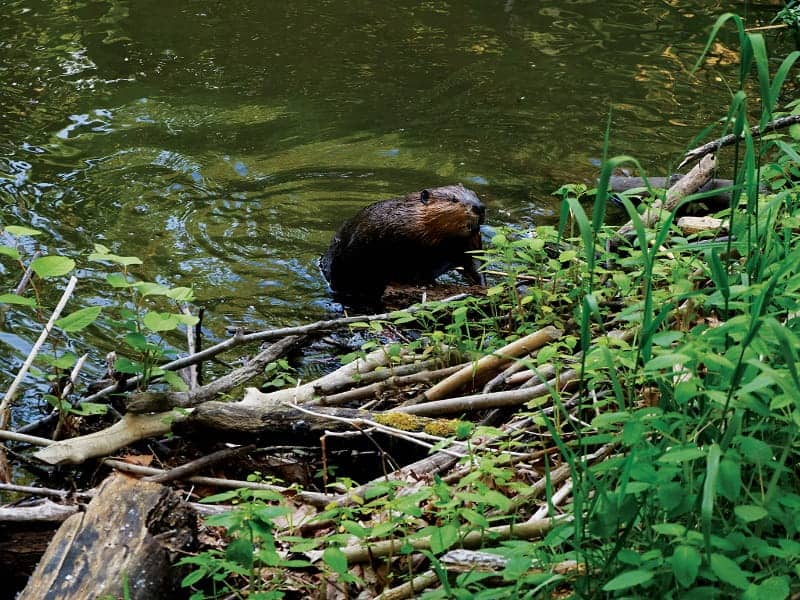
Some homeowners view beavers as a nuisance, as they’re apt to chew down trees to provide wood for their dams, which can sometimes lead to flooded property. But the dams they build also have tremendous value, as they provide a safe and sanitary underwater area for Coho salmon to spawn, among other benefits.
“Beavers are really great at storing water,” explains Newton. “Especially at this time of climate change, we want that water to be stored as long as it can to increase groundwater levels. When beavers build a dam, it slows water down to either prevent a flood or store water during a drought. It’s healthier when it gets sent downstream because it sorts through any sediment or pollutants. Beavers create a safe space for other animals who might not have their normal habitats available in an urban environment.”
Among those animals at Longfellow Creek alone are eagles, owls, smaller birds, coyotes, raccoons, geese, frogs, otters, ducks, and fish. Without the beavers’ stewardship of the creek, such biodiversity would be implausible.
“They are the ultimate regenerators,” says Kim Schwarzkopf of the Delridge Neighborhoods Development Association. “They know how to take care of a place, and we humans can learn a lot from them.”
Other than the money she earns from her Airbnb tours and the occasional conference or library presentation, Adams does not profit much from her beaver expertise, often paying out of pocket for netting and other supplies to keep trees and beavers safe along the creek.
“I’m just quietly watching, going to the same place every day and seeing the changes,” she says. “I think there’s value in that—observation is science. I want to make these Longfellow beavers famous and help everybody. I think there needs to be a crazy beaver person at every watershed.”
The Freelance Beaver Detective will screen for free Sept. 25 at Youngstown Cultural Arts Center as part of “Stories Connect Us,” followed by a panel discussion featuring Pamela Adams.
Follow Us

Inn at Langley: Where the Shore Meets the Sky
After a property-wide redesign, the Whidbey Island retreat reopens with a locally inspired take on vacationing in the Pacific Northwest.
Michelin-star chef Johnny Spero never planned to end up in the Pacific Northwest. A lifelong East Coaster born and raised in Baltimore, he began his culinary career at 16, working for a series of big-name chefs and restaurants before opening his own establishments in Washington, D.C., including Reverie, which earned him his Michelin star in…

The Northwest’s Gateway to Wine, Culture & Adventure
Escape the crowds. Slow down. Savor fall in the Lewis Clark Valley. As autumn paints the hillsides in gold, crimson, and amber, the Lewis Clark Valley becomes a picture-perfect place to slow down and savor the season. Where Washington and Idaho meet, fall brings crisp days, colorful landscapes, harvest among the vines, and plenty of…

A Wellness Pilgrimage to the Olympic Peninsula
Two hours from Seattle, a new kind of luxury is taking root—one built on stillness, old-growth forests, and the subtle art of slowing down.
There is a school of thought among the overworked and overscheduled that the most subversive thing a person can do is stop. Put down the phone, close the laptop, and go somewhere that actively resists attempts to stay plugged in. The Olympic Peninsula has always offered this, in its blunt, mossy way. For some city…

Seabrook Is a Little Coastal Utopia
This walkable beach town gives families room to roam, relax, and leave the car parked.
There’s nothing quite like finding an edible mushroom in the forest with a five-year-old. The excitement and pride my son displayed when we found chicken of the woods were contagious, and after battering and frying the mushrooms, our wonderful day got even better. The dark, wet forests in which our mushrooms grew are part of…