





Weekend Getaways
Read More ›
A Wellness Pilgrimage to the Olympic Peninsula
Two hours from Seattle, a new kind of luxury is taking root—one built on stillness, old-growth forests, and the subtle art of slowing down.

This article originally appeared in the July/August 2026 issue of Seattle magazine.
There is a school of thought among the overworked and overscheduled that the most subversive thing a person can do is stop. Put down the phone, close the laptop, and go somewhere that actively resists attempts to stay plugged in. The Olympic Peninsula has always offered this, in its blunt, mossy way.
For some city dwellers, though—us included—the idea of camping does not conjure tranquility. Travelers increasingly point their compasses inward rather than outward. They want to sleep well. They want to choose relaxation over logistical stress. Finally, the infrastructure of ease is catching up to the grandeur of the peninsula, with luxury and wellness acting as an anchor.
Forest cocooning at Menizei
The centerpiece of any wellness itinerary on the peninsula right now is Menizei, the adults-only campground perched on a bluff high above the Salish Sea. Glamping has taken a firm foothold in Washington state, and Menizei cranks the glam well into luxury territory, as in: caviar on a hot dog luxury. The name, derived from the scientific nomenclature for Douglas fir (Pseudostuga menziesii), suggests something between a spell and a sigh, and the experience more or less delivers both.
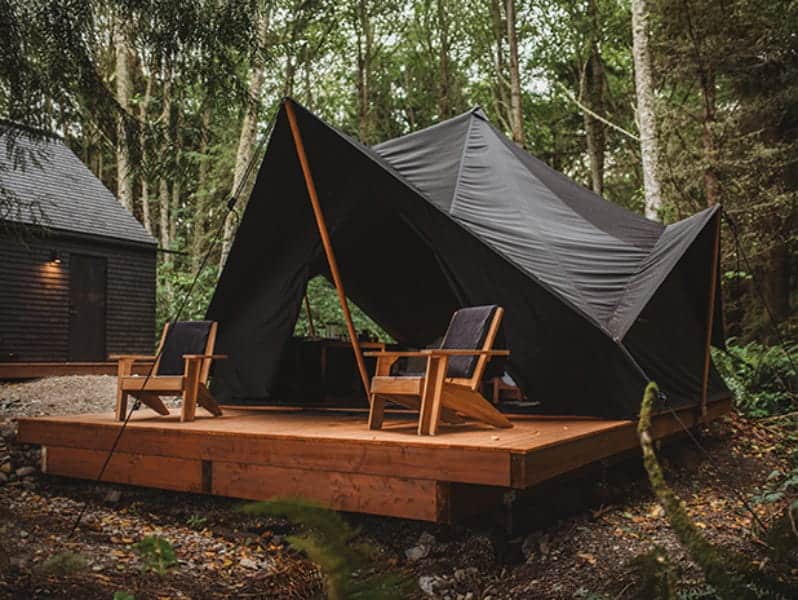
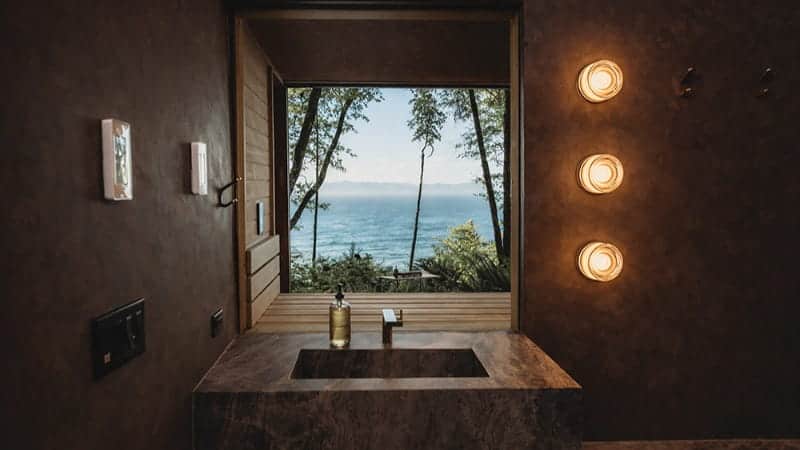
Owners Janice Wilson and Mark Zawistoski’s dual obsessions—wild landscapes and generous hospitality—dovetail seamlessly at Menizei. The couple coined the phrase “forest cocooning,” an urban detox designed for guests who arrive frazzled and later leave, if all goes according to plan, fundamentally rearranged. There is no WiFi. There are no schedules. There is no one else in sight. There is very little to fetter the astounding, unfettered views of Vancouver Island and the Strait of Juan de Fuca.
Few things feel more distinctly Northwest than a cedar sauna overlooking the Salish Sea. After a day on the trails of Olympic National Park, drizzle water over the sauna stones, let the heat work its way into tired muscles, and watch the evening light morph from amber to pink.
A signature blackout tent, cantilevered amid skyscraping trees, is our home for two nights. The tent is sturdy, naturally cooled by the ocean breeze, and appointed with a heated king bed and leather chairs that would not look out of place at a Relais & Châteaux. A private viewing deck overlooks the water, and on clear days, Canada’s coastline shimmers in the background like an inviting, distant apparition.
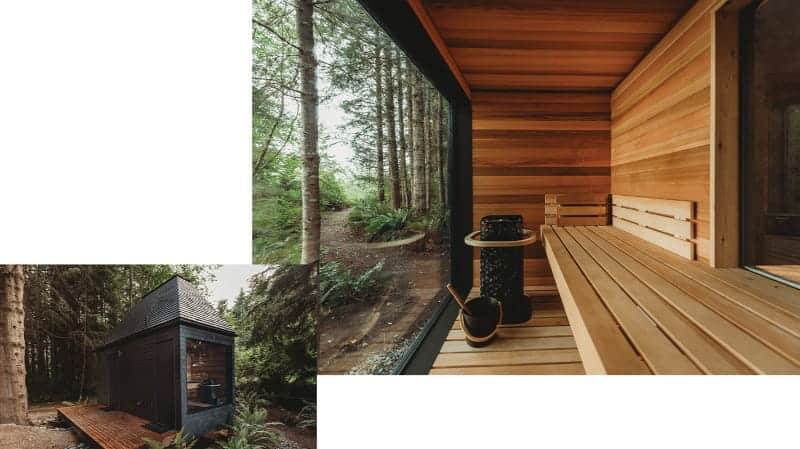
Our bathhouse has a private sauna designed by award-winning architects GO’C, and is a personal space that, in a perfect world, would redefine hotel showers. Private, floating lightly on the pine needles beneath, biophilic to its core, it blurs indoors and outdoors with skylights, generous windows, and not a mirror in sight. The architects threaded the structures carefully through the existing forest rather than clearing it away, grounding the bathhouses on low-impact foundations that hover just above the undergrowth. The effect is less “built environment” than the feeling that the forest acquiesced to let humans borrow a corner of it.
Few things feel more distinctly Northwest than a cedar sauna overlooking the Salish Sea. After a day on the trails of Olympic National Park, drizzle water over the sauna stones, let the heat work its way into tired muscles, and watch the evening light morph from amber to pink. It isn’t complicated; it is exactly enough. Wellness add-ons include massages, as well as rituals designed to encourage serenity and connection. The rites are perfect for couples, and we relish some of the details: cedar smudges in the sauna, hot stones before bed.
Menizei offers three base camps for couples or singles—Grand Fir (canopy and views), Twin Cedars (maximum seclusion), and Red Alder (dramatic arrival and more views)—each positioned on the bluffs with thoughtful sightline management. There is water and electricity, coffee and tea, and a nightcap kit that will produce two Old Fashioneds. Snacks and treats can be added: s’mores, of course, and the aforementioned caviar-laden Black Label dogs. There is ice, a small refrigerator, and enough wood, fire starters, and cooking equipment to keep the retreat nourished and well-heated.
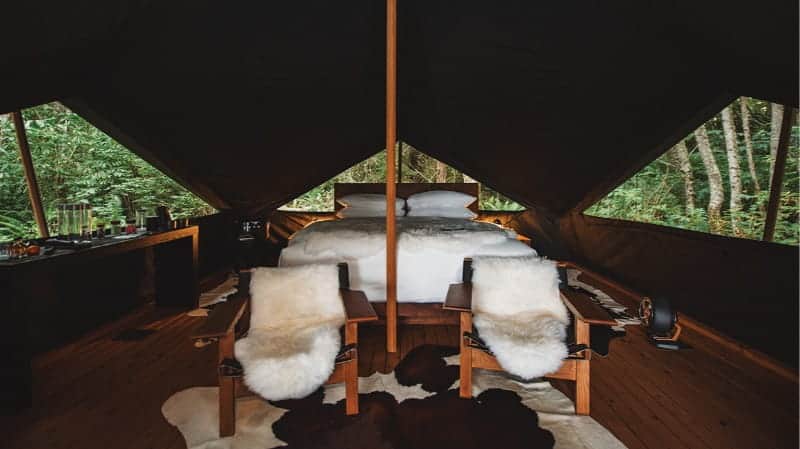
Menizei is catnip for anyone who loves towering forests served with a huge helping of convenience and luxury. We stayed in Grand Fir and became instantly, fiercely, proud of our base camp. Our wood fire might have burned so hot that it briefly raised the temperature on the moon. The barbecued hot dogs hit the spot, accessorized with brioche buns, potato salad, and every conceivable condiment. The site is nirvana for grilling, and next time, we mused, we would also bring burgers, steaks, and fresh salmon for the flames.
Long before wellness became an industry, the peninsula’s Indigenous nations understood these forests and waterways as places of physical and spiritual renewal. Cedar, still central to many cultural traditions throughout the region, appears everywhere: in canoes, longhouses, and now, somewhat poetically, in luxury saunas for weary Seattleites.
Olympic National Park
Menizei’s great advantage, beyond the bluff and the view, is its position as a launchpad for Olympic National Park, where nature still feels unapologetically huge. Lake Crescent lies just fifteen minutes away: a glacially carved cobalt basin surrounded by immense firs. We stretch our legs on the immaculate Spruce Railroad Trail, which continues as a paved, easy bike ride much farther than the 4 miles listed online, and make a mental note to return to swim in Devil’s Punchbowl when the water heats up.
An hour deeper into the park, Sol Duc Hot Springs Resort continues the peninsula’s long-standing argument against constant connectivity. There is no reliable cell service, no algorithms, only a cluster of mineral pools steaming beneath old- growth evergreens. The hot springs, naturally heated underground and rich with minerals filtered through volcanic rock, range from soothing to bracing. It’s always worth the trip to see which mood they’re in on a given day.
Solace in Port Townsend
At our final stop, we surrender to the water at Soak on the Sound. Tucked into downtown Port Townsend, the bathhouse feels like the natural final chapter to a peninsula wellness circuit built around elemental pleasures: air, wood, heat, water.
Founder Wren Farris arrived at the concept through her own journey, empowered to prescribe healing through long soaks and sauna culture. The result, in 2014, was the Pacific Northwest’s first dedicated saltwater bathhouse and, according to Farris, the only private saltwater soaking tubs in the United States. The decadently tiled copper basins contain roughly 25 pounds of salt, calibrated to approximate the salinity of the human body.
Here, the water is silky and viscous, and circulates continuously through UV and salt filtration systems. It creates an experience that feels less like sitting in a hot tub than steeping gently in warm mineral buoyancy. There are Finnish steam saunas, infrared saunas constructed from sustainably harvested materials, and a breezy back patio that invites cooling down with a local beer or wine. The retail area is curated with natural products, jewelry, and clothing. Later this summer, Soak expands further with the Well, a massive communal copper tub paired with a Finnish sauna for alternating hot-and-cold hydrotherapy circuits.
Slow down. Bask in water and steam. Watch the evergreens sway above the Salish Sea. On the Olympic Peninsula, restoration begins with the radical act of giving ourselves permission to stop.
Follow Us

Inn at Langley: Where the Shore Meets the Sky
After a property-wide redesign, the Whidbey Island retreat reopens with a locally inspired take on vacationing in the Pacific Northwest.
Michelin-star chef Johnny Spero never planned to end up in the Pacific Northwest. A lifelong East Coaster born and raised in Baltimore, he began his culinary career at 16, working for a series of big-name chefs and restaurants before opening his own establishments in Washington, D.C., including Reverie, which earned him his Michelin star in…

The Northwest’s Gateway to Wine, Culture & Adventure
Escape the crowds. Slow down. Savor fall in the Lewis Clark Valley. As autumn paints the hillsides in gold, crimson, and amber, the Lewis Clark Valley becomes a picture-perfect place to slow down and savor the season. Where Washington and Idaho meet, fall brings crisp days, colorful landscapes, harvest among the vines, and plenty of…

Meet West Seattle’s “Freelance Beaver Detective”
A group of urban beavers helped Pamela Adams through a tough time. Now she’s returning the favor.
Pamela Adams was living in Port Townsend when her marriage fell apart. Little did she know at the time that she would soon find love again while doggedly pursuing the Five Families—not the ones of Mafia lore, but a four-legged sort living along the Longfellow Creek Watershed. Prior to moving to Washington, Adams resided in…

Seabrook Is a Little Coastal Utopia
This walkable beach town gives families room to roam, relax, and leave the car parked.
There’s nothing quite like finding an edible mushroom in the forest with a five-year-old. The excitement and pride my son displayed when we found chicken of the woods were contagious, and after battering and frying the mushrooms, our wonderful day got even better. The dark, wet forests in which our mushrooms grew are part of…