





Features
Read More ›
Every Dress Tells a Story
Dhivya Balasubramanian’s new collection reworks fashion classics using Indian textiles.
 By Sarah Stackhouse May 12, 2026

For Dhivya Balasubramanian, the story often starts with a sari. Sometimes a client brings one in, folded carefully and full of family history. Other times, Balasubramanian pulls from the collection she has gathered on trips to India. Either way, the fabric usually comes first. At her Queen Anne studio, it might become a gown, a tailored suit, or a cocktail dress made to fit one person perfectly.
Balasubramanian is the designer behind DHIVYA BALA, a bridal and formalwear label centered on custom garments and hand tailoring. Her new collection, “Draped in History,” arrives just in time for wedding season.
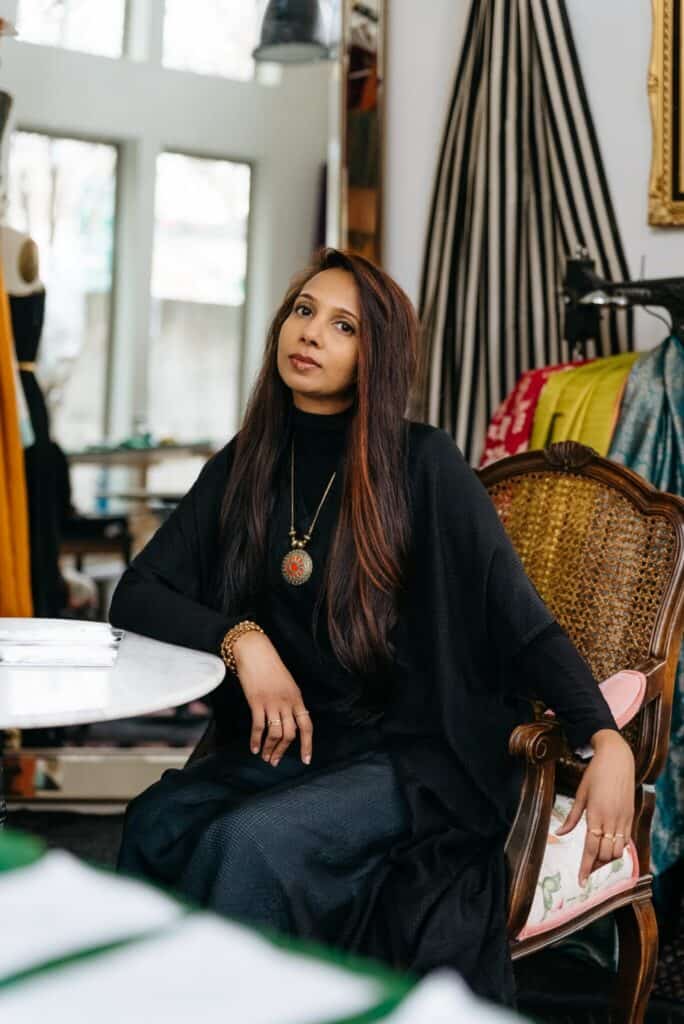
Originally from Kerala, in South India, Balasubramanian moved to the United States more than 20 years ago for graduate school. Fashion came later, as a second career and, as she puts it, “a reinvention of sorts.” In her 30s, while living in California, she started reassessing what she wanted her work to look like. She had studied hospitality and tourism, but that career path no longer felt right.
Fashion had been in the back of her mind for years. As a teenager in India, she applied to fashion school after high school and made it through several rounds of the application process before missing the final cut. She planned to try again, but college life pulled her in another direction. She studied history, made friends, and followed the path in front of her. “I was having too much fun in college,” she says.
Years later, the old interest came back. Balasubramanian enrolled at Apparel Arts in San Francisco, where she studied pattern making, draping, and technical garment construction. She spent three months in New York interning at Marchesa and Nanette Lepore, where the work was unpaid and demanding. “It was backbreaking, grueling work,” she says. “I learned the fashion industry and fashion district like the back of my hand by the end of that.”
She moved to Seattle after her husband took a job at Amazon and their first child was still a baby. For a while, she freelanced, including work with costume designers and private clients. In 2020, she set up her studio as a made-to-order, made-to-measure design space, a model that comes partly from the way she grew up. In India, Balasubramanian remembers going with her mother to the local tailor, choosing from the many fabrics, looking through pattern books, and asking for what she wanted. “Every family had their tailor shop, the local tailor shop,” she says. “It wasn’t expensive.” She loved the anticipation of waiting for fabric to become a garment.
“That customization, that attention to detail, knowing what my client wants and kind of crafting something that looks beautiful on her body and fits her style and her taste,” she says. “That was the premise on which I started.”
Through DHIVYA BALA, Balasubramanian designs made-to-measure pieces that are tailored locally. A bride might bring in a family sari, while someone else might arrive with a favorite dress or a Pinterest board inspired by what she wants to wear for a special occasion. From there, Balasubramanian sketches, fits, cuts, and builds the piece with them. The process usually takes four to six weeks. “I think it’s nice to have that choice of being able to get something that fits you and that you were part of the creation process,” she says. “It makes fashion very personal, as opposed to just going online and ordering something.”
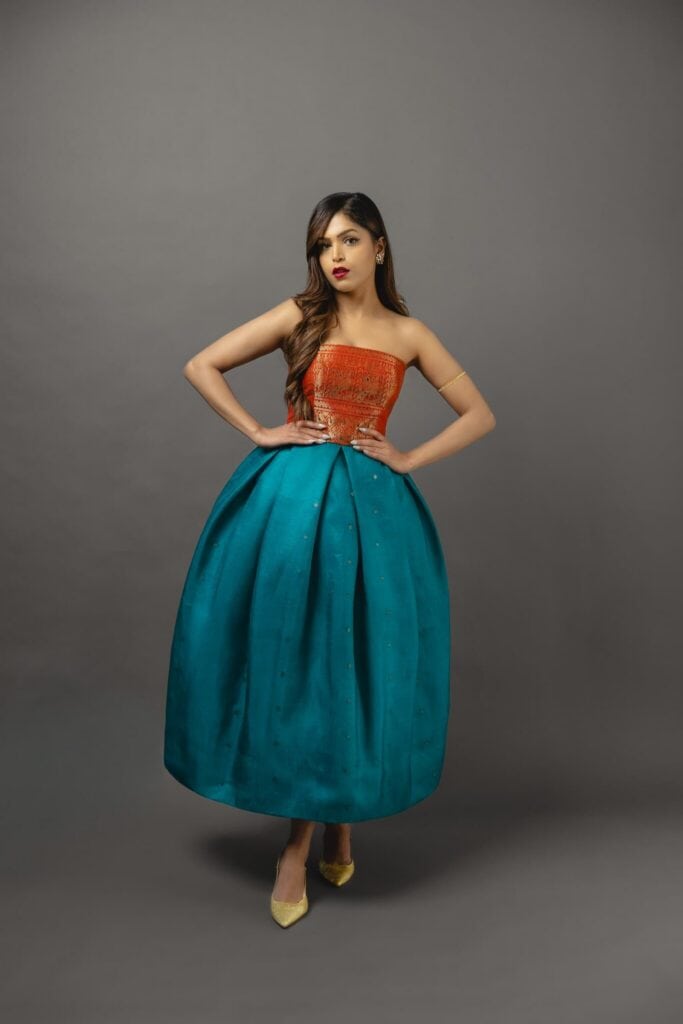
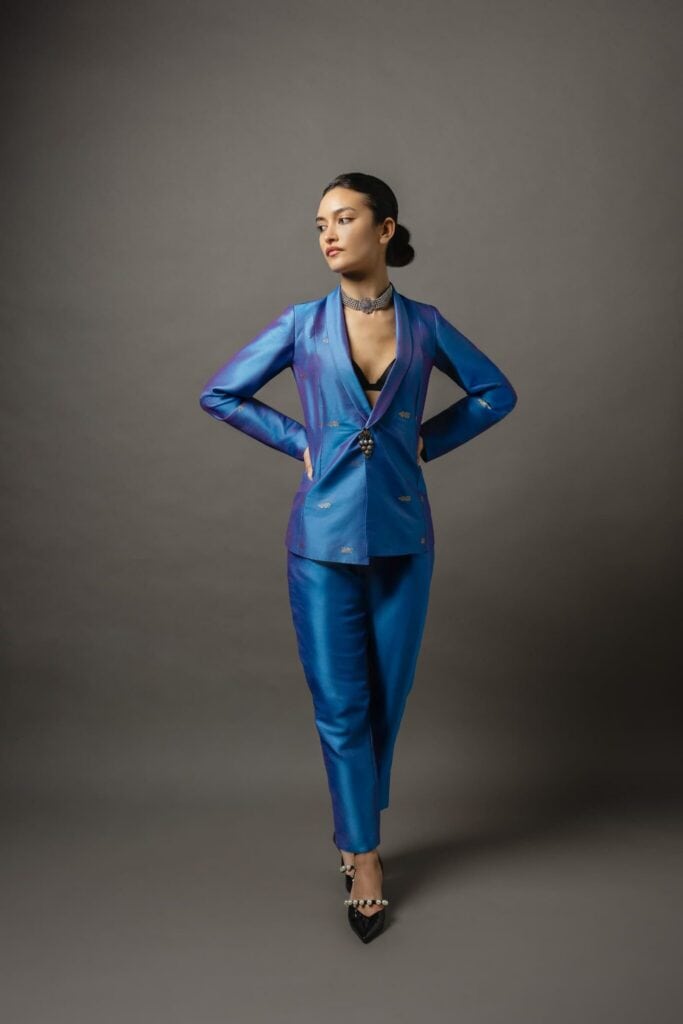
During fashion school, Balasubramanian took a short couture sewing course where each student had to design and create a gown. She cut up one of her mother’s old saris and made a dress from it. A sari can contain five to six yards of fabric. Even if a textile is damaged, there is still enough material to create something new. “A lot of it is that the fabric is the inspiration, the sari is the inspiration, and kind of guides what that outfit becomes,” she says.
The eight-piece collection includes a Grecian gown, a Regency-inspired jacket, a flapper dress, a Dior-style bar suit, a cocktail dress, a mod shift dress, a ball gown inspired by Charles James, and a jewel-toned take on Yves Saint Laurent’s 1966 “Le Smoking” pantsuit. “My creations are my interpretations of the dual, conflicting, east-meets-west world that I inhabit,” she says. The idea began with a few dresses Balasubramanian could not stop thinking about, including the white dress from the final scene of “Dirty Dancing” and Yves Saint Laurent’s Mondrian dress.
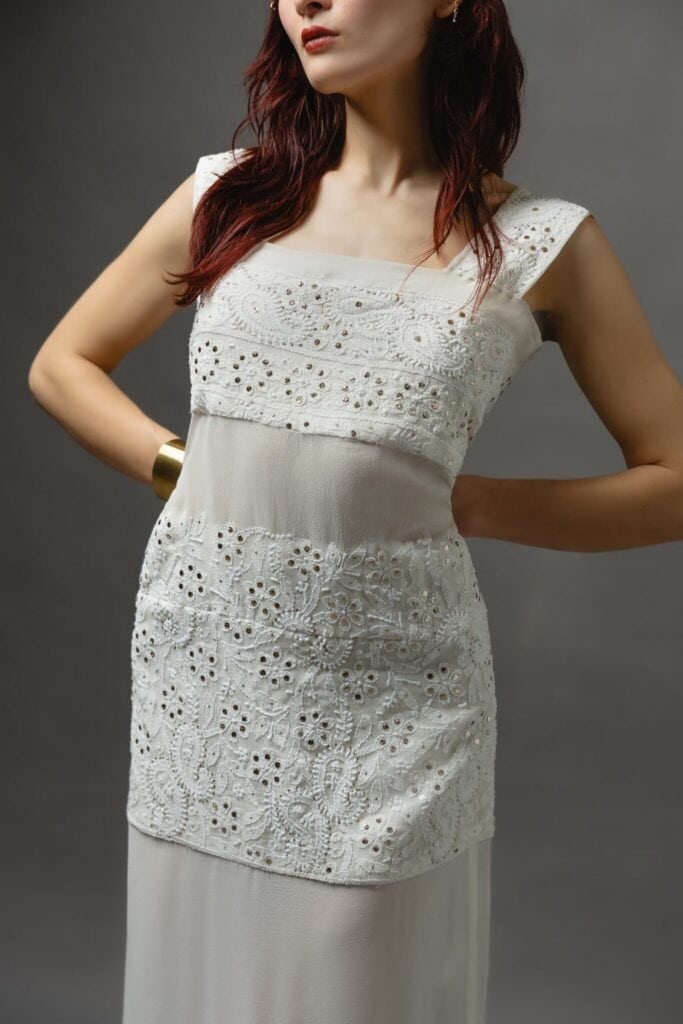
She researched fashion history and mapped out silhouettes that could work with a sari’s structure, length, borders, and embellishment. The Regency piece grew out of her love of Jane Austen and period dramas, while the Charles James-inspired gown gave her a technical challenge. “I wanted to learn and kind of push myself in recreating something that was very technically challenging,” she says.
The collection recently showed at downtown gallery Art Love Salon. “The model as a piece of art, a living installation amongst the art, that was very exciting to me,” she says. “Clothes can be art. And the art of dressmaking is a creative process.”
Balasubramanian collects fabric scraps and uses them for packaging details, small drawstring bags, and future product ideas. She shops secondhand and looks for older pieces before buying new ones. That instinct, she says, comes from childhood as much as fashion school. She grew up in a household where very little was thrown away. Shopping bags were brought from home and boxes were reused, while fabric, sheets, and household items found second lives. “My mother would not throw away anything,” she says. “If you can find a use for it, it was used as something else.”
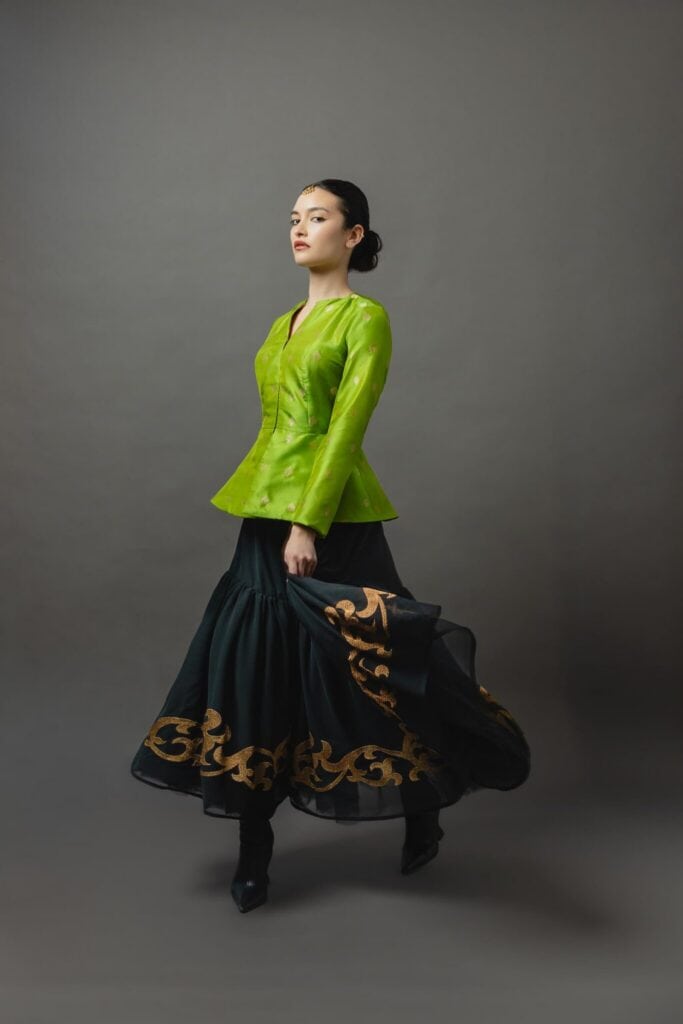
That thinking now shapes the business she is building. “I wanted to create a brand that told a story, has a mission to it, and also wanted to involve the client or involve the customer in that process and that mission,” she says.
For now, the studio remains a working space rather than a full retail shop, but she hopes to eventually expand into a designer boutique with a range of bridal and formalwear, along with pieces made from leftover materials.
Follow Us

WALKDONTRUN Returns This Saturday, Turning Downtown Seattle Into a Sprawling Art Show
In its second year, the free festival brings 200-plus artists to a 20-block route September 19, with a secret garden and a former 7-Eleven stocked with art.
Most walks through downtown Seattle involve trying to get somewhere. On September 19, the crosswalk itself might be the reason to stop. Heap Troupe will turn a four-way crossing into a performance, one of dozens of encounters planned for this year’s WALKDONTRUN. The free, all-ages art walk stretches across more than 20 blocks. From 11…

At Two Dot Schoolhouse, Ruth Marie Tomlinson Builds an Artistic Community
For nearly 20 years, the Seattle artist and her husband have welcomed artists, writers, and musicians to a historic Montana schoolhouse. Now they’re searching for its next stewards.
At her solo exhibition last year at The Vestibule, Seattle artist Ruth Marie Tomlinson presented a new series of work inspired by her close readings of British nature writer J.A. Baker’s The Peregrine and Icelandic author Sjón’s The Blue Fox. As if on sheets torn from a sketchbook, her pages included excerpts and outtakes of…

Rearview Mirror: Seahawks Off the Field, Seattle on the Board, and Smoked Oysters
Things I did, saw, ate, learned, or read in the past week (or so).
HOOKED ON KNOCKS Admittedly, I am late to this one. The Seahawks’ first season of Hard Knocks, the HBO series that follows NFL teams through training camp, premiered in August, but until last week, I had never heard of it. To be honest, my football knowledge starts with knowing what a touchdown is and doesn’t…

Studio Sessions: Colleen Louise Barry
Multi-hyphenate artist Colleen Louise Barry on discipline, the arts ecosystem in Seattle, and saving abandoned trampoline from the side of the road.
It’s hard not to smile around artist and writer Colleen Louise Barry. Bubbly and bright, she radiates optimism and cheer that would put most stereotypical Seattleites on edge. I think she is an absolute delight. Originally from Albany, Barry received her MFA from the University of Massachusetts, Amherst, before moving to Seattle in 2016. Once here,…