





News
Read More ›
Seattle’s Call to Protect the Endangered Species Act
A key wildlife law faces major rollbacks as the public comment period ticks down.
 By Sarah Stackhouse December 9, 2025

There’s plenty to do this season—lights, shows, markets, food—but here’s one more important thing worth putting on your list.
The Endangered Species Act (ESA), the federal law that helped bring back the bald eagle and gray wolf, is now facing changes that could weaken its protections. The Trump administration has proposed updates to four ESA rules, and the public comment period closes on December 22.
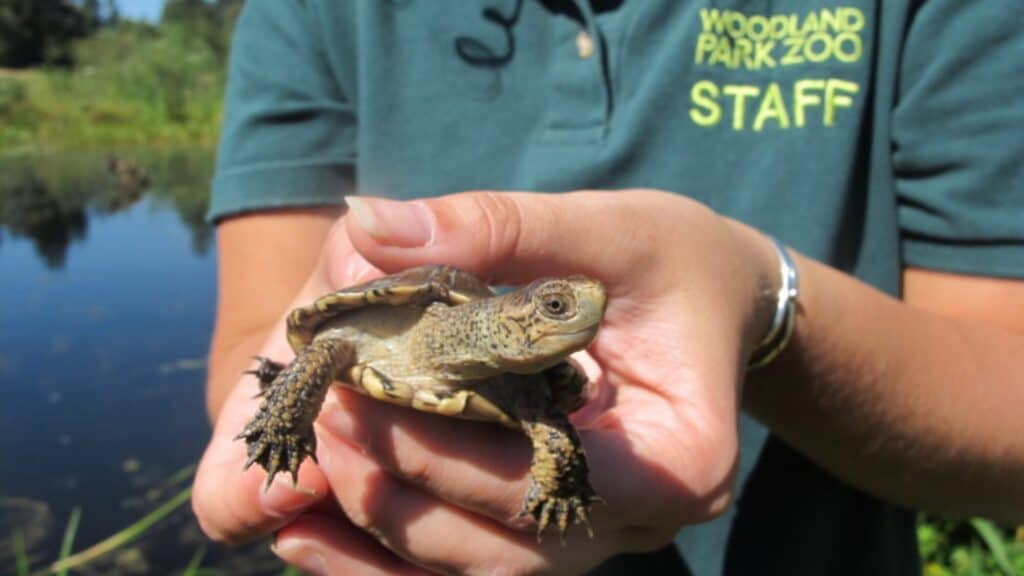
Woodland Park Zoo, which supports more than 35 conservation projects in the Northwest and around the world, is urging Washingtonians to speak up for good reason. More than 80% of Americans support the ESA, and the law has a long track record of doing what it was designed to do, with 99% of listed species avoiding extinction. Locally, the zoo works to protect threatened wildlife such as western pond turtles, Canada lynx, Oregon silverspot butterflies and Pacific martens. These proposed rollbacks could make their recovery much harder.
Here’s what the rule changes would do:
1. Require consideration of potential economic impacts when deciding whether to list a species, putting financial and political interests ahead of science.
2. Remove long-standing protections for species listed as “threatened,” opening the door to habitat destruction or harm.
3. Shorten the time horizon used to determine whether a species needs protection, potentially ignoring slow-moving threats like climate change and habitat loss.
4. Reduce coordination among federal agencies on projects—including pipelines, dams, mining and roadbuilding—that may impact wildlife and habitat.
“Saving wildlife is at the core of Woodland Park Zoo’s mission, and the Endangered Species Act has enabled countless species to survive, recover and thrive,” says Dr. Robert Long, carnivore scientist and director of the Living Northwest Program. “Without the Endangered Species Act, numerous species would have been lost forever. They survive today thanks to federal protection. We need to preserve these protections for current and future threatened and endangered species.”
For anyone who wants to weigh in, even one comment helps. The zoo recommends submitting one comment if you have a minute, or all four if you have a little more time. Guidance and links are available here.
The deadline is December 22.
Follow Us

The Northwest’s Gateway to Wine, Culture & Adventure
Escape the crowds. Slow down. Savor fall in the Lewis Clark Valley. As autumn paints the hillsides in gold, crimson, and amber, the Lewis Clark Valley becomes a picture-perfect place to slow down and savor the season. Where Washington and Idaho meet, fall brings crisp days, colorful landscapes, harvest among the vines, and plenty of…

Meet West Seattle’s “Freelance Beaver Detective”
A group of urban beavers helped Pamela Adams through a tough time. Now she’s returning the favor.
Pamela Adams was living in Port Townsend when her marriage fell apart. Little did she know at the time that she would soon find love again while doggedly pursuing the Five Families—not the ones of Mafia lore, but a four-legged sort living along the Longfellow Creek Watershed. Prior to moving to Washington, Adams resided in…

A Wellness Pilgrimage to the Olympic Peninsula
Two hours from Seattle, a new kind of luxury is taking root—one built on stillness, old-growth forests, and the subtle art of slowing down.
There is a school of thought among the overworked and overscheduled that the most subversive thing a person can do is stop. Put down the phone, close the laptop, and go somewhere that actively resists attempts to stay plugged in. The Olympic Peninsula has always offered this, in its blunt, mossy way. For some city…

Seabrook Is a Little Coastal Utopia
This walkable beach town gives families room to roam, relax, and leave the car parked.
There’s nothing quite like finding an edible mushroom in the forest with a five-year-old. The excitement and pride my son displayed when we found chicken of the woods were contagious, and after battering and frying the mushrooms, our wonderful day got even better. The dark, wet forests in which our mushrooms grew are part of…