
Holding the Line
Skijoring’s wild mix of skiing and horsepower is pulling new crowds across the West and giving Washington’s winter a rush of its own.
 By Sarah Stackhouse January 7, 2026

This article originally appeared in the January/February 2026 issue of Seattle magazine.
The thousand-pound horse barrels forward, muscles flickering under its winter coat as its rider leans forward, urging the animal to go faster. Snow explodes in every direction. A skier grips the 33-foot rope trailing behind, his skis skimming the surface as they surge over a 750-foot course at 40 miles an hour.
“It’s the biggest adrenaline rush you can find,” says Spokane professional skier Cody Smith, who’s been skijoring—a winter sport in which a person on skis is pulled by a horse, dogs, or a motor vehicle along a snowy course—since the late ’90s. “You go from standing still to full speed in seconds. It’s over before you can even think.”
Rider Bailey McCanna, cofounder of Washington’s only equine skijoring event in Chewelah, says the energy on race weekend is like nothing else. The competition, held each winter at 49 Degrees North Mountain Resort, started in 2024 and has steadily gained popularity across northeastern Washington. “You have to make split-second decisions,” she says. “You’re working with another human and a horse that’s running as fast as it can.”
Long before horses and riders took to snow-covered race courses in the American West, skijoring—believed to have derived from the Norwegian skikjøring, meaning “ski driving”—is thought to have originated in Scandinavia, where people hitched themselves to reindeer and glided over ice and tundra to travel. Similar forms likely existed in Nordic Indigenous cultures before it was documented in Europe.
Skijoring has even brushed Olympic ice. It appeared at the 1924 Winter Games in Chamonix, France, and again in 1928 in St. Moritz, Switzerland, where skiers were pulled behind riderless horses across a snow-covered frozen lake.
By the early 1900s, the sport had made its way to the United States, carried home by Americans who’d seen it while vacationing in Europe. Loren Zhimanskova, founder of Skijor International and Skijor USA, says early ski clubs began organizing recreational runs in Lake Placid and at Dartmouth’s Winter Carnival, with exhibitions even in front of the Washington Monument in Washington, D.C. “It was a fun, social thing—people being pulled on skis behind horses, like sledding,” she says. Men and women showed up in wool coats and hats, turning it into a stylish winter pastime before it ever became a race.
Skijoring found a different rhythm in the American West. Ranchers and rodeo riders began pairing their horses with local skiers for races, and the mix of Western grit and ski culture stuck. “As it moved westward, it took on a whole different look,” Zhimanskova says. “It wasn’t European anymore. It was Western: ranchers, rodeo people, cowboys, and cowgirls. They made it theirs.”
That’s how Smith got involved. In 1998, while training with the U.S. development ski team in Jackson Hole, Wyoming, local riders were looking for skiers willing to trail a horse while on skis. “One of the skijoring guys came into the race shop and asked if any skiers were interested,” Smith says. “My coaches told me, ‘You can win a bunch of money,’ and I was in.”
Small-town races began cropping up across Montana, Wyoming, and Colorado, setting the stage for today’s circuit.
When Zhimanskova launched Skijor USA in 2012, there were no more than ten races each season. In 2024, Skijor USA listed 30, and now, there are nearly 50 across North America. Tracks range from straightaways to curved lanes with an obstacle course set for the skier to navigate. Winners earn cash prizes and rodeo-style belt buckles.
Across the Rocky Mountain West, equine skijoring events reach capacity within hours of registration opening, and new organizers are eyeing Oregon and California. Recent inquiries have even come from Leavenworth.
McCanna capped Chewelah’s entries at 40 teams last year, but spectators numbered in the thousands. “It’s been incredible to watch it grow,” she says. “People are driving hours just to come watch or try it themselves.” This year’s event will be held January 24-25.
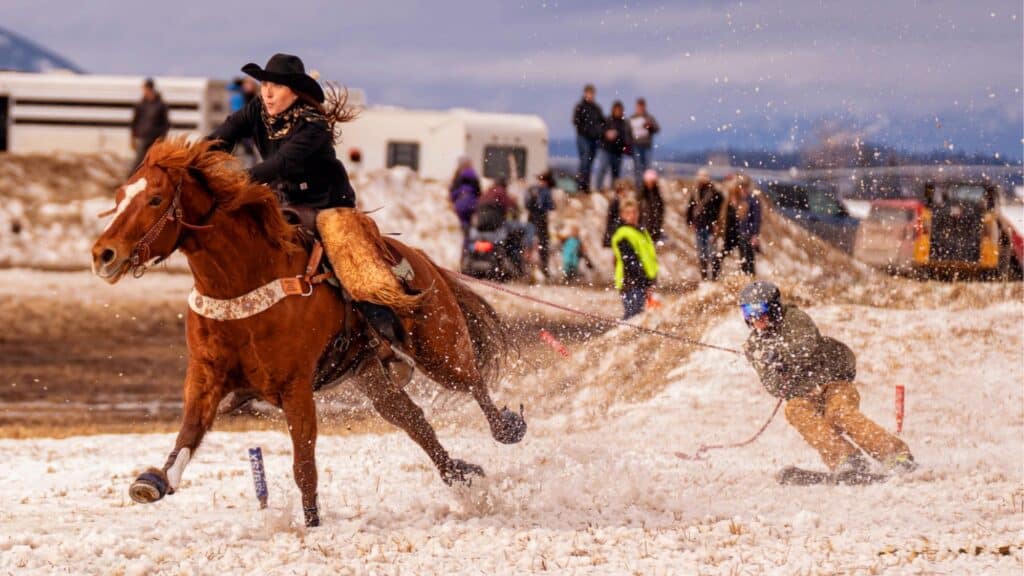
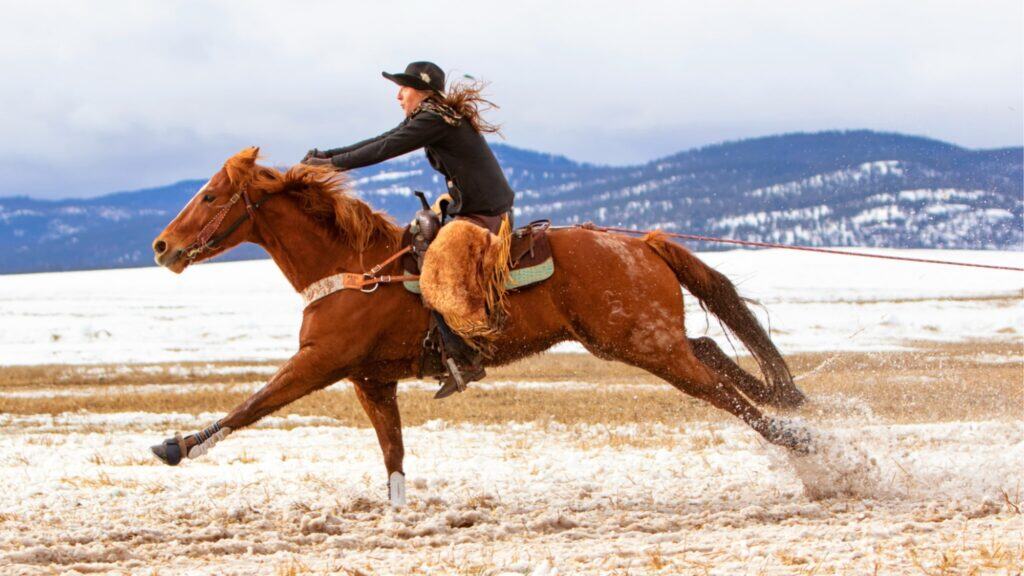
Zhimanskova says skijoring is a team of three heartbeats—the rider, the skier, and the horse. When they sync, it’s seamless. “A seventy-year-old rider can team up with a twenty-year-old skier and a ten-year-old horse,” she says. “Everyone brings something different to the line.” On social media, videos of equine skijoring have gone viral: horses cutting through snow and skiers launching off jumps. Riders wear fur chaps, cowboy hats, and sunglasses; skiers show up in colorful race suits and goggles. “It’s become its own culture,” says Smith. “You’ve got fur, flags, hot tubs on the sidelines—it’s a full-on spectator sport.” The imagery is pure Western poetry—freedom, power, and partnership.
As the sport expands, so does its ambition. Zhimanskova says larger sponsors are starting to take notice, and organizers in France, Italy, and Utah have floated the idea of showcasing skijoring at the 2030 Olympics in the French Alps and in 2034 in Salt Lake City, Utah, as an independent exhibition—though true Olympic recognition would require a unified federation and consistent rules across countries.
For now, though, it’s what it’s always been—thudding hearts and a rush of snow.
Follow Us

From Ph.D. to Paralympics
She found adaptive sports while pursuing her doctorate. Now the UW alum and world-class Para Nordic skier is racing in Italy.
Nicole Zaino should have been working on her Ph.D. qualifying exam. It was 2019, her second year as a graduate student in the University of Washington Department of Mechanical Engineering, and though Zaino was excelling academically and enjoying her coursework, something was missing. “I was feeling burnt out and a little too stressed,” she says….

To Skate Like A Girl
The Professional Women’s Hockey League expands to Seattle with the Torrent, a talent-filled team poised to sweep the ice.
When Danielle Serdachny was growing up, she dreamed of playing professional hockey. This wasn’t unusual, given that she’s from Alberta, Canada, where hockey is as much a passion as a sport. Her dad teaches skating and hockey skills, and he’d even worked for the National Hockey League’s Edmonton Oilers at one point. Her older sister…

Please Stop Talking About Malcolm Butler
This Seahawks run deserves to be enjoyed on its own terms, not filtered through old Super Bowl trauma.
I refuse to learn what Malcolm Butler has been up to. This has taken a conscious effort on my part. Within 12 hours of the Seahawks winning their way to the Super Bowl this past Sunday, I saw the first story on the Patriots player who broke Seattle’s heart 11 years ago. I did not…

We’re in a Pickle
Kings of the court.
Unlike some trends, the popularity of pickleball has only increased with time. Here in Washington, the birthplace of the game, we’ve seen a recent wave of new facilities dedicated to the state’s official sport. Last October, Sideout Tsunami Pickleball Center opened in Mt. Baker with 26 state-of-the-art courts that offer instant video replays sent straight…