





Seattle Artifact
Read More ›
Artifacts: Ink Queen
Known as Seattle’s First Lady of Tattoo, Vyvyn Lazonga paved the way for women in the industry—both as artists and clients.

This article originally appeared in the January/February 2026 issue of Seattle magazine.
Upon my arrival at Madame Lazonga’s Tattoo parlor, I can’t help but notice that one of the windows is boarded up. After welcoming me inside the corner space on Western Avenue, just across the street from Pike Place Market, owner Vyvyn Lazonga informs me about a recent burglary. The thieves spared most things of monetary value, such as her tattoo equipment, but rather oddly, they made off with a cherished marionette doll that a friend had created in her likeness, and which served as the shop’s mascot. “It had far more personal than financial value,” she says with a sigh and a resigned shake of her head. “It was a hard thing to lose.” With a Zen-like perspective, she then shrugs. “Things come and things go. Nothing lasts forever.” Ironically, in a city where it seems that more and more things “go” these days, Lazonga is a lasting presence, with a tattoo career that started in downtown Seattle’s seedy 70s era.
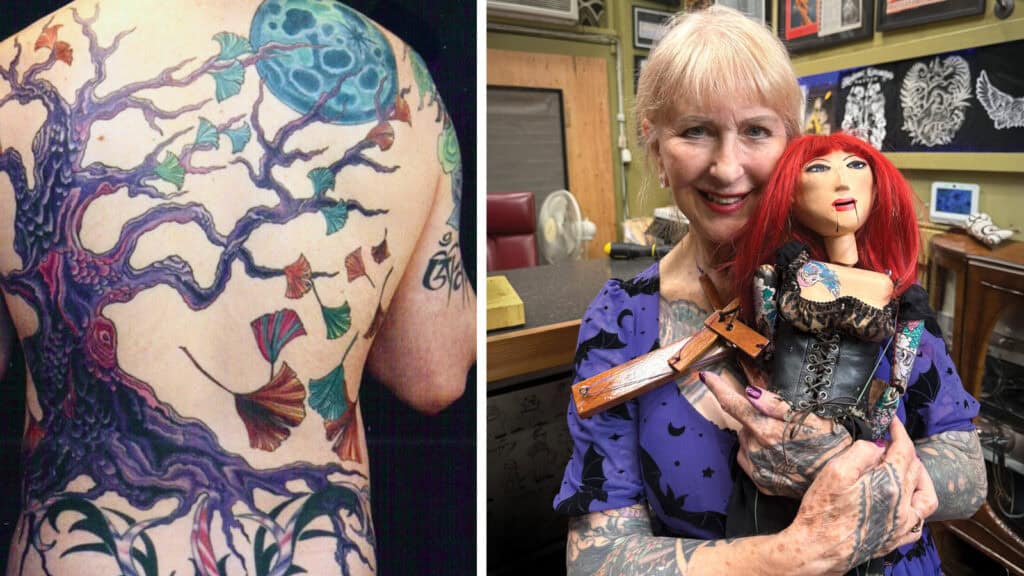
Lazonga is nearly an octogenarian, but she appears far younger. Her eyes still possess a youthful sparkle, and the creative vibrancy that has fueled her art for the last fifty years remains intact. The faded tattoos on her arms provide one of the few clues to a long and well-lived life. With a warm smile and extended hand, she offers me a chair; we sit down to discuss her story as the city’s longest-practicing tattoo artist.
A Seattle native, Lazonga was born in 1947 and started drawing as soon as her hands were able to hold a pencil. As a lifelong artist, she has always harbored a strong creative curiosity, which likely compelled her to walk through the doors of a downtown tattoo shop back in the early 1970s. Located on First Avenue at the time—infamous during that era due to its gritty array of taverns, peep shows, and pawn shops—the Seattle Tattoo Emporium is still inking customers today as one of America’s oldest tattoo shops. (It now sits on the west side of Capitol Hill, just above the I-5 freeway.) When Lazonga walked in, the shop was being run by C.J. Danzl, or “Danny,” as everyone knew him—a World War II Veteran and established tattooist whose laryngectomy forced him to speak out of a small speaker in his throat. Lazonga immediately found herself drawn to the artistry of tattoos and was soon learning the craft as Danny’s apprentice.
At the time, there were no other female tattoo artists in Seattle. It made Lazonga an anomaly. She recalls how local suburban kids used to make sojourns to First Avenue to gawk at the adult theaters and porn shops. The tattoo parlor also became a frequent stop—especially when the beguiling red-haired Lazonga could be seen through the windows. “They would stick their heads in the door and yell stuff at me,” she says with a laugh. Tattooing was much different back then. Aside from the fact that it was strictly a boy’s club, there was little to no custom work. Rather, the walls of most shops contained panels of pre-made “flash” art that were used to select a tattoo. Customers would spend a few minutes browsing through the flash, point to their desired choice, and it would then be tattooed somewhere on their body. Needless to say, most flash art at the time was designed with a male customer base in mind. Over time, however, Lazonga noticed that an increasing number of women were walking through the doors, and she began creating her own female-oriented flash art, a pioneering act that helped usher in a more gender-inclusive era in the industry.
In 1979, Lazonga decided to open her own shop, becoming the proprietor of one of the first female-owned tattoo parlors in the United States. This allowed her the creative freedom to develop her personal style, which emphasized experimenting with design and color. By the early 1980s, custom work spiked in popularity, and Lazonga put her drawing skills to work on personalized requests. Taking pencil to paper is a skill she continues to practice to this day, with an open disdain for computer-generated tattoo art. “It’s disrespectful to the craft,” she explains pointedly.
As Lazonga was getting her studio up and running, punk rock and alternative music hit the radio waves, bringing with it a whole new style of musicians. Leather jackets, spiked hair, and tattoos became popular, and traditional tattoo clients—mostly bikers and sailors—suddenly found themselves getting inked alongside blackclad college kids.
By the end of the decade, Modern Primitives—dubbed the “bible of the tattooing-piercing underground”—was published, launching a new revolution in body art. Lazonga’s work featured prominently in the book, which further established her role as a pioneer in the industry. Modern Primitives was a cultural game-changer, helping to usher in the pierced-and-tattooed zeitgeist of the 1990s and paving the way for tattoos to go mainstream.

As tattooing became more socially acceptable, Lazonga’s clientele started to include women requesting mastectomy scar cover-ups following their battles with breast cancer. This opened a whole new world of creative possibilities for her as she straddled the line between artist and healer, with the ability to turn something traumatic into something beautiful. Many of her female customers have reported this cover-up work as being an important part of their post-mastectomy recovery. She continues to perform such tattooing, with the therapeutic aspect of her work remaining a chief component. “Your energy goes into the person you’re working on, and you’ll feel their energy too,” she tells me, “It’s incredibly powerful.”
As my conversation with Lazonga wraps up, we discuss what the future holds for her. She reflects on her long and storied career, revealing that being hyper-focused on tattooing for so many decades has left her feeling unbalanced and longing for a life outside of her shop. “I would like to take some classes to learn more about some of my interests,” she tells me. “Gemstones and minerals, for instance.” She also admits to having a strong case of wanderlust. “I’m fascinated with traveling to Southeast Asia…and maybe even a move down to Mexico City.” Given her story so far, wherever her next chapter brings her is unlikely to be without a sense of purpose or creative adventure.
Note: In October, Lazonga’s marionette was returned by a woman who had seen a story about the break-in on the local news and spotted it while shopping at Goodwill.
Follow Us

SENSORIUM Takes on Our Screen Addiction
Dance, drag, and immersive art collide in an eight-week exploration of our phone-obsessed lives, with a few surprises along the way.
What do drag queens, smartphone addiction, art installations, and an old luggage shop have in common? According to longtime Seattle choreographer Alana O’Farrell Rogers, a lot. “There’s no dead time anymore,” says Rogers, explaining how the proliferation of smartphones fills the empty spaces that once served as time for rest or connection. Where we snuggled…

Salt-N-Pepa on Breaking Barriers and Staying Power
Ahead of their performance at Seattle’s Museum of Pop Culture gala, the hip-hop pioneers talk about creative ownership, connecting with new generations, and the songs that still resonate.
The Museum of Pop Culture (MOPOP) will host its annual ICONS of Pop Culture Gala in Seattle on October 22, honoring five artists and institutions whose work has helped shape entertainment and culture. This year’s honorees are martial arts and film legend Bruce Lee, fashion designer Jeremy Scott, the video game franchise Halo, hip-hop pioneers…

Studio Sessions: Christopher Paul Jordan
Drawing on childhood memories, neighborhood history, and salvaged materials, Christopher Paul Jordan’s latest show at Cornish’s Behnke Family Gallery explores how the past stays with us.
Start in the middle. It’s good advice for telling a story, and a way into Christopher Paul Jordan’s paintings. By the time you encounter them, their materials have already been something else, and who knows what they might move on to become. The Tacoma interdisciplinary artist works with salvaged objects, including screens, picture frames, canvas,…

Rearview Mirror: Wedding Bells, A Furniture Launch, and the Symphony’s New Look
Things I did, saw, ate, learned, or read in the past week (or so).
WEDDING BELLS I’ve been a bit absent from this column lately, but I think I have a pretty good excuse: I got married! It’s already been three weeks since my September 19 wedding, but I’m still reflecting on the magic of the day. My fiancé, well husband now (I can’t get used to saying it!),…