Page 1
Image One:
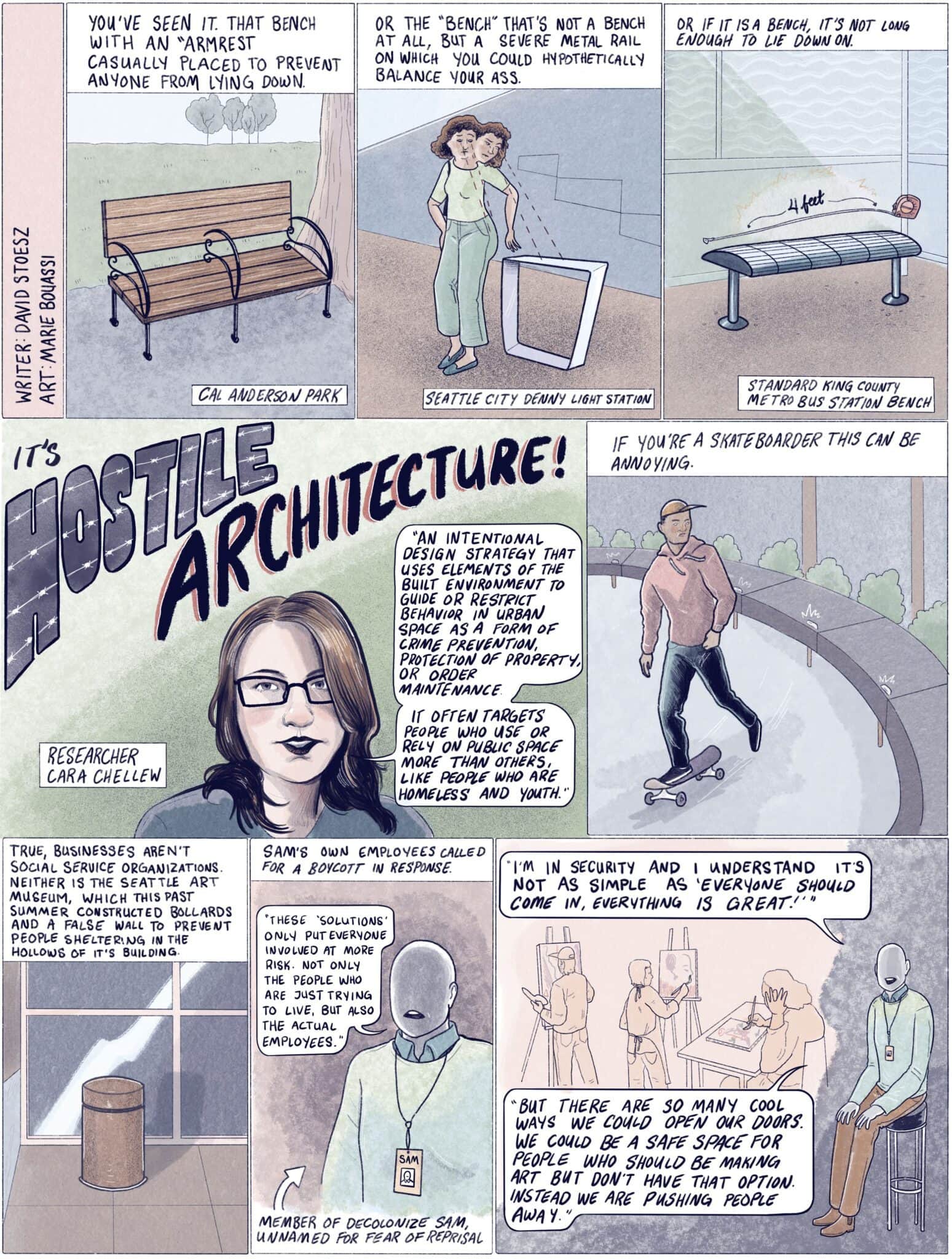
Text:“You’ve seen it. That bench with an armrest casually placed to prevent anyone from lying down.”
Alt text: A bench in Cal Anderson Park with a central armrest that prevents people from lying down.
Image Two:
Text: “Or the ‘bench’ that’s not a bench at all, but a severe metal rail on which you could hypothetically balance your ass.”
Alt text: A woman standing near a metal rail at Seattle City Denny Light Station, which appears to be an intentionally uncomfortable seating structure.
Image Three:
Text: “Or if it is a bench, it’s not long enough to lie down on.”
Alt text: A short metal bench at a Standard King County Metro bus station with a sign indicating it is only four feet long, preventing someone from lying down.
Image Four:
Text: “If you’re a skateboarder this can be annoying.”
Alt text: A skateboarder approaching a curved ledge with metal bumps, designed to prevent skating.
Image Five:
Text: “It’s Hostile Architecture!” Researcher Cara Chellew: “An intentional design strategy that uses elements of the built environment to guide or restrict behavior in urban space as a form of crime prevention, protection of property, or order maintenance. It often targets people who use or rely on public space more than others, like people who are homeless and youth.”
Alt text: A portrait of researcher Cara Chellew alongside her quote explaining hostile architecture.
Image Six:
Text: “True, businesses aren’t social service organizations. Neither is the Seattle Art Museum, which this past summer constructed bollards and a false wall to prevent people sheltering in the hollows of its building.”
Alt text: A view of the Seattle Art Museum’s exterior, featuring newly installed bollards and barriers meant to deter people from resting in the space.
Image Seven:
Text: “Sam’s own employees called for a boycott in response.”
Alt text: A security badge-wearing figure speaking anonymously about the negative impact of hostile architecture, “These ‘solutions’ only put everyone involved at more risk. Not only the people who are just trying to live, but also the actual employees.”
Image Eight:
Text: Security guard: “I’m in security and I understand it’s not as simple as ‘Everyone should come in, everything is great.’ But there are so many cool ways we could open our doors. We could be a safe space for people who should be making art but don’t have that option. Instead, we are pushing people away.”
Alt text: A security guard inside an art museum discussing how the space could be more welcoming instead of using exclusionary tactics.
Page 2
Image One:
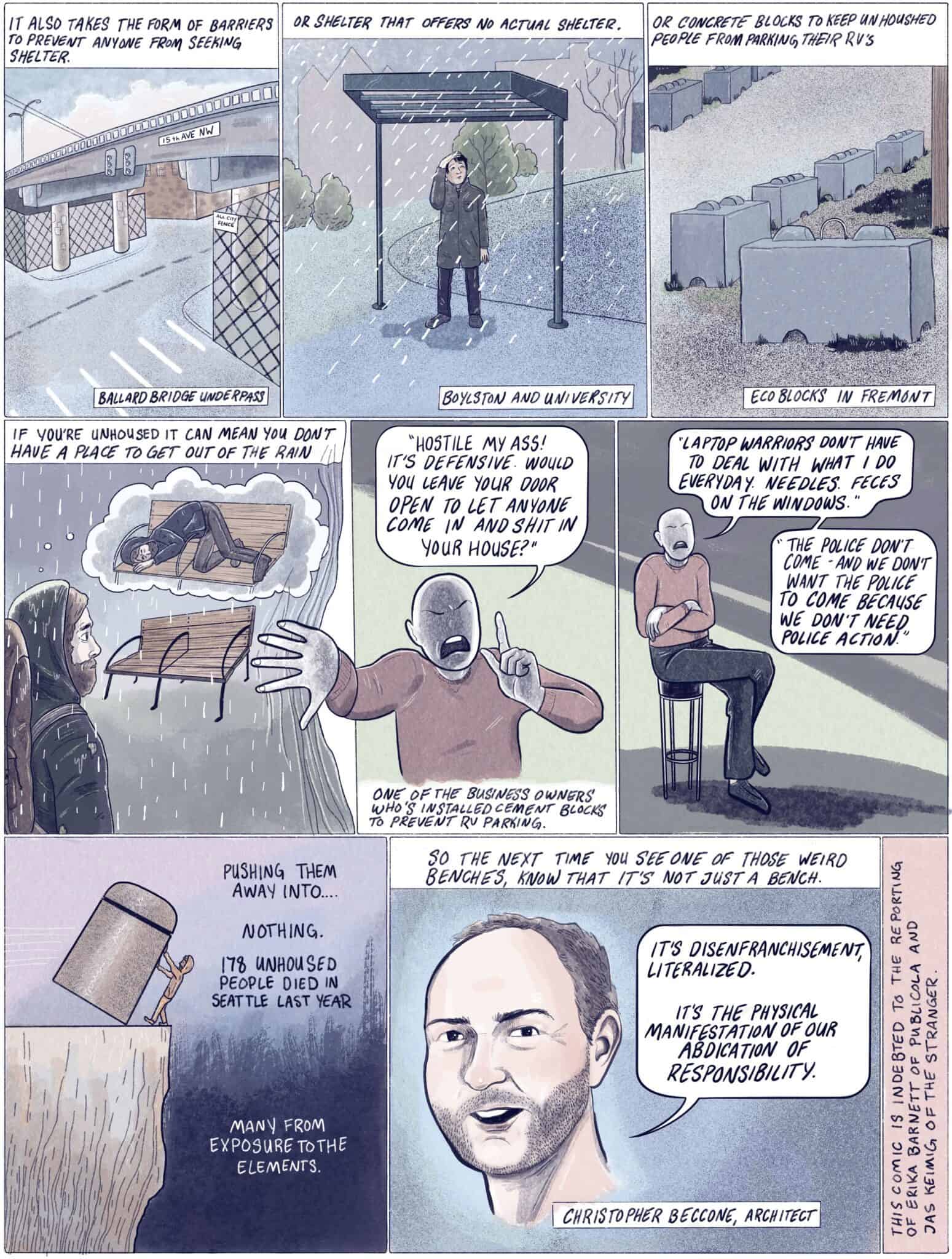
Text: “It also takes the form of barriers to prevent anyone from seeking shelter.”
Alt text: A view of the Ballard Bridge underpass, where fences block off areas that could provide shelter.
Image Two:
Text: “Or shelter that offers no actual shelter.”
Alt text: A person stands in the rain under a small metal structure at Boylston and University, which provides no meaningful protection.
Image Three:
Text: “Or concrete blocks to keep unhoused people from parking their RVs.”
Alt text: A row of large concrete “eco blocks” in Fremont, designed to prevent RVs from parking.
Image Four:
Text: “If you’re unhoused, it can mean you don’t have a place to get out of the rain.”
Alt text: A person looks at a bench with an arm in the middle, while imagining themselves trying to sleep on it in the cold.
Image Five:
Text: One of the business owners who installed cement blocks to prevent RV parking:
“Hostile my ass! It’s defensive. Would you leave your door open to let anyone come in and shit in your house?”
Alt text: A man angrily gestures while defending the use of hostile architecture.
Image Six:
Text: Another business owner: “Laptop warriors don’t have to deal with what I do every day. Needles. Feces on the windows.The police don’t come – and we don’t want the police to come because we don’t need police action.”
Alt text: A man sitting on a stool expresses frustration about homelessness and crime.
Image Seven:
Text: “Pushing them away into… nothing. 178 unhoused people died in Seattle last year. Many from exposure to the elements.”
Alt text: A person is pushed by a large bollard off a cliff, symbolizing the displacement of homeless individuals into dangerous conditions.
Image Eight:
Text: “So the next time you see one of those weird benches, know that it’s not just a bench.” “It’s disenfranchisement, literalized. It’s the physical manifestation of our abdication of responsibility.” — Christopher Beccone, Architect
Alt text: A portrait of architect Christopher Beccone alongside his quote about hostile architecture.
Image Nine:
Text: “This comic is indebted to the reporting of Erika Barnett of Publicola and Jas Keimig of The Stranger.”
Alt text: A final acknowledgment of the sources that inspired this comic.