





Travel
Read More ›
Inn at Langley: Where the Shore Meets the Sky
After a property-wide redesign, the Whidbey Island retreat reopens with a locally inspired take on vacationing in the Pacific Northwest.
 By Rachel Gallaher October 5, 2026

This article originally appeared in the September/October 2026 issue of Seattle magazine.
Michelin-star chef Johnny Spero never planned to end up in the Pacific Northwest.
A lifelong East Coaster born and raised in Baltimore, he began his culinary career at 16, working for a series of big-name chefs and restaurants before opening his own establishments in Washington, D.C., including Reverie, which earned him his Michelin star in 2022. “I was in D.C. for the past 20 years,” Spero says. “There were times when I’d leave, but I’d always come back. The East Coast was my landing pad.”

That all changed when a recruiter reached out asking if he’d be interested in taking the helm of the restaurant at the newly renovated Inn at Langley on Whidbey Island. Although he hadn’t spent much time in the Northwest, Spero was at a crossroads in his life—in July 2025, he announced he would close Reverie that October—and saw the potential relocation as an opportunity not only for his career, but for his family. “Moving here was not something I expected to do when I announced the closure,” he says, “but I wanted to give my kids a different way of life.”
Reverie closed October 4, 2025, and five days later, Spero loaded his wife (who was moving to Whidbey Island sight unseen), three kids, and two dogs into a minivan and started driving west. Something happened when they arrived on the island. Starting with the ferry ride to Clinton, his kids were in awe, watching boats glide along in the distance as Whidbey grew closer on the approach. In the weeks that followed, as the family settled in at Langley, they discovered the magic of small-town living in the Pacific Northwest: the proximity to nature (Spero’s kids hike in the woods and play on the beach regularly), the slower pace of life, and the deep ties between the businesses, the arts scene, and the residents that make the community thrive. “I want my kids to grow up here and then leave—and then come back because they can’t find a place that’s better,” says Spero.

It’s a sentiment that attracts many people to Whidbey Island, both as full-time dwellers and seasonal vacationers. Spero landed at the Inn at Langley last fall; the storied resort opened in 1989, a project by former Seattle mayor Paul Schell and his wife, Pamela. Designed by architecture firm GGLO, the 28-room hotel sits on a bluff above Saratoga Passage. Purchased in 2025 by Los Angeles-based boutique hotel group Akin Hospitality, the waterfront property underwent a thoughtful refresh featuring an interior redesign by Ellison Mills Studio.
“I had goosebumps walking the property because it was so unique,” says Matt Kurtz, a managing partner at Akin Hospitality, of his first visit to the inn. “We sat on the boardwalk overlooking the water, and it felt so special. We were lucky to become the next stewards of the property, and we wanted to retain its soul.”
According to Kurtz, the building had great character, but the interiors felt dated and needed a refresh.
“There was an incredibly rich history there,” adds Zack Finder, who is also a managing partner at Akin Hospitality. “We knew we could come in and build on that to take it to the next level and continue to tell that story in a more elevated way.” Part of gaining local trust was retaining as much of the existing staff as possible—some of whom have been working at the property for more than a decade. “We needed to make sure that we had buy-in from the staff,” Finder says. “Everyone’s local, so if we can keep them, it allows us to continue providing an experience that holds the spirit of the inn.”
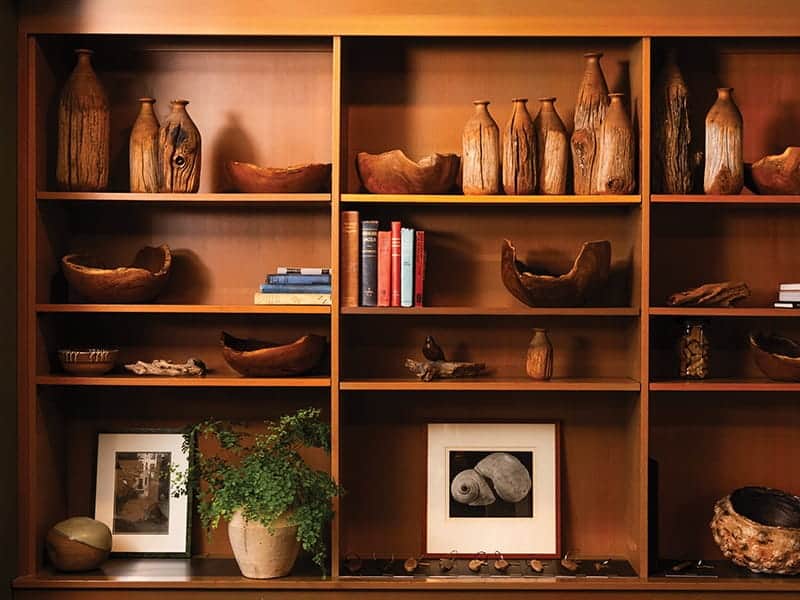
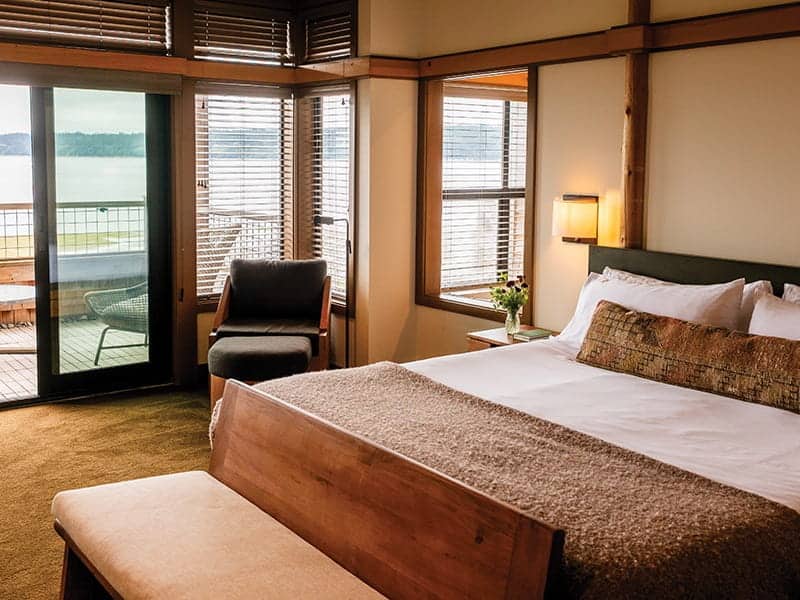
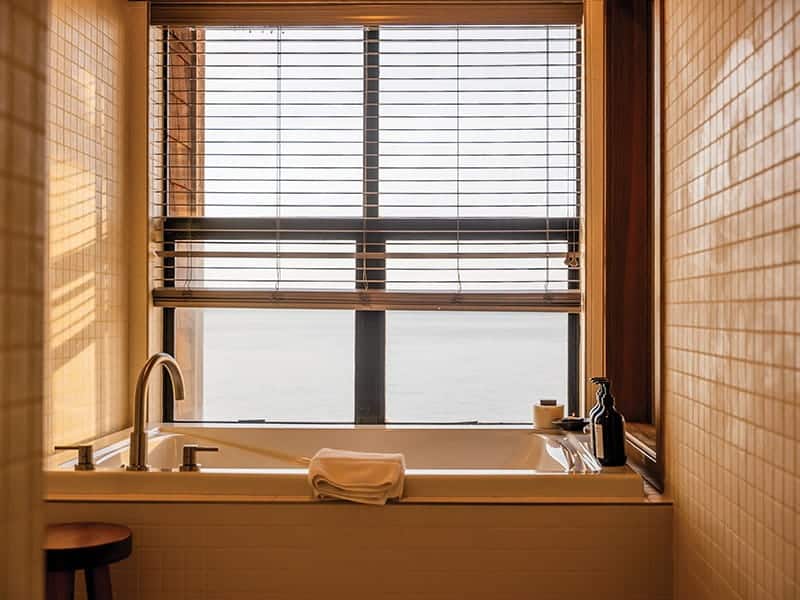
That notion was the guiding principle that Kurtz and Finder gave interior designer Cate Mills, of Ellison Mills Studio, who describes her design as “intentionally restrained,” to encourage guests to focus on the setting, including the water and its attendant wildlife, the sherbet sunsets gracing the evening skies, and the views to neighboring Camano Island. Mills was brought in to revamp every guest-facing space, including the reception area, all guest rooms, the restaurant, spa, and portions of the surrounding landscape.
“The Inn has a rare quality; it immediately invites you to slow down,” Mills says. “The original owners created the property with extraordinary care, and as we peeled back layers from previous renovations, the strength of the architecture and its quiet beauty were revealed.” Architectural references include traditional Japanese design and the work of Frank Lloyd Wright. “Those became our North Stars throughout the renovation. Rather than reinventing the Inn, our goal was to uncover what was already there and allow it to breathe again.”
Working with a palette of natural materials (wood, handcrafted clay tile) and neutral colors inspired by the island’s landscape (deep greens, rich browns, and mossy sages), Mills created cozy guest rooms replete with thoughtful details—fresh flowers, wood-burning fireplaces, actual metal keys, handmade Do Not Disturb signs, and a gratis snack bar stocked with locally sourced treats—that humanize and elevate the visitor experience. Mills also designed custom guest room and restaurant furniture, fabricated in white oak.
“One of my favorite collaborations was with artist Stephanie Carendi of V. Carendi, who created the Inn’s hand-carved great blue heron logo and the restaurant’s water-inspired mark,” Mills says. “The heron felt like the perfect symbol—quiet, elegant, deeply rooted in the Pacific Northwest, and always connected to the shoreline.”
“The original owners created the property with extraordinary care, and as we peeled back layers from previous renovations, the strength of the architecture and its quiet beauty were really revealed.”—Cate Mills, interior designer, Ellison Mills Studio
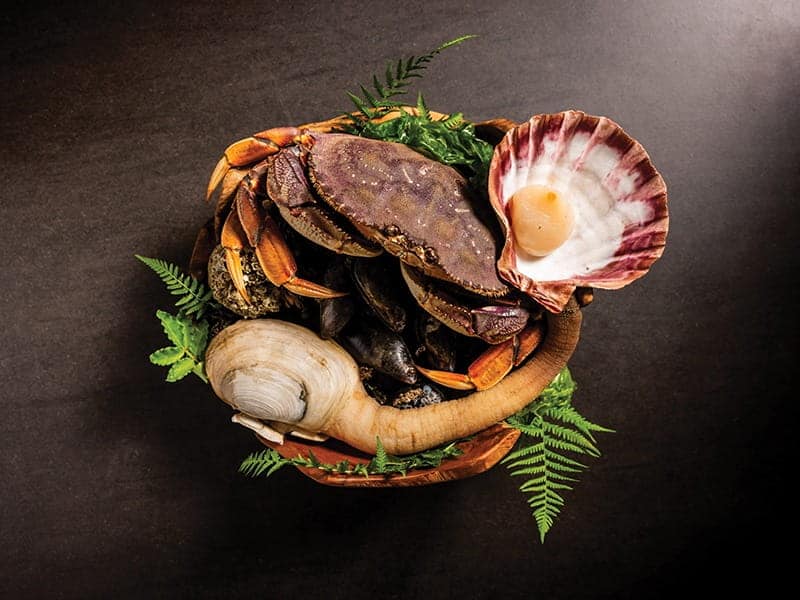
At Passage Restaurant, chef Spero serves up a gorgeous tasting menu, featuring local seafood and produce, along with biodynamic wine or non-alcoholic drink pairings (On the night I was there, the kitchen offered one meat-based entrée that was easily substituted with fish.) Starting with a birch amazake (fermented rice drink) to open up the palate, the dinner unspooled through a series of artistic courses, including a juniper-smoked mussel served in its shell on a pedestal of seaweed-covered stones; a decadently rich Haenuki rice dish with Dungeness crab and crab fat; and clean slices of fresh rougheye red rockfish, prepared using the kombujime method, where raw fish is cured between sheets of kelp.
“Our goal is to highlight the ingredients we can get from around here,” Spero says. He admits that he is impressed by the number of farm stands in proximity to the restaurant. “You can just go, grab the most beautiful flat of strawberries, and have them on the menu that day.” His approach to the cuisine on offer is letting farmers, ranchers, and fishermen dictate much of what he serves based on what’s available, rather than requesting specific items such as heirloom tomatoes or cucumbers—especially if they are out of season. This is part of the thrill of Passage. Guests can visit two weeks in a row, and they might have a different menu experience each time. “I’m always trying to highlight the people here,” Spero says, “because without them, we’ve got nothing.”
For those who have been visiting the Inn at Langley for decades and those stepping foot on its shores for the first time, this hyper-locality is often a draw—the approach cocoons guests in a distinctly Northwest experience that, contrary to popular myth, is actually friendly and inviting. It’s part of what caused chef Spero to move his family from one Washington to the other. In D.C., his commute was up to an hour and a half each way. These days, he relishes waking up, having time to make his kids pancakes for breakfast, and driving five minutes to the restaurant, where his team is full of hardworking islanders who enjoy showcasing the best that Whidbey has to offer.
“There’s a warmth that spreads from every department at the Inn, whether you’re the housekeeper, at the front desk, or in the kitchen,” he says. “There’s so much history here, we’re standing on the shoulders of everybody who was here before us. We’re still pushing and focusing on the culinary experience. We’re not going to take any shortcuts or offer a lesser experience because we’re on an island. In fact, that’s one of our strengths.”
Follow Us

The Northwest’s Gateway to Wine, Culture & Adventure
Escape the crowds. Slow down. Savor fall in the Lewis Clark Valley. As autumn paints the hillsides in gold, crimson, and amber, the Lewis Clark Valley becomes a picture-perfect place to slow down and savor the season. Where Washington and Idaho meet, fall brings crisp days, colorful landscapes, harvest among the vines, and plenty of…

Meet West Seattle’s “Freelance Beaver Detective”
A group of urban beavers helped Pamela Adams through a tough time. Now she’s returning the favor.
Pamela Adams was living in Port Townsend when her marriage fell apart. Little did she know at the time that she would soon find love again while doggedly pursuing the Five Families—not the ones of Mafia lore, but a four-legged sort living along the Longfellow Creek Watershed. Prior to moving to Washington, Adams resided in…

A Wellness Pilgrimage to the Olympic Peninsula
Two hours from Seattle, a new kind of luxury is taking root—one built on stillness, old-growth forests, and the subtle art of slowing down.
There is a school of thought among the overworked and overscheduled that the most subversive thing a person can do is stop. Put down the phone, close the laptop, and go somewhere that actively resists attempts to stay plugged in. The Olympic Peninsula has always offered this, in its blunt, mossy way. For some city…

Seabrook Is a Little Coastal Utopia
This walkable beach town gives families room to roam, relax, and leave the car parked.
There’s nothing quite like finding an edible mushroom in the forest with a five-year-old. The excitement and pride my son displayed when we found chicken of the woods were contagious, and after battering and frying the mushrooms, our wonderful day got even better. The dark, wet forests in which our mushrooms grew are part of…