





Music
Read More ›
The Concert Hall Has Left the Building
Pianist Hunter Noack’s IN A LANDSCAPE brings classical music outside, where the piano, the audience, and the scenery all get to move a little.
 By Sarah Stackhouse July 14, 2026

Find a tree to lean against or look at. Put your feet in the water. Sit down and make a flower crown out of dandelions. Spread a blanket over the grass and close your eyes.
“You can experience this show in really whatever way you want to,” says pianist Hunter Noack. “The people next to you are also listening with headphones, and they’re not gonna be annoyed if you crack open a bag of chips and start snacking.”
It’s a remarkably loose set of rules for a classical concert, particularly one centered around a nine-foot Steinway concert grand, the same model found in Carnegie Hall and major concert halls around the world. But that is largely the point.
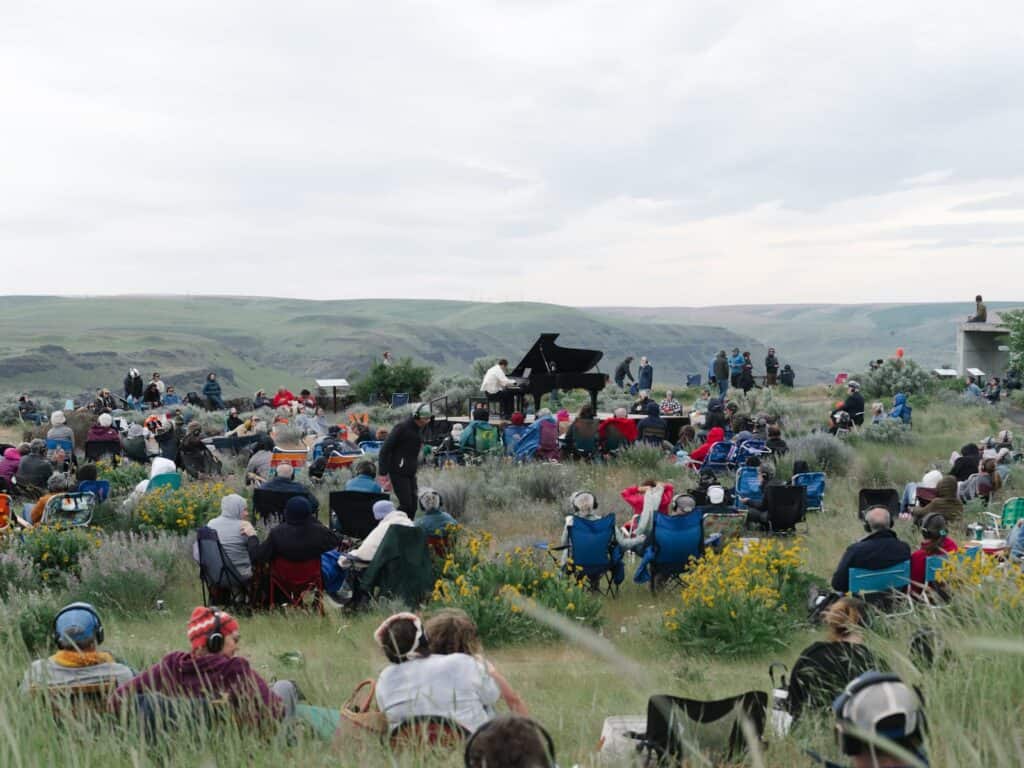
Noack’s outdoor concert series, IN A LANDSCAPE: Classical Music in the Wild, comes to Luther Burbank Park on Mercer Island on July 21 and Golden Gardens Park on July 22. Audience members wear wireless headphones that carry the sound of Noack’s piano as they move through their surroundings, free from the rows of seats and expectations of a concert hall.
“I feel like I’m more of a guide than a performer,” Noack says.
Over the course of about 90 minutes, he talks between pieces, occasionally nudging listeners toward a different way of experiencing the music. A piece that works particularly well with leaves moving in the wind might come with an invitation to find a tree. For Claude Debussy’s “Reflections in the Water,” Noack encourages people to get close to the water and watch the light move across it.
“The music that I’m performing is a soundtrack to people’s sensory experience in the wild,” he says.
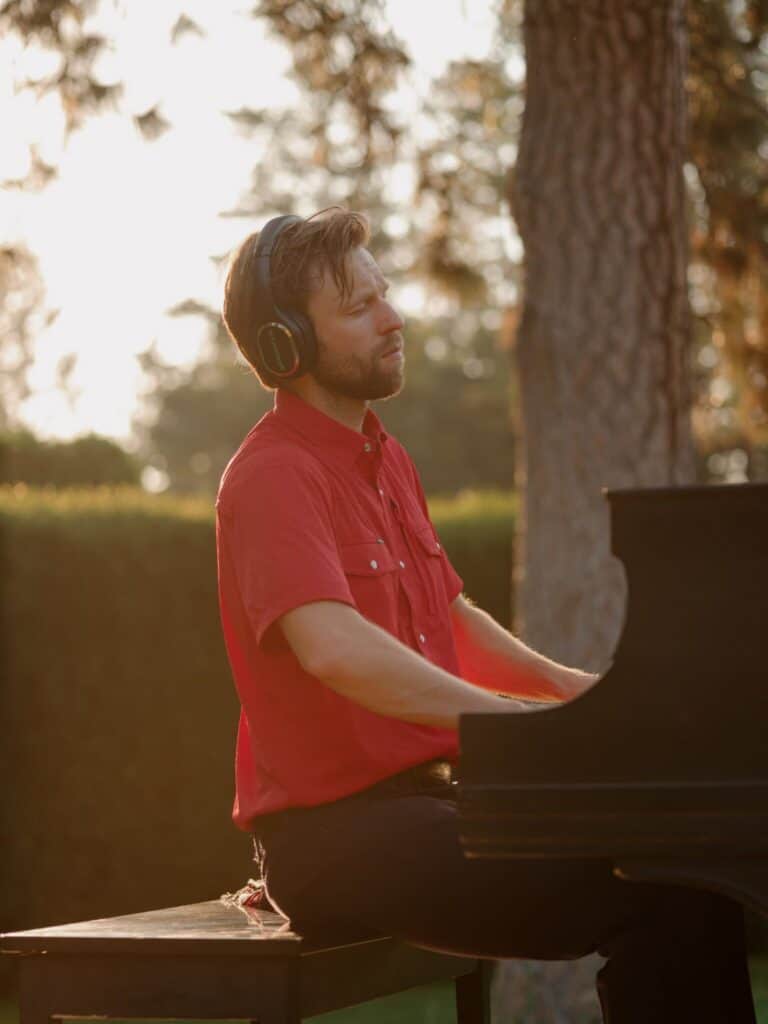
Noack grew up in the small Central Oregon town of Sunriver and began playing piano at age 4. He was, by his own description, “debilitatingly shy” as a child, too uncomfortable to attend the group music class offered in town. His mother taught him at home instead. “I wasn’t like a prodigy, but I just really liked being at the piano,” he says.
That interest eventually took him to Interlochen Arts Academy in Michigan, the San Francisco Conservatory of Music, USC, and the Guildhall School of Music and Drama in London. Yet even as his classical training became more serious, Noack found himself increasingly interested in what happened outside the usual recital format. At USC, many of his friends were actors putting on independent productions that Noack remembers as scrappy and fun. He began inviting actors into his own performances, changing the lighting and adding monologues and poetry between pieces. And, after a backpacking trip in Yosemite, Noack came home to Oregon wanting to spend more time outside.
Then came the question of how to bring the feeling of a concert hall into the open air.
An immersive opera production he had heard about in Los Angeles offered one answer. Invisible Cities, staged at Union Station, gave listeners wireless headphones and allowed them to follow performers through the building. Noack was fascinated by the way technology could carry the quality and intimacy of concert sound into a place not designed for classical music.
He started experimenting at parks around Oregon. IN A LANDSCAPE launched in 2016, and this season has stretched from The Sea Ranch in California to the Banff Centre in Alberta, with stops at Alvord Desert and Black Butte Ranch along the way. What Noack discovered was that moving the music outside did more than change the view.
“There’s all of this synergy that’s happening that we couldn’t possibly choreograph or plan,” Noack says.
Many classical composers wrote while retreating from cities to the countryside, he notes, and the natural world has long been a source of musical inspiration. Put that music back outside and the environment becomes part of the performance in ways no musician can control. The light changes, the wind moves through the trees, or maybe the temperature drops. A piece played in a forest takes on a different context in a desert or on a mountaintop. Even over the course of a single concert, the landscape refuses to stay still.
The piano changes, too.
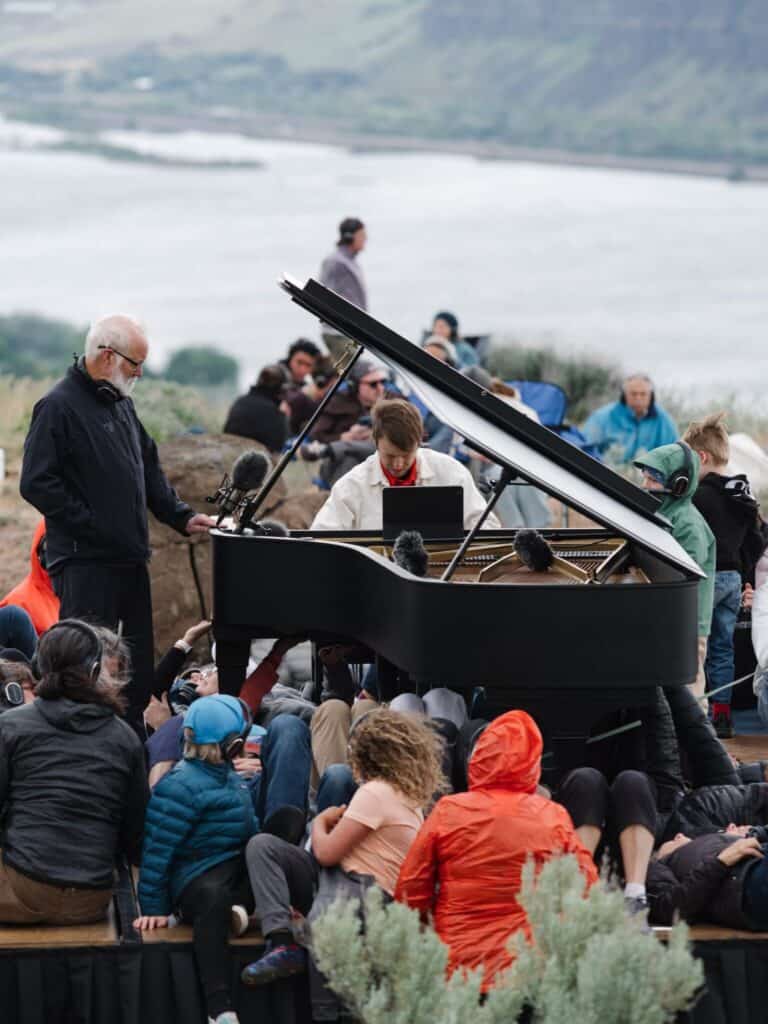
It weighs about 1,000 pounds, so IN A LANDSCAPE developed a trailer system that keeps the Steinway in place while the trailer transforms into a stage. The instrument—a 1912 Steinway Noack calls Maude—was given by Portland philanthropist and art collector Jordan Schnitzer, an early mentor and supporter of the project. A piano technician works on Maude for a couple of hours before every performance. Noack has taken it up mountains and over hours of rough roads. He has performed in below-zero temperatures in Montana and in 107-degree heat in Oregon, a temperature he admits he might not willingly repeat. Lightning and wildfire smoke can stop a performance. Otherwise, the show is generally rain or shine.
Some piano technicians are, Noack says, “aghast” at what the Steinway goes through. Its tuning can shift during the course of a 90-minute performance as the temperature and environment change.
“It isn’t perfect,” Noack says, “and that’s also a part of the beauty of it, and it’s part of the show.”
That constant sensory input, Noack believes, changes the way people hear music. About 30% of the IN A LANDSCAPE audience, he says, is experiencing live classical music for the first time.
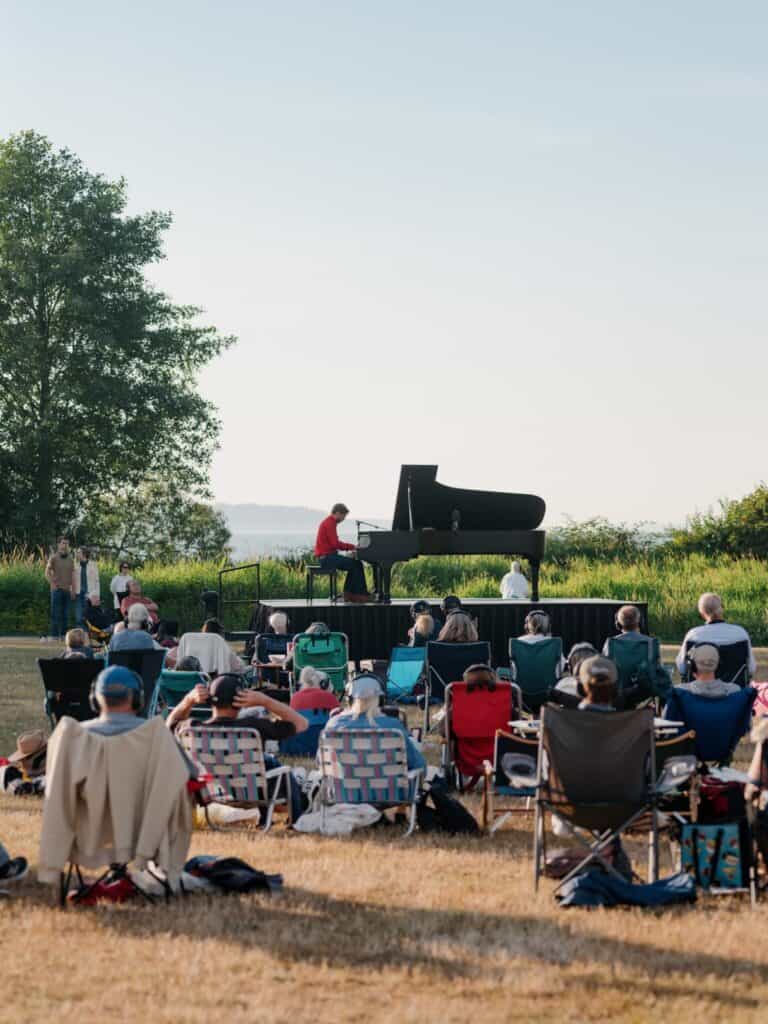
“For a lot of people, the discomfort that they have associated with sitting in a seat in a row, having to be still, having to dress a certain way, having this kind of imagined expectation about the knowledge that they’re supposed to have had before they enter the space, that all kind of goes away when you’re in a park,” he says.
Noack traces some of IN A LANDSCAPE’s inspiration to the Federal Music and Theatre Projects of the Works Progress Administration, which brought music and performances into parks and public spaces during the Great Depression. He thinks of public lands and parks as “the most democratic spaces.”
And once people are comfortable, something else happens.
“They’re much more open to feeling,” Noack says.
They pay attention to parts of the landscape they might otherwise pass by. Noack believes that state of relaxation can give listeners room to turn inward, too, allowing feelings to surface while the music plays. And somewhere between the headphones and the freedom to walk toward the water, Noack has noticed that people begin to listen differently.
“There’s something much bigger than me happening,” he says.
IN A LANDSCAPE performs July 21 near Calkins Point Sand Beach in Mercer Island’s Luther Burbank Park, where listeners can spread out on the grass or settle near the water, and July 22 at Golden Gardens Park. Other Washington stops this season include Maryhill Museum of Art in Goldendale, Suncadia in Cle Elum, and Sleeping Lady Mountain Resort in Leavenworth.
Tickets and more information are available at inalandscape.org.
Follow Us

WALKDONTRUN Returns This Saturday, Turning Downtown Seattle Into a Sprawling Art Show
In its second year, the free festival brings 200-plus artists to a 20-block route September 19, with a secret garden and a former 7-Eleven stocked with art.
Most walks through downtown Seattle involve trying to get somewhere. On September 19, the crosswalk itself might be the reason to stop. Heap Troupe will turn a four-way crossing into a performance, one of dozens of encounters planned for this year’s WALKDONTRUN. The free, all-ages art walk stretches across more than 20 blocks. From 11…

At Two Dot Schoolhouse, Ruth Marie Tomlinson Builds an Artistic Community
For nearly 20 years, the Seattle artist and her husband have welcomed artists, writers, and musicians to a historic Montana schoolhouse. Now they’re searching for its next stewards.
At her solo exhibition last year at The Vestibule, Seattle artist Ruth Marie Tomlinson presented a new series of work inspired by her close readings of British nature writer J.A. Baker’s The Peregrine and Icelandic author Sjón’s The Blue Fox. As if on sheets torn from a sketchbook, her pages included excerpts and outtakes of…

Rearview Mirror: Seahawks Off the Field, Seattle on the Board, and Smoked Oysters
Things I did, saw, ate, learned, or read in the past week (or so).
HOOKED ON KNOCKS Admittedly, I am late to this one. The Seahawks’ first season of Hard Knocks, the HBO series that follows NFL teams through training camp, premiered in August, but until last week, I had never heard of it. To be honest, my football knowledge starts with knowing what a touchdown is and doesn’t…

Studio Sessions: Colleen Louise Barry
Multi-hyphenate artist Colleen Louise Barry on discipline, the arts ecosystem in Seattle, and saving abandoned trampoline from the side of the road.
It’s hard not to smile around artist and writer Colleen Louise Barry. Bubbly and bright, she radiates optimism and cheer that would put most stereotypical Seattleites on edge. I think she is an absolute delight. Originally from Albany, Barry received her MFA from the University of Massachusetts, Amherst, before moving to Seattle in 2016. Once here,…